


Refine Results
Sort By
From
To

The purpose of the volume is to provide a support for a first course in Mathematical Analysis, along the lines of the recent Programme Specifications for mathematical teaching in European universities. The contents are organised to appeal especially to Engineering, Physics and Computer Science students, all areas in which mathematical tools play a crucial role. Basic notions and methods of differential and integral calculus for functions of one real variable are presented in a manner that elicits critical reading and prompts a hands-on approach to concrete applications. The layout has a specifically-designed modular nature, allowing the instructor to make flexible didactical choices when planning an introductory lecture course. The book may in fact be employed at three levels of depth. At the elementary level the student is supposed to grasp the very essential ideas and familiarise with the corresponding key techniques.
Lie groups has been an increasing area of focus and rich research since the middle of the 20th century. Procesi's masterful approach to Lie groups through invariants and representations gives the reader a comprehensive treatment of the classical groups along with an extensive introduction to a wide range of topics associated with Lie groups: symmetric functions, theory of algebraic forms, Lie algebras, tensor algebra and symmetry, semisimple Lie algebras, algebraic groups, group representations, invariants, Hilbert theory, and binary forms with fields ranging from pure algebra to functional analysis.
In this book, film scholar Rasmus Greiner develops a theoretical model for the concept of the histosphere to refer to the “sphere” of a cinematically modelled, physically experienceable historical world.

The book presents objections to the most common response given by contemporary legal and political theorists to the moral complexity of decision-making in modern societies, namely: the attempt to release public agents from their argumentative burden by insulating a particular set of reasons from the general.
"Auralization" is the technique of creation and reproduction of sound on the basis of computer data. With this tool is it possible to predict the character of sound signals which are generated at the source and modified by reinforcement, propagation and transmission in systems such as rooms, buildings, vehicles or other technical devices. This book is organized as a comprehensive collection of the basics of sound and vibration, acoustic modelling, simulation, signal processing and audio reproduction. Implementations of the auralization technique are described using examples drawn from various fields in acoustic’s research and engineering, architecture, sound design and virtual reality.
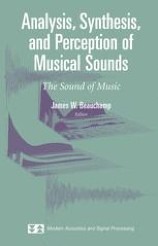
Analysis, Synthesis, and Perception of Musical Sounds contains a detailed treatment of basic methods for analysis and synthesis of musical sounds, including the phase vocoder method, the McAulay-Quatieri frequency-tracking method, the constant-Q transform, and methods for pitch tracking with several examples shown. Various aspects of musical sound spectra such as spectral envelope, spectral centroid, spectral flux, and spectral irregularity are defined and discussed. One chapter is devoted to the control and synthesis of spectral envelopes. Two advanced methods of analysis/synthesis are given: "Sines Plus Transients Plus Noise" and "Spectrotemporal Reassignment" are covered. Methods for timbre morphing are given. The last two chapters discuss the perception of musical sounds based on discrimination and multidimensional scaling timbre models.
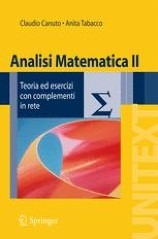
Intends to support a second teaching of Mathematical Analysis according to the principles of the new Didactic Regulations. It is especially designed for those study courses (such as Engineering, Computer Science, Physics) in which the mathematical tool is a significant part of the training. The fundamental concepts and methods of the differential and integral calculus of several variables, the series of functions and the ordinary differential equations are presented with the primary objective of training the student in their operational but critical use. The didactic setting of the text follows the one used for ANALYSIS I. The method of presentation of the arguments allows a flexible and modular use of the text, in order to respond to the various possible didactic choices in the organization of a Mathematical Analysis course.
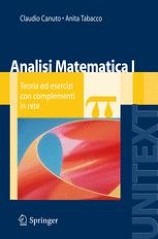
Intends to support a first teaching of Mathematical Analysis according to the principles of the new Didactic Regulations. It is especially designed for Engineering, Computer Science, Physics. The text has three different levels of reading. An essential level allows the student to grasp the essential concepts of the subject and to familiarize himself with the related calculation techniques. An intermediate level provides justifications for the main findings and enriches the presentation with useful observations and complements. A third level of reading, based on numerous references to a virtual text available online, allows the more motivated and interested student to deepen his or her preparation on the subject. Numerous examples and exercises with solutions complete the text. The captivating 2-color graphics make this text a fundamental point of reference for the study of the discipline.

Il testo intende essere di supporto ad un primo insegnamento di Analisi Matematica secondo i principi dei nuovi Ordinamenti Didattici. È in particolare pensato per Ingegneria, Informatica, Fisica. Il testo presenta tre diversi livelli di lettura. Un livello essenziale permette allo studente di cogliere i concetti indispensabili della materia e di familiarizzarsi con le relative tecniche di calcolo. Un livello intermedio fornisce le giustificazioni dei principali risultati e arricchisce l'esposizione mediante utili osservazioni e complementi. Un terzo livello di lettura, basato su numerosi riferimenti ad un testo virtuale disponibile in rete, permette all'allievo più motivato ed interessato di approfondire la sua preparazione sulla materia. Completano il testo numerosi esempi ed esercizi con soluzioni. La grafica accattivante, a 2 colori, fa di questo testo un punto di riferimento fondamentale per lo studio della disciplina.

This volume is the outcome of the first CASY workshop on "Advances in Control Theory and Applications" which was held at University of Bologna on May 22-26, 2006. It consists of selected contributions by some of the invited speakers and contains recent results in control. The volume is intended for engineers, researchers, and students in control engineering.

Addresses the problem by introducing a dynamic, on-line fuzzy inference system. In this system membership functions and control rules are not determined until the system is applied and each output of its lookup table is calculated based on current inputs. The tuning process is a major focus in this volume because it is the most difficult stage in fuzzy control application. Using new methods such as µ-law technique, histogram equalization and the Bezier-based method, all detailed here, the tuning process can be significantly simplified and control performance improved. The other great strength of this book lies in the range and contemporaneity of its applications and examples which include: laser tracking and control; robot calibration; image processing and pattern recognition; medical engineering; audio systems; autonomous underwater vehicles and data mining.

Daraa Highway - Ghabagheb - Syria
+963-15 2050 - 15 860 380 /1/2/3 - 11 662 3900