


Refine Results
Sort By
From
To

Clear Blogging sets out to answer in non-technical terms what blogging has to offer, and why and how you should blog. Clear Blogging will show you why blogging has shaken up mainstream media, and how a blogger can end up on CNN.
This book is written for members of the scholarly research community, and for persons involved in research evaluation and research policy. More specifically, it is directed towards the following four main groups of readers: – All scientists and scholars who have been or will be subjected to a quantitative assessment of research performance using citation analysis. – Research policy makers and managers who wish to become conversant with the basic features of citation analysis, and about its potentialities and limitations. – Members of peer review committees and other evaluators, who consider the use of citation analysis as a tool in their assessments. – Practitioners and students in the field of quantitative science and technology studies, informetrics, and library and information science. Citation analysis involves the construction and application of a series of indicators of the ‘impact’, ‘influence’ or ‘quality’ of scholarly work, derived from citation data, i.e. data on references cited in footnotes or bibliographies of scholarly research publications. Such indicators are applied both in the study of scholarly communication and in the assessment of research performance. The term ‘scholarly’ comprises all domains of science and scholarship, including not only those fields that are normally denoted as science – the natural and life sciences, mathematical and technical sciences – but also social sciences and humanities.
This book celebrates the life and work of Karen Spärck Jones in her seventieth year. she is one of the major figures of 20th century and early 21st Century computing and information processing. It book consists of fifteen new and original chapters written by leading international authorities reviewing the state of the art and her influence in the areas in which Karen Spärck Jones has been active. Although she has a publication record which goes back over forty years, it is clear even the very early work reviewed in the book can be read with profit by those working on recent developments in information processing like bioinformatics and the semantic web.
Discusses advances in smart and sustainable development of smart environments. The authors discuss the challenges faced in developing sustainable smart applications and provide potential solutions. The solutions are aimed at improving reliability and security with the goal of affordability, safety, and durability. Topics include health care applications, sustainable smart transportation systems, intelligent sustainable wearable electronics, and sustainable smart building and alert systems. Authors are from both industry and academia and present research from around the world. Addresses problems and solutions for sustainable development of smart cities; Includes applications such as healthcare, transportation, wearables, security, and more ; Relevant for scientist and researchers working on real time smart city development.
This book clearly describes how to establish an architecture practice that delivers value for an organization. The authors demonstrate a wealth of experience and a deep understanding of the multifaceted nature of this challenging task and they provide sound advice on how to avoid the many pitfalls that may be encountered along the way. Building an Enterprise Architecture Practice provides practical advice on how to develop your enterprise architecture practice.

Botnet Detection: Countering the Largest Security Threat, a contributed volume by world-class leaders in this field, is based on the June 2006 ARO workshop on Botnets. This edited volume represents the state-of-the-art in research on Botnets. It provides botnet detection techniques and response strategies, as well as the latest results from leading academic, industry and government researchers.
In this book, a team of renowned web designers take you through the ins and outs of putting together great blogs. They waste no time harking on about the philosophy of blogs, or the community behind them. Instead, they get straight to the practical details, showing how to set up a basic blog in some of the world's most popular blogging engines Movable Type, ExpressionEngine, WordPress, and Textpattern. With your blog set up, they then show you how to build great looking, usable layouts for your blog. The last chapter even shows you how to build your very own PHP/MySQL-based blog engine!

Blockchain technology is a powerful, cost-effective method for network security. Essentially, it is a decentralized ledger for storing all committed transactions in trustless environments by integrating several core technologies such as cryptographic hash, digital signature and distributed consensus mechanisms. Over the past few years, blockchain technology has been used in a variety of network interaction systems such as smart contracts, public services, Internet of Things (IoT), social networks, reputation systems and security and financial services. With its widespread adoption, there has been increased focus on utilizing blockchain technologies to address network security concerns and vulnerabilities as well as understanding real-world security implications.
Then Part I provides a thorough guide to the various bioinspired methodologies – neural networks, evolutionary computing (particularly genetic algorithms and grammatical evolution), particle swarm and ant colony optimization, and immune systems. Part II brings the reader through the development of market trading systems. Finally, Part III examines real-world case studies where BIA methodologies are employed to construct trading systems in equity and foreign exchange markets, and for the prediction of corporate bond ratings and corporate failures.
This book highlights basic paradigms of problem analysis and algorithm design in the context of core bioinformatics problems. Mathematically demanding themes are put across to the reader by properly chosen representations with the aid of lots of illustrations.

Presents an evaluation of nanotechnologies outputs (academic outputs and patents) and their impact from 2000-2019. The evaluation uses Elsevier’s Scopus (the largest abstract and citation database of peer-reviewed literature), SciVal (a scientific research analysis platform), Funding Institutional (a funding database), and PatentSight (a patent analysis platform). It covers four key topics regarding nanoscience research, including: 1) An overview of nano-related scholarly output, 2) Nanoscience and its contribution to basic science, 3) Nanoscience and its impact on and collaboration with industry partners, and 4) Key factors that promote the development of nanoscience.
Not everything that counts can be counted. Not everything that is counted counts. Albert Einstein This is a book about software measurement from the practitioner’s point of view and it is a book for practitioners. Software measurement needs a lot of practical guidance to build upon experiences and to avoid repeating errors. This book t- gets exactly this need, namely to share experiences in a constructive way that can be followed. It tries to summarize experiences and knowledge about software measurement so that it is applicable and repeatable. It extracts experiences and lessons learned from the narrow context of the specific industrial situation, thus facilitating transfer to other contexts. Software measurement is not at a standstill. With the speed software engine- ing is evolving, software measurement has to keep pace. While the underlying theory and basic principles remain invariant in the true sense (after all, they are not specific to software engineering), the application of measurement to specific contexts and situations is continuously extended. The book thus serves as a ref- ence on these invariant principles as well as a practical guidance on how to make software measurement a success.
This book presents a set of basic techniques for estimating the benefit of IT development projects and portfolios. It also offers methods for monitoring how much of that estimated benefit is being achieved during projects. Readers can then use these benefit estimates together with cost estimates to create a benefit/cost index to help them decide which functionalities to send into construction and in what order. This allows them to focus on constructing the functionality that offers the best value for money at an early stage.
Beginning Web Development, Silverlight, and ASP.NET AJAX: From Novice to Professional aims to give you the skills you need to start building web applications with Microsoft's next–generation technology as quickly as possible. Whether you're interested in ASP.NET AJAX, Silverlight, or the technologies that support them (WPF, WCF, WF, etc.), this book is the starting point that you need. It adopts a “zero to hero” approach that concentrates on achieving practical results you can use in real projects rather than presenting a deep academic treatment that can't be immediately applied.
Beginning Perl Web Development: From Novice to Professional introduces you to the world of Perl Internet application development. This book tackles all areas crucial to developing your first web applications and includes a powerful combination of real-world examples coupled with advice. Topics range from serving and consuming RSS feeds, to monitoring Internet servers, to interfacing with e-mail. You'll learn how to use Perl with ancillary packages like Mason and Nagios. Though not version-specific, this book is an ideal read if you have had some grounding in Perl basics and now want to move into the world of web application development. Author Steve Suehring emphasizes the security implications of Perl, drawing on years of experience teaching readers how to think safe, avoid common pitfalls, and produce well-planned, secure code.
Beginning VB 2008 Databases teaches you everything you need to know about relational databases, SQL, and ADO.NET 2.0, giving you a sound start in developing console and Windows database applications. The book also includes chapters on the SQL Server XML data type and the LINQ enhancements to the next version of Visual Basic. In addition to teaching you database basics like using SQL to communicate with databases, this book provides you with detailed, code-practical techniques to access data in Visual Basic 2008 across a range of coding situations. Code-heavy and full of practical detail, this book has been fully revised and upgraded for .NET 3.5 and offers you the best contemporary practice in this core programming area, so that you'll find yourself using it in nearly all your .NET projects.
You love it as the world's most popular desktop Linux distribution, and now Ubuntu is available at a server near you. Embracing the very same features desktop users have grown to love, system administrators are rapidly adopting Ubuntu due to their ability to configure, deploy, and manage network services more effectively than ever. Beginning Ubuntu Server Administration guides you through all of the key configuration and administration tasks you'll need to know. Whether you're interested in adopting Ubuntu within a Fortune 500 environment or just want to use Ubuntu to manage your home network, this book is your go–to guide to using the distribution securely for a wide variety of network services. Topics include file, print, web, and FTP management, command–line tips and tricks, automated installation, configuration and deployment processes, and kernel management.
The book starts by introducing you to the world of Linux. Then, it outlines Ubuntu installation in illustrated steps, after which you'll learn how to configure every piece of everyday tech hardware such as your Internet connection, printers, 3D graphics cards, Bluetooth devices, and much more. Then you'll learn fun tasks such as listening to audio CDs and MP3s, watching movies, performing office tasks, and even image editing.
Beginning Ubuntu Linux is the perfect guide for those switching to the world's favorite Linux. The new edition has been thoroughly updated to cover technology introduced in the 6.10 release. You'll learn how to install Linux, set up your hardware and software, customize the desktop experience, browse the Web and send/receive e-mail, play back audio and video, edit digital images, use the OpenOffice.org office suite, and more.
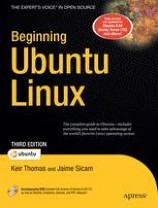
Beginning Ubuntu Linux, the award–winning and best–selling Ubuntu book for beginners, is now in its third edition, presenting readers with an up–to–the–minute introduction to the world of Linux and the open source community. A detailed overview of Ubuntu's installation and configuration process encourages you to take the plunge and switch to Linux, and from there you'll learn how to wield total control over your newly installed operating system. Guided through the most commonly desired tasks such as printer configuration, listening to audio CDs and MP3s, watching movies, performing office and Internet–related tasks, as well as general system maintenance matters, authors Keir Thomas and Jaime Sicam will soon have you using and enjoying Ubuntu Linux and never looking back.

Daraa Highway - Ghabagheb - Syria
+963-15 2050 - 15 860 380 /1/2/3 - 11 662 3900