



الصفحة 1
الصفحة 1

Information hiding ; 6th International Workshop, IH 2004, Toronto, Canada, May 23-25, 2004, Revised selected papers
All papers were divided into eight sessions: digital media watermarking, steganalysis, digital forensics, steganography, software watermarking, security and privacy, anonymity, and data hiding in unusual content. This year, the workshop included a one-hour rump session that offered an opportunity to the delegates to share their work in progress and other brief but interesting contributions.

Concurrent Zero-Knowledge : With Additional Background by Oded Goldreich
Zero-knowledge proofs are fascinating and extremely useful constructs. Their fascinating nature is due to their seemingly contradictory de?nition; ze- knowledge proofs are convincing and yet yield nothing beyond the validity of the assertion being proved. Their applicability in the domain of cryptography is vast; they are typically used to force malicious parties to behave according to a predetermined protocol. In addition to their direct applicability in cr- tography, zero-knowledge proofs serve as a good benchmark for the study of variousproblemsregardingcryptographicprotocols(e.g.,“securecomposition of protocols”).
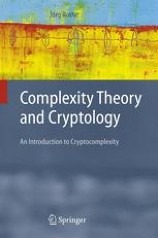
Complexity Theory and Cryptology : An Introduction to Cryptocomplexity
Modern cryptology employs mathematically rigorous concepts and methods from complexity theory. Conversely, current research in complexity theory often is motivated by questions and problems arising in cryptology. This book takes account of this trend, and therefore its subject is what may be dubbed "cryptocomplexity,'' some sort of symbiosis of these two areas. This textbook is suitable for undergraduate and graduate students of computer science, mathematics, and engineering, and can be used for courses on complexity theory and cryptology, preferably by stressing their interrelation. Starting from scratch, it is an accessible introduction to cryptocomplexity and works its way to the frontiers of current research. It provides the necessary mathematical background, has numerous figures, exercises, and examples, and presents some central, up-to-date research topics and challenges. Due to its comprehensive bibliography and subject index, it is also a valuable source for researchers, teachers, and practitioners working in these fields.
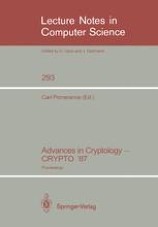
Advances in cryptology - CRYPTO -87 ; Conference on the theory and applications of cryptographic techniques : Proceedings
Zero-knowledge interactive proofsystems are a new technique which can be used as a cryptographic tool for designing provably secure protocols. Goldwasser, Micali, and Rackoff originally suggested this technique for controlling the knowledge released in an interactive proof of membership in a language, and for classification of languages. In this approach, knowledge is defined in terms of complexity to convey knowledge if it gives a computational advantage to the receiver, theory, and a message is said for example by giving him the result of an intractable computation. The formal model of interacting machines is described in. A proof-system (for a language L) is an interactive protocol by which one user, the prover, attempts to convince another user, the verifier, that a given input x is in L. We assume that the verifier is a probabilistic machine which is limited to expected polynomial-time computation, while the prover is an unlimited probabilistic machine.
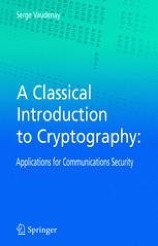
A Classical Introduction to Cryptography : Applications for Communications Security
This advanced-level textbook covers conventional cryptographic primitives and cryptanalysis of these primitives; basic algebra and number theory for cryptologists; public key cryptography and cryptanalysis of these schemes; and other cryptographic protocols, e.g. secret sharing, zero-knowledge proofs and undeniable signature schemes.
