



الصفحة 1
الصفحة 1

Complex Motion ; 1st International Workshop, IWCM 2004, Günzburg, Germany, October 12-14, 2004, Revised Papers
The world we live in is a dynamic one: we explore it by moving through it, and many of the objects which we are interested in are also moving. Trafic, for instance, is an example of a domain where detecting and processing visual motion is of vital interest, both in a metaphoric as well as in a purely literal sense. Visual communication is another important example of an area of science which is dominated by the need to measure, understand, and represent visual motion in an eficient way. Visual motion is a subject of research which forces the investigator to deal with complexity; complexity in the sense of facing efiects of motion in a very large diversity of forms, starting from analyzing simple motion in a changing envir- ment (illumination, shadows, . . . ), under adverse observation conditions, such as bad signal-to-noiseratio (low illumination, small-scaleprocesses, low-dosex-ray, etc. ), covering also multiple motions of independent objects, occlusions, and - ing as far as dealing with objects which are complex in themselves (articulated objects such as bodies of living beings). The spectrum of problems includes, but does not end at, objects which are not ‘bodies’ at all, e. g. , when anal- ing fiuid motion, cloud motion, and so on. Analyzing the motion of a crowd in a shopping mall or in an airport is a further example that implies the need to struggle against the problems induced by complexity.

Articulated Motion and Doformable Objects ; 4th International Conference, AMDO 2006, Port d'Andratx, Mallorca, Spain, July 11-14, 2006, Proceedings
The subject of the conference was ongoing research in articulated motionon a sequence of images and sophisticated models for deformable objects. Thegoals of these areas are to understand and interpret the motion of complexobjects that can be found in sequences of images in the real world. The maintopics considered as priority were: geometric and physical deformable models,motion analysis, articulated models and animation, modelling and visualizationof deformable models, deformable models applications, motion analysis applica-tions, single or multiple human motion analysis and synthesis, face modelling,tracking, recovering and recognition models, virtual and augmentedreality, haptics devices, biometrics techniques.

Advances in visual computing ; Vol. 4292 ; 2nd International symposium, ISVC 2006, Lake Tahoe, NV, USA, November 6-8, 2006, Proceedings, Part II
This year, the program consisted of 13 oral sessions, one poster session, ten special tracks, and six keynote presentations. The response to the call for - pers was very strong. We received more than twice the papers received last year. Specifcally, we received over 280 submissions for the main symposium from which we accepted 65 papers for oral presentation (23% acceptance) and 56 papers for poster presentation (20% acceptance). Special track papers were solicited separately through the Organizing and Program Committees of each track. A total of 57 papers were accepted for presentation in the special tracks. All papers were reviewed with an emphasis on potential to contribute to the state of the art in the ?eld. Selection criteria included accuracy and originality of ideas, clarity and signi?cance of results, and presentation quality. The review process was quite rigorous, involving two to three independent blind reviews followed by several days of discussion.

Advances in Visual Computing ; Vol. 4291 ; 2nd International Symposium, ISVC 2006, Lake Tahoe, NV, USA, November 6-8, 2006, Proceedings, Part I
This year, the program consisted of 13 oral sessions, one poster session, ten special tracks, and six keynote presentations. The response to the call for - pers was very strong. We received more than twice the papers received last year. Specifcally, we received over 280 submissions for the main symposium from which we accepted 65 papers for oral presentation (23% acceptance) and 56 papers for poster presentation (20% acceptance). Special track papers were solicited separately through the Organizing and Program Committees of each track. A total of 57 papers were accepted for presentation in the special tracks. All papers were reviewed with an emphasis on potential to contribute to the state of the art in the ?eld. Selection criteria included accuracy and originality of ideas, clarity and signi?cance of results, and presentation quality. The review process was quite rigorous, involving two to three independent blind reviews followed by several days of discussion. During the discussion period we tried to correct anomalies and errors that might have existed in the initial reviews.
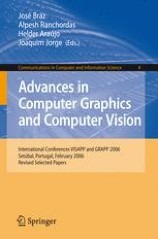
Advances in computer graphics and computer vision ; International conferences VISAPP and GRAPP 2006, Setúbal, Portugal, February 25-28, 2006, Revised Selected Papers
Includes selected papers from the first International Conferences on Computer Vision Theory and Applications (VISAPP), and Computer Graphics Theory and Applications (GRAPP),

Advanced studies in biometrics : Summer School on biometrics, Alghero, Italy, June 2-6, 2003. Revised Selected Lectures and Papers
This book originates from an international summer school on biometrics, held in Alghero, Italy, in June 2003. The seven revised tutorial lectures by leading researchers introduce the reader to biometrics-based person authentication, fingerprint recognition, gait recognition, various aspects of face recognition and face detection, topologies for biometric recognition, and hand detection. Also included are the four best selected student papers, all dealing with face recognition.

Advanced Concepts for Intelligent Vision Systems ; Vol. 4179 ; 8th International Conference, ACIVS 2006, Antwerp, Belgium, September 18-21, 2006, Proceedings
This book constitutes the refereed proceedings of the 8th International Conference on Advanced Concepts for Intelligent Vision Systems, ACIVS 2006, held in Antwerp, Belgium in September 2006. The 45 revised full papers and 65 revised poster papers presented were carefully reviewed and selected from around 242 submissions. The papers are organized in topical sections on noise reduction and restoration, segmentation, motion estimation and tracking, video processing and coding, camera calibration, image registration and stereo matching, biometrics and security, medical imaging, image retrieval and image understanding, as well as classification and recognition.

Adaptive Hypermedia and Adaptive Web-Based Systems ; 4th International Conference, AH 2006, Dublin, Ireland, June 21-23, 2006, Proceedings
Here are the refereed proceedings of the 4th International Conference on Adaptive Hypermedia and Adaptive Web-Based Systems, AH 2006, held in Dublin, Ireland, June 2006. The book presents 22 revised full papers and 19 revised short papers together with abstracts of 3 keynotes, 12 poster papers, and 14 doctoral consortium posters. Topics include pioneering theories, techniques, and innovative technologies to provide dynamic personalization, adaptation, and contextualization of hypermedia resources and services.

Active Lighting and Its Application for Computer Vision : 40 Years of History of Active Lighting Techniques
Computer vision entails both passive and active illumination techniques. Whereas passive techniques observe the scene statically and analyse it as is, by contrast active techniques give the scene some actions and try to facilitate the analysis. In particular, active illumination techniques project specific light, for which the characteristics are known beforehand, to a target scene to enable stable and accurate analysis of the scene.
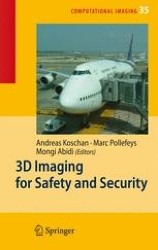
3D Imaging for Safety and Security
This book is so far the first that covers the current state of the art in 3D imaging for safety and security. Special attention was given to advanced 3D imaging technologies in the context of safety and security applications. Comparative evaluation studies showing advantages of 3D imaging over traditional 2D imaging for a given computer vision or pattern recognition task were emphasized. Moreover, additional experts in the field of 3D imaging for safety and security were invited by the editors for a contribution to this book.

3D design reconstruction
This report will talk about a way to design and rebuild a cheap, true-to-the-truth 3D system using reverse engineering. The system provides the service of reconstructing objects into 3D models by placing the object in a predetermined place facing a set of sensors and cameras at a certain distance and at precise angles, using the angle of rotation for each image and combining the points of triangulation we can build a form of 3D modeling types. These models can be used in digital animation or printed with 3D printers for a wide variety of applications.
