



الصفحة 1
الصفحة 1

Introduction to Scientific Programming with Python
This book offers an initial introduction to programming for scientific and computational applications using the Python programming language. The presentation style is compact and example-based, making it suitable for students and researchers with little or no prior experience in programming.

Finite Difference Computing with Exponential Decay Models
This text provides a very simple, initial introduction to the complete scientific computing pipeline: models, discretization, algorithms, programming, verification, and visualization. The pedagogical strategy is to use one case study – an ordinary differential equation describing exponential decay processes – to illustrate fundamental concepts in mathematics and computer science. The book is easy to read and only requires a command of one-variable calculus and some very basic knowledge about computer programming. Contrary to similar texts on numerical methods and programming, this text has a much stronger focus on implementation and teaches testing and software engineering in particular.

Data science in theory and practice : Techniques for big data analytics and complex data sets
Delivers a comprehensive treatment of the mathematical and statistical models useful for analyzing data sets arising in various disciplines, like banking, finance, health care, bioinformatics, security, education, and social services. Written in five parts, the book examines some of the most commonly used and fundamental mathematical and statistical concepts that form the basis of data science. The authors go on to analyze various data transformation techniques useful for extracting information from raw data, long memory behavior, and predictive modeling. Readers will also learn from topics like: Analyses of foundational theoretical subjects, including the history of data science, matrix algebra and random vectors, and multivariate analysis A comprehensive examination of time series forecasting, including the different components of time series and transformations to achieve stationarity Introductions to both the R and Python programming languages, including basic data types and sample manipulations for both languages An exploration of algorithms, including how to write one and how to perform an asymptotic analysis A comprehensive discussion of several techniques for analyzing and predicting complex data sets
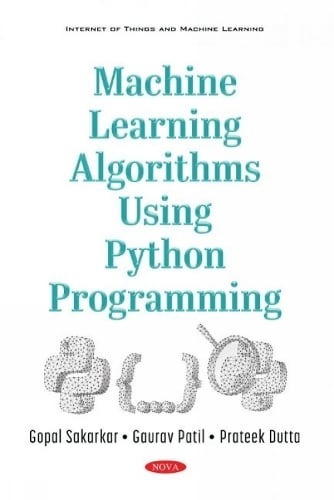
Machine Learning Algorithms Using Python Programming
Presents the key concepts of Machine Learning which includes Python concepts and Interpreter, Foundation of Machine Learning, Data Pre-processing, Supervised Machine Learning, Unsupervised Machine Learning, Reinforcement Learning, Kernel Machine, Design and analysis of Machine Learning experiment and Data visualization. The theoretical concepts along with coding implementation are covered. This book aims to pursue a middle ground between a theoretical textbook and one that focuses on applications. The book concentrates on the important ideas in machine learning.
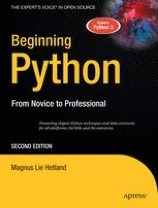
Beginning Python : From novice to professional
Gain a fundamental understanding of Python's syntax and features with the second edition of Beginning Python, an up–to–date introduction and practical reference. Covering a wide array of Python–related programming topics, including addressing language internals, database integration, network programming, and web services, you'll be guided by sound development principles. Ten accompanying projects will ensure you can get your hands dirty in no time. Updated to reflect the latest in Python programming paradigms and several of the most crucial features found in Python 3.0 (otherwise known as Python 3000), advanced topics, such as extending Python and packaging/distributing Python applications, are also covered
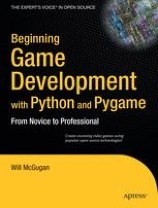
Beginning Game Development with Python and Pygame : From novice to professional
Beginning Game Development with Python and Pygame is written with the budding game developer in mind, introducing games development through the Python programming language and the popular Pygame games development library. You'll be privy to insights that will not only help you to exploit Pygame to its maximum potential, but also make you a more creative and knowledgeable games developer all round.
Artificial Intelligence with Python
Introduces readers to various topics and examples of programming in Python, as well as key concepts in artificial intelligence. Python programming skills will be imparted as we go along. Concepts and code snippets will be covered in a step-by-step manner, to guide and instill confidence in beginners. Complex subjects in deep learning and machine learning will be broken down into easy-to-digest content and examples. Artificial intelligence implementations will also be shared, allowing beginners to generate their own artificial intelligence algorithms for reinforcement learning, style transfer, chatbots, speech, and natural language processing.
