



الصفحة 1
الصفحة 1
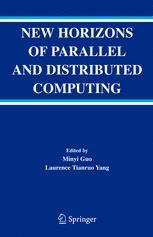
New Horizons of Parallel and Distributed Computing
Parallel and distributed computing is one of the foremost technologies for shaping future research and development activities in academia and industry. Hyperthreading in Intel processors, hypertransport links in next generation AMD processors, multicore silicon in today’s high-end microprocessors, emerging cluster and grid computing, has moved parallel/distributed computing into the mainstream of computing. New Horizons of Parallel and Distributed Computing is a collection of self-contained chapters written by pioneers and researchers to provide solutions for newly emerging problems in this field. This volume will not only provide novel ideas, work in progress and state-of-the-art techniques in the field, but also stimulate future research activities in the area of parallel and distributed computing with applications. New Horizons of Parallel and Distributed Computing is intended for researchers and graduate students in computer science and electrical engineering, as well as researchers and developers in industry. This book can be used as a textbook and a reference for use by students, researchers, and developers.

Multi-processor system-on-chip 1 : Architectures
covers the key components of MPSoC: processors, memory, interconnect and interfaces. It describes advance features of these components and technologies to build efficient MPSoC architectures. All the main components are detailed: use of memory and their technology, communication support and consistency, and specific processor architectures for general purposes or for dedicated applications.

Modern front-end architecture : Optimize your front-end development with components, storybook, and mise en place philosophy
Learn how to build front-end applications that can help you ship applications faster with fewer defects. Many software projects fail because they are not planned well, or lack organization. Applying strategies from other industries can help you create better software. Explores the “mise en place” technique from cooking and reveals how you can apply it to the art of creating software. Describes to how to structure your code base for reuse, and how to communicate the code’s intent to other developers. You’ll develop your components in isolation and test these building blocks for quality at a granular level. Then compose these components as building blocks in increasingly complicated features. Finally, you’ll apply some strategies not directly related to code to ensure maximum quality and efficiency. You will : Structure an application as a series of components / Build a component library that others in an organization can leverage / Ensure quality and accessibility at a component level rather than a page or app level / Test code in a way that gives the maximum amount of confidence while providing an excellent developer experience / Automate repeatable tasks

Microprocessor 5 : Software and hardware aspects of development, debugging and testing - the microcomputer
Focuses more particularly on the first two generations of microprocessors, those that handle 4- and 8- bit integers. Microprocessor 5 – the fifth and final volume of this series of books – first presents the hardware and software aspects of the development chain of a microprocessor-based digital system. Finally, to round up the series and offer a historical perspective, the architectures of the first microcomputers are detailed. A comprehensive approach is used, with examples drawn from current and past technologies that illustrate theoretical concepts, making them accessible.

Microprocessor 2 : Communication in a digital system
Focuses more particularly on the first generations of microprocessors, that is to say those that handle integers in 4 and 8-bit formats. The first chapter presents the calculation function and reminds the memory function. The following is devoted to notions of calculation model and architecture. The concept of bus is then presented. Chapters 4 and 5 can then address the internal organization and operation of the microprocessor first in hardware and then software. The mechanism of the function call, conventional and interrupted, is more particularly detailed in a separate chapter. The book ends with a presentation of architectures of the first microcomputers for a historical perspective. The knowledge is presented in the most exhaustive way possible with examples drawn from current and old technologies that illustrate and make accessible the theoretical concepts. Each chapter ends if necessary with corrected exercises and a bibliography. The list of acronyms used and an index are at the end of the book.

Introduction to Assembly Language Programming : For Pentium and RISC Processors
Assembly language continues to hold a core position in the programming world because of its similar structure to machine language and its very close links to underlying computer-processor architecture and design. These features allow for high processing speed, low memory demands, and the capacity to act directly on the system’s hardware. This completely revised second edition of the highly successful Introduction to Assembly Language Programming introduces readers to assembly language programming and its role in computer programming and design. It focuses on providing a firm grasp of the main features of assembly programming, and how it can be used to improve a computer's performance. The revised edition covers a broad scope of subjects and adds valuable material on protected-mode Pentium programming, MIPS assembly language programming, and use of the NASM and SPIM assemblers for a Linux orientation. All of the language's main features are covered in depth. The book requires only some basic experience with a structured, high-level language.

Information security and privacy ; 6th Australasian Conference, ACISP 2001, Sydney, Australia, July 11-13, 2001. Proceedings
A Few Thoughts on E-Commerce.- New CBC-MAC Forgery Attacks.- Cryptanalysis of a Public Key Cryptosystem Proposed at ACISP 2000.- Improved Cryptanalysis of the Self-Shrinking Generator.- Attacks Based on Small Factors in Various Group Structures.- On Classifying Conference Key Distribution Protocols.- Pseudorandomness of MISTY-Type Transformations and the Block Cipher KASUMI.- New Public-Key Cryptosystem Using Divisor Class Groups.- First Implementation of Cryptographic Protocols Based on Algebraic Number Fields.- Practical Key Recovery Schemes.- Non-deterministic Processors.- Personal Secure Booting.- Evaluation of Tamper-Resistant Software Deviating from Structured Programming Rules.- A Strategy for MLS Workflow.- Condition-Driven Integration of Security Services.- SKETHIC: Secure Kernel Extension against Trojan Horses with Informat ion-Carrying Codes.- Secure and Private Distribution of Online Video and Some Related Cryptographic Issues.- Private Information Retrieval Based on the Subgroup Membership Problem.

High-Performance Modelling and Simulation for Big Data Applications: Selected Results of the COST Action IC1406 cHiPSet
This book is the final compendium of case studies emanated from “High-Performance Modelling and Simulation for Big Data Applications” (cHiPSet).cHiPSet has created a sustainable reference network linking applied research in High Performance Computing (HPC) and Modelling & Simulation to tangibly address Big Data challenges.cHiPSet has also endeavoured to use and exploit results through Open Science practices, i.e., open access publication, open access to data repositories, and open-source software development. A testament to this philosophy, this compendium is set to become a required reference for the fast-changing fields of HPC, Big Data, and Modelling & Simulation.
High performance embedded architectures and compilers ; 3rd International Conference, HiPEAC 2008, Göteborg, Sweden, January 27-29, 2008. Proceedings
This book constitutes the refereed proceedings of the Third International Conference on High Performance Embedded Architectures and Compilers, HiPEAC 2008, held in Göteborg, Sweden, January 27-29, 2008. The 25 revised full papers presented together with 1 invited keynote paper were carefully reviewed and selected from 77 submissions. The papers are organized in topical sections on Multithreaded and Multicore Processors, Reconfigurable - ASIP, Compiler Optimizations, Industrial Processors and Application Parallelization, Power-Aware Techniques, High-Performance Processors, Profiles: Collection and Analysis as well as Optimizing Memory Performance.
High performance embedded architectures and compilers ; 2nd International Conference, HiPEAC 2007, Ghent, Belgium, January 28-30, 2007. Proceedings
This book constitutes the refereed proceedings of the Second International Conference on High Performance Embedded Architectures and Compilers, HiPEAC 2007, held in Ghent, Belgium, in January 2007. The 19 revised full papers presented together with one invited keynote paper were carefully reviewed and selected from 65 submissions.
High performance embedded architectures and compilers ; 1st International Conference, HiPEAC 2005, Barcelona, Spain, November 17-18, 2005, Proceedings
The ProgramCommittee received a total of 84 submissions; only 17 were selected for presentation as full-length papers and another one as an invited paper. Each paper was rigorously reviewed by three ProgramCommittee members and at least one external referee. Many reviewers spent a great amount of e?ort to provide detailed feedback. In many cases, such feedback along with constructive shepherding resulted in dramatic improvement in the quality of accepted papers. The names of the Program Committee m- bers and the referees are listed in the proceedings. The net result of this team e?ort is that the symposium proceedings include outstanding contributions by authors from nine countries in three continents. In addition to paper presentations, this ?rst HiPEAC conference featured two keynotes delivered by prominent researchers from industry and academia.

High performance computing - HiPC 2008 ; 15th International Conference, Bangalore, India, December 17-20, 2008. Proceedings
This book constitutes the refereed proceedings of the 15th International Conference on High-Performance Computing, HiPC 2008, held in Bangalore, India, in December 2008.The 46 revised full papers presented together with the abstracts of 5 keynote talks were carefully reviewed and selected from 317 submissions. The papers are organized in topical sections on applications performance optimizazion, parallel algorithms and applications, scheduling and resource management, sensor networks, energy-aware computing, distributed algorithms, communication networks as well as architecture.

High performance computing - HiPC 2004 ; 11th International Conference, Bangalore, India, December 19-22, 2004, Proceedings
Keynote Addresses.- Rethinking Computer Architecture Research.- Event Servers for Crisis Management.- DIET: Building Problem Solving Environments for the Grid.- The Future Evolution of High-Performance Microprocessors.- Low Power Robust Computing.- Networks and Games.- Plenary Session - Best Papers.- An Incentive Driven Lookup Protocol for Chord-Based Peer-to-Peer (P2P) Networks.- A Novel Battery Aware MAC Protocol for Ad Hoc Wireless Networks, and other

Handbook Of Mathematical Models For Languages And Computation
Introduces a variety of concepts in discrete mathematics and mathematical modeling for languages and computation. The authors pay special attention to the implementation of mathematical concepts to explain clearly how to encode them in computational practice. All computer programs are written in C#. The theory of computation is used to address challenges arising in many computer science areas such as artificial intelligence, language processors, compiler writing, information and coding systems, programming language design, computer architecture and more. To grasp topics concerning this theory readers need to familiarize themselves with its computational and language models, based on concepts of discrete mathematics including sets, relations, functions, graphs and logic.

Guide to RISC Processors : for Programmers and Engineers
This guidebook provides an accessible and all-encompassing compendium on RISC processors, introducing five RISC processors: MIPS, SPARC, PowerPC, ARM, and Itanium. Initial chapters explain the differences between the CISC and RISC designs and clearly discuss the core RISC design principles. The text then integrates instruction on MIPS assembly language programming, thereby enabling readers to concretely grasp concepts and principles introduced earlier. Readers need only have a basic knowledge of any structured, high-level language to obtain the full benefits here.

Euro-Par 2020 : Parallel Processing ; 26th International Conference on Parallel and Distributed Computing, Warsaw, Poland, August 24–28, 2020, Proceedings
This book constitutes the proceedings of the 26th International Conference on Parallel and Distributed Computing, Euro-Par 2020, held in Warsaw, Poland, in August 2020. The conference was held virtually due to the coronavirus pandemic. The 39 full papers presented in this volume were carefully reviewed and selected from 158 submissions. They deal with parallel and distributed computing in general, focusing on support tools and environments; performance and power modeling, prediction and evaluation; scheduling and load balancing; high performance architectures and compilers; data management, analytics and machine learning; cluster, cloud and edge computing; theory and algorithms for parallel and distributed processing; parallel and distributed programming, interfaces, and languages; multicore and manycore parallelism; parallel numerical methods and applications; and accelerator computing.

Euro-Par 2019 : Parallel Processing Workshops ; Euro-Par 2019 International Workshops, Göttingen, Germany, August 26–30, 2019, Revised Selected Papers
Euro-Par is an annual, international conference in Europe, covering all aspects of parallel and distributed processing. These range from theory to practice, from small to the largest parallel and distributed systems and infrastructures, from fundamental computational problems to full-edged applications, from architecture, compiler, language and interface design and implementation to tools, support infrastructures, and application performance aspects.
Energy Efficient Servers : Blueprints for Data Center Optimization
The book includes a deep examination of different features used in processors, memory, interconnects, I/O devices, and other platform components. It outlines the power and performance impact of these features and the role firmware and software play in initialization and control. Using examples from cloud, HPC, and enterprise environments, the book demonstrates how various power management technologies are utilized across a range of server utilization. It teaches the reader how to monitor, analyze, and optimize their environment to best suit their needs. It shares optimization techniques used by data center administrators and system optimization experts at the world’s most advanced data centers.

Embedded robotics : From mobile robots to autonomous vehicles with Raspberry Pi and Arduino
Presents a unique examination of mobile robots and autonomous vehicles using embedded systems, from introductory to advanced level. It is structured in four parts, dealing with Embedded Systems (processors, sensors, actuators, control, multitasking and communication), Robot Hardware (driving and walking robots, autonomous boats and planes, as well as robot manipulators), Robot Software (localization, navigation, image processing and automotive systems), and Artificial Intelligence (neural networks, genetic algorithms and deep learning). The book is organized for ease of use, with numerous figures, photographs, and worked example programs. The book is written as a text for courses in computer science, computer engineering, IT, electronics engineering, and mechatronics, as well as a guide for robot hobbyists and researchers.

Embedded Computer Systems : Architectures, Modeling, and Simulation ; 7th International Workshop, SAMOS 2007, Samos, Greece, July 16-19, 2007, Proceedings
The book is unique in the sense that not only solved research problems are presented and discussed but also (partly) unsolved pr- lems and in-depth topical reviews can be unleashed in the scientific arena. C- sequently, it provides the participants with an environment where collaboration rather than competition is fostered.
