



الصفحة 1
الصفحة 1
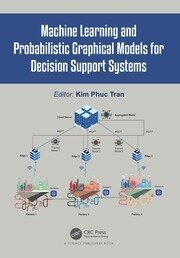
Machine Learning and Probabilistic Graphical Models for Decision Support Systems
Presents recent advancements in research, a review of new methods and techniques, and applications in decision support systems (DSS) with Machine Learning and Probabilistic Graphical Models, which are very effective techniques in gaining knowledge from Big Data and in interpreting decisions. It explores Bayesian network learning, Control Chart, Reinforcement Learning for multicriteria DSS, Anomaly Detection in Smart Manufacturing with Federated Learning, DSS in healthcare, DSS for supply chain management, etc. Researchers and practitioners alike will benefit from this book to enhance the understanding of machine learning, Probabilistic Graphical Models, and their uses in DSS in the context of decision making with uncertainty. The real-world case studies in various fields with guidance and recommendations for the practical applications of these studies are introduced in each chapter.
Bayesian networks and Influence diagrams : A guide to construction and analysis
Probabilistic networks, also known as Bayesian networks and influence diagrams, have become one of the most promising technologies in the area of applied artificial intelligence, offering intuitive, efficient, and reliable methods for diagnosis, prediction, decision making, classification, troubleshooting, and data mining under uncertainty. Bayesian Networks and Influence Diagrams: A Guide to Construction and Analysis provides a comprehensive guide for practitioners who wish to understand, construct, and analyze intelligent systems for decision support based on probabilistic networks. Intended primarily for practitioners, this book does not require sophisticated mathematical skills or deep understanding of the underlying theory and methods nor does it discuss alternative technologies for reasoning under uncertainty.

Bayesian Networks and Decision Graphs
Probabilistic graphical models and decision graphs are powerful modeling tools for reasoning and decision making under uncertainty. As modeling languages they allow a natural specification of problem domains with inherent uncertainty, and from a computational perspective they support efficient algorithms for automatic construction and query answering. This includes belief updating, finding the most probable explanation for the observed evidence, detecting conflicts in the evidence entered into the network, determining optimal strategies, analyzing for relevance, and performing sensitivity analysis. The book introduces probabilistic graphical models and decision graphs, including Bayesian networks and influence diagrams.It contians two parts. The first part focuses on probabilistic graphical models. Compared with the previous book, the new edition also includes a thorough description of recent extensions to the Bayesian network modeling language, advances in exact and approximate belief updating algorithms, and methods for learning both the structure and the parameters of a Bayesian network. The second part deals with decision graphs, and in addition to the frameworks described in the previous edition, it also introduces Markov decision processes and partially ordered decision problems.
