



الصفحة 1
الصفحة 1

Management of Multimedia Networks and Services ; 8th International Conference on Management of Multimedia Networks and Services, MMNS 2005, Barcelona, Spain, October 24-26, 2005, Proceedings
We are delighted to present the proceedings of the 8th IFIP/IEEE International Conference on Management of Multimedia Networks and Services (MMNS 2005). The MMNS 2005 conference was held in Barcelona, Spain on October 24–26, 2005. As in previous years, the conference brought together an international audience of researchers and scientists from industry and academia who are researching and developing state-of-the-art management systems, while creating a public venue for results dissemination and intellectual collaboration. This year marked a challenging chapter in the advancement of management systems for the wider management research community, with the growing complexities of the “so-called” multimedia over Internet, the proliferation of alternative wireless networks (WLL, WiFi and WiMAX) and 3G mobile services, intelligent and high-speed networks scalable multimedia services and the convergence of computing and communications for data, voice and video delivery. Contributions from the research community met this challenge with 65 paper submissions; 33 high-quality papers were subsequently selected to form the MMNS 2005 technical program. The diverse topics in this year’s program included wireless networking technologies, wireless network applications, quality of services, multimedia, Web applications, overlay network management, and bandwidth management.

Load balancing using SDN
Software-Defined Network (SDN) is considered a breakthrough to the global network. It plays an important role in performance improvement and network optimization. SDN is a new mechanism for managing and designing networks rather than the current traditional network system which does not afford more services and higher data rates; therefore, we analyze the effect of applying load balancing techniques and its importance in different SDN environments. In this paper, we propose a dynamic server load balancing technique in SDN architecture. Hence, we implement a server Connection-based load balancing technique and evaluate its performance with a static Round-robin and Random-based in both mininet emulation environment and OpenFlow-enabled switch using Ryu OpenFlow controller.

Job Scheduling Strategies for Parallel Processing ; Vol. 3834 : 11th International Workshop, JSSPP 2005, Cambridge, MA, USA, June 19, 2005, Revised Selected Papers
Constitutes the refereed postproceedings of the 11th International Workshop on Job Scheduling Strategies for Parallel Processing, 2005, held in conjunction with the 19th ACM International Conference on Supercomputing. This book covers a range of parallel architectures, from distributed grids, through clusters, to massively-parallel supercomputers.

Job Scheduling Strategies for Parallel Processing ; Vol. 3277 : 10th International Workshop, JSSPP 2004, New York, NY, USA, June 13, 2004, Revised Selected Papers
Contains the papers presented at the 10th Anniversary Workshop on Job Scheduling Strategies for Parallel Processing. The workshop was held in New York City, on June 13, 2004, at Columbia University, in conjunction with the SIGMETRICS 2004 conference. Although it is a workshop, the papers were conference-reviewed, with the full versions being read and evaluated by at least five and usually seven members of the Program Committee. We refer to it as a workshop because of the very fast turnaround time, the intimate nature of the actual presentations, and the ability of the authors to revise their papers after getting feedback from workshop attendees. On the other hand, it was actually a conference in that the papers were accepted solely on their merits as decided upon by the Program Committee.

Job Scheduling Strategies for Parallel Processing ; 13th International Workshop, JSSPP 2007, Seattle, WA, USA, June 17, 2007. Revised Papers
Constitutes the thoroughly refereed post-workshop proceedings of the 13th International Workshop on Job Scheduling Strategies for Parallel Processing, JSSPP 2007, held in Seattle, WA, USA, in June 2007, in conjunction with the 21st ACM International Conference on Supercomputing, ICS 2007.The 10 revised full research papers presented went through the process of strict reviewing and subsequent improvement. The papers cover all current issues of job scheduling strategies for parallel processing from the supercomputer-centric viewpoint but also address many nontraditional high-performance computing and parallel environments that cannot or need not access a traditional supercomputer.

Job Scheduling Strategies for Parallel Processing ; 12th International Workshop, JSSPP 2006, Saint-Malo, France, June 26, 2006, Revised Selected Papers
Constitutes the thoroughly refereed post-proceedings of the 12th International Workshop on Job Scheduling Strategies for Parallel Processing, JSSPP 2006, held in Saint-Malo, France in June 2006 in conjunction with the Joint International Conference on Measurement and Modeling of Computer Systems SIGMETRICS/Performance 2006.

Bio-inspired computing and communication ; 1st Workshop on Bio-inspired design of networks, BIOWIRE 2007 Cambridge, UK, April 2-5, 2007 Revised Selected Papers
The book constitutes the thoroughly refereed post-workshop proceedings of the First Workshop on Bio-Inspired Design of Networks, BIOWIRE 2007, held in Cambridge, UK, in April 2007.

Algorithms and architectures for parallel processing ; 8th International Conference, ICA3PP 2008, Cyprus, June 9-11, 2008 Proceedings
This book constitutes the refereed proceedings of the 8th International Conference on Algorithms and Architectures for Parallel Processing, ICA3PP 2008, held in Agia Napa, Cyprus, in June 2008.

Algorithms and architectures for parallel processing ; 7th International Conference, ICA3PP 2007, Hangzhou, China, June 11-14, 2007, Proceedings
The improvements in computation and communication capabilities have enabled the creation of demanding applications in critical domains such as the environment, health, aerospace, and other areas of science and technology. Similarly, new classes of applications are enabled by the availability of heterogeneous large-scale distributed systems which are becoming available nowadays (based on technologies such as grid and peer-to-peer systems).Parallel computing systems exploit a large diversity of computer architectures, from supercomputers, shared-memory or distributed-memory multi processors, to local networks and clusters of p- sonal computers. With the recent emergence of multi core architectures, parallel computing is now set to achieve “mainstream” status. Approaches that have been advocated by parallel computing researchers in the past are now being utilized in a number of software libraries and hardware systems that are available for everyday use. Parallel computing ideas have also come to dominate areas such as multi user gaming (especially in the development of gaming engines based on “cell” arc- tectures).

Advances in grid computing - EGC 2005 ; European grid conference, Amsterdam, The Netherlands, February 14-16, 2005, Revised Selected Papers
This book constitutes the proceedings of the European Grid Con-ference 2005, held at the Science Park Amsterdam The aim of the European Grid Conference was to be the premier event onGrid computing in Europe in 2005, focusing on all aspects of Grid computingand bringing together participants from research and industry. In this book you find the final versions of these accepted papers.

Advances in grid and pervasive computing ; 1st International Conference, GPC 2006, Taichung, Taiwan, May 3-5, 2006, Proceedings
This book constitutes the refereed proceedings of the First International Conference on Grid and Pervasive Computing, GPC 2006, held in Taichung, Taiwan, in May 2006.The 64 revised full papers were carefully reviewed and selected from 267 submissions. The papers are organized in topical sections on grid scheduling, peer-to-peer computing, Web/grid services, high performance computing, ad hoc networks, wireless sensor networks, grid applications, data grid, pervasive applications, semantic Web, semantic grid, grid load balancing, wireless ad hoc/sensor networks, and mobile computing.

Advanced parallel processing technologies ; 7th International Symposium, APPT 2007 Guangzhou, China, November 22-23, 2007 Proceedings
APPT was upgraded to the International Symposium on Advanced Parallel Processing Technologies. However, it kept its traditional flavor by sharing of the underlying theories and applications, and the establishment of new and long-term collaborative channels. And it will continue to provide a forum for researchers, professionals, and industrial practitioners from around the world to report on new advances in high-performance architecture and software, as well as to identify issues and directions for research and development in the new era of evolving technologies.
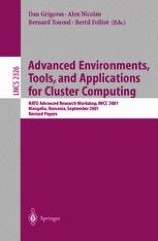
Advanced environments, tools, and applications for cluster computing ; NATO Advanced Research Workshop, IWCC 2001, Mangalia, Romania, September 1-6, 2001. Revised Papers
Started by small group of well known scientists with the aim of sharing knowledge, experiences, and results on all aspects of cluster computing, the initiative of a workshop on cluster computing received more attention after IFIP WG 10.3 and IEEE Romania Section accepted our request for sponsorship. Moreover, the application for a NATO ARW grant was successful, leading to a greater interest in the workshop. In this respect, we have to say that we chose Romania in order to attract scientists from Central and Eastern European countries and improve the cooperation in the region, in the field of cluster computing. We had an extremely short time to organize the event, but many people joined us and enthusiastically contributed to the process. The success of the workshop is wholly due to the hard work of the organizing committee, members of the program committee, key speakers, speakers from industry, and authors of accepted papers.
