



الصفحة 1
الصفحة 1
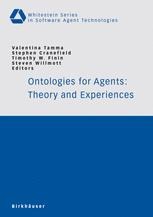
Ontologies for Agents : Theory and Experiences
On the other hand, ontologies have established themselves as a powerful tool to enable kno- edge sharing, and a growing number of applications have bene?ted from the use of ontologies as a means to achieve semantic interoperability among heterogeneous, distributed systems. In principle ontologies and agents are a match made in heaven, that has failed to happen. What makes a simple piece of software an agent is its ability to communicate in a ”social” environment, to make autonomous decisions, and to be proactive on behalf of its user. Communication ultimately depends on und- standing the goals, preferences, and constraints posed by the user. Autonomy is theabilitytoperformataskwithlittleornouserintervention,whileproactiveness involves acting autonomously with no need for user prompting. Communication, but also autonomy and proactiveness, depend on knowledge. The ability to c- municate depends on understanding the syntax (terms and structure) and the semantics of a language. Ontologies provide the terms used to describe a domain and the semantics associated with them. In addition, ontologies are often comp- mented by some logical rules that constrain the meaning assigned to the terms. These constraints are represented by inference rules that can be used by agents to perform the reasoning on which autonomy and proactiveness are based.

omputational science and its applications - ICCSA 2005 ; Vol. 3480 ; International Conference, Singapore, May 9-12, 2005, Proceedings, Part I
The four volume set assembled following The 2005 International Conference on Computational Science and its Applications, ICCSA 2005, held in Suntec International Convention and Exhibition Centre, Singapore, from 9 May 2005 till 12 May 2005, represents the ?ne collection of 540 refereed papers selected from nearly 2,700 submissions. Computational Science has ?rmly established itself as a vital part of many scienti?c investigations, a?ecting researchers and practitioners in areas ranging from applications such as aerospace and automotive, to emerging technologies such as bioinformatics and nanotechnologies, to core disciplines such as ma- ematics, physics, and chemistry. Due to the shear size of many challenges in computational science, the use of supercomputing, parallel processing, and - phisticated algorithms is inevitable and becomes a part of fundamental t- oretical research as well as endeavors in emerging ?elds.

OMDoc : An Open Markup Format for Mathematical Documents [version 1.2]
Computers arechanging the way wethink. Of course,nearly all desk-workers have access to computers and use them to email their colleagues, search the Web for information and prepare documents. But I’m not referring to that. I mean that people have begun to think about what they do in compu- tional terms and to exploit the power of computers to do things that would previously have been unimaginable. This observation is especially true of mathematicians.

Object-Oriented Technology. ECOOP 2007 Workshop Reader ; ECOOP 2007 Workshops, Berlin, Germany, July 30-31, 2007, Final Reports
Contains the reports from the workshopsheld at the 21st European Conference on Object-Oriented Programming - ECOOP 2007 - at Technische Universit] at Berlin. Nineteen workshops were heldin the courseofthis conference on July 30 and July 31, 2007, covering a large spectrum of hot research topics. As in previous editions of ECOOP, numerous scientists from academia and industry took the chance to present innovative and topical ideas in an environment ofering optimal conditions for exciting discussions and fruitful interactions. The Workshop Reader which contains the reports from the workshops has been a substantial part of the ECOOP conference for more than10 years
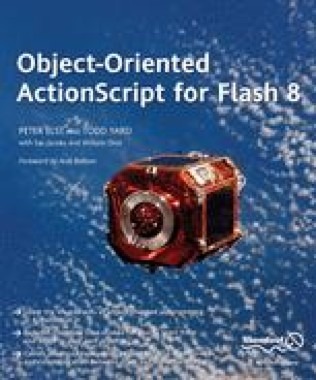
Object-Oriented ActionScript for Flash 8
Object-Oriented ActionScript For Flash 8 teaches the theory and practice of OOP with ActionScript. You do not need any extensive prior programming experience, you just need to want to go beyond the usual Flash interfaces. Authors and working Flash developers Peter Elst and Todd Yard take you through the complete development cycle of a series of related applications, using numerous step-by-step instructions. You'll be able to develop highly reusable applications and services that leverage the dynamic features in Flash. This book demonstrates professional OOP skills and techniques that are completely transferable to other programming languages and technologies, including Inheritance, Polymorphism, managing classes, component development, consuming web services, and much more. It also includes some cutting edge ActionScript programming techniques, and animation and effects classes.

Object detection with deep learning models : Principles and applications
Discusses recent advances in object detection and recognition using deep learning methods, which have achieved great success in the field of computer vision and image processing. It provides a systematic and methodical overview of the latest developments in deep learning theory and its applications to computer vision, illustrating them using key topics, including object detection, face analysis, 3D object recognition, and image retrieval / A structured overview of deep learning in object detection / A diversified collection of applications of object detection using deep neural networks / Emphasize agriculture and remote sensing domains / Exclusive discussion on moving object detection

Numerical Methods and Applications ; 6th International Conference, NMA 2006, Borovets, Bulgaria, August 20-24, 2006, Revised Papers
This book constitutes the thoroughly refereed post-proceedings of the 6th International Conference on Numerical Methods and Applications, NMA 2006. The papers are organized in topical sections on numerical methods for hyperbolic problems, robust preconditioning solution methods, Monte Carlo and quasi-Monte Carlo for diverse applications, metaheuristics for optimization problems, uncertain/control systems and reliable numerics, interpolation and quadrature processes, large-scale computations in environmental modelling, and contributed talks.

Numerical computation, data analysis and software in mathematics and engineering
Include the aspects of the meshless method, numerical simulation, mathematical models, deep learning and data analysis. Meshless methods, such as the improved element-free Galerkin method, the dimension-splitting, interpolating, moving, least-squares method, the dimension-splitting, generalized, interpolating, element-free Galerkin method and the improved interpolating, complex variable, element-free Galerkin method, are presented. Some complicated problems, such as tge cold roll-forming process, ceramsite compound insulation block, crack propagation and heavy-haul railway tunnel with defects, are numerically analyzed.

Numerical Analysis and Its Applications ; 3rd International Conference, NAA 2004, Rousse, Bulgaria, June 29 - July 3, 2004, Revised Selected Papers
Constitutes the refereed post-proceedings of the Third International Conference on Numerical Analysis and Its Applications, held in Bulgaria in June/July 2004. This book addresses various aspects of numerical analysis. It covers the application fields such as computational sciences and engineering, chemistry, physics, economics, and simulation.

Numerical analysis
Introduces readers to the theory and application of modern numerical approximation techniques. Providing an accessible treatment that only requires a calculus prerequisite, the authors explain how, why, and when approximation techniques can be expected to work-and why, in some situations, they fail. A wealth of examples and exercises develop readers' intuition, and demonstrate the subject's practical applications to important everyday problems in math, computing, engineering, and physical science disciplines.

Nonlinear kalman filtering for force-controlled robot tasks
This monograph focuses on how to achieve more robot autonomy by means of reliable processing skills. "Nonlinear Kalman Filtering for Force-Controlled Robot Tasks " discusses the latest developments in the areas of contact modeling, nonlinear parameter estimation and task plan optimization for improved estimation accuracy.

Nonlinear Analyses and Algorithms for Speech Processing ; International Conference on Non-Linear Speech Processing, NOLISP 2005, Barcelona, Spain, April 19-22, 2005, Revised Selected Papers
We present in this volume the collection of ?nally accepted papers of NOLISP 2005 conference. It has been the third event in a series of events related to N- linear speech processing, in the framework of the European COST action 277 “Nonlinear speech processing”. Many speci?cs of the speech signal are not well addressed by conv- tional models currently used in the ?eld of speech processing. The purpose of NOLISP is to present and discuss novel ideas, work and results related to alternative techniques for speech processing, which depart from mainstream approaches. With this intention in mind, we provide an open forum for discussion. Alt- nate approaches are appreciated, although the results achieved at present may not clearly surpass results based on state-of-the-art methods. The call for papers was launched at the beginning of 2005, addressing the following domains: 1. Non-Linear Approximation and Estimation 2. Non-Linear Oscillators and Predictors 3. Higher-Order Statistics 4. Independent Component Analysis 5. Nearest Neighbors 6. Neural Networks 7. Decision Trees 8. Non-Parametric Models 9. Dynamics of Non-Linear Systems 10. Fractal Methods 11. Chaos Modeling 12. Non-Linear Di?erential Equations 13. Others All the main ?elds of speech processing are targeted by the workshop, namely: 1. Speech Coding:Thebit rateavailablefor speechsignalsmustbe strictly l- ited in order to accommodate the constraints of the channel resource.
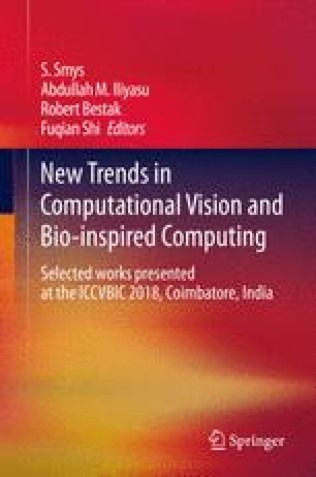
New trends in computational vision and bio-inspired computing : Selected works presented at the ICCVBIC 2018, Coimbatore, India
Gathers selected, peer-reviewed original contributions presented at the International Conference on Computational Vision and Bio-inspired Computing (ICCVBIC) conference which was held in Coimbatore, India, on November 29-30, 2018. The works included here offer a rich and diverse sampling of recent developments in the fields of Computational Vision, Fuzzy, Image Processing and Bio-inspired Computing. The topics covered include computer vision; cryptography and digital privacy; machine learning and artificial neural networks; genetic algorithms and computational intelligence; the Internet of Things; and biometric systems, to name but a few. The applications discussed range from security, healthcare and epidemic control to urban computing, agriculture and robotics.

New metropolitan perspectives : Knowledge dynamics, innovation-driven policies towards the territories’ attractiveness ; Vol.1
This book presents the outcomes of the symposium “NEW METROPOLITAN PERSPECTIVES,” held at Mediterranea University, Reggio Calabria, Italy on May 26–28, 2020.

New insights in machine learning and deep neural networks
Gatheres ten exemplary papers, each delineating advancements within the spheres of machine learning and deep neural networks. Commencing with a thorough exploration by Figueira and Vaz, readers are introduced to the nuances of synthetic data generation and evaluation, followed closely by Silva and Pedroso's systematic approach to leveraging deep reinforcement learning within the intricate realm of delivery logistics. Kamran et al. contribute an astute methodology for camouflage object segmentation, whereas Pinheiro and collaborators offer a crafted semi-supervised strategy for predicting EGFR mutations via CT images. Subsequent contributions, such as Lee and Yoo's framework for portrait emotion recognition and Balakrishnan et al.'s analytical exploration of transformer models for Twitter disaster detection, further exemplify the depth of research contained herein.

New frontiers in artificial intelligence ; JSAI-isAI International Workshops, JURISIN, AI-Biz, LENLS, Kansei-AI, Yokohama, Japan, November 10–12, 2019, Revised Selected Papers
This book constitutes extended, revised and selected papers from the 11th International Symposium of Artificial Intelligence supported by the Japanese Society for Artificial Intelligence, JSAI-isAI 2019. It was held in November 2019 in Yokohama, Japan. The 26 papers were carefully selected from 46 submissions and deal with topics of AI research and are organized into 4 sections, according to the 4 workshops: JURISIN 2019, AI-Biz 2019, LENLS 16, and Kansei-AI 2019.

New Frontiers in Artificial Intelligence ; Joint JSAI 2005 Workshop Post-Proceedings
The objectives of this book are to present the award papers from the 19th annual conference of JSAI 2005 and the selected papers from the ?ve co-located international workshops and to promote the study exchange among worldwide researchers. Five papers received awards among more than 200 presentations in the conference, and 40 papers were selected from the workshops of Logic and Engineering of Natural Language Semantics 2005 (LENLS 2005), Learning with Logics and Logics for Learning (LLLL 2005), Agent Network Dynamics and Intelligence (ANDI 2005), Conversational Informatics (CI 2005) and Risk Management Systems with Intelligent Data Analysis (RMSIDA 2005).

New advances in audio signal processing
In the era of digitalization, audio signal processing is gaining peculiar relevance as an automation and remote analysis means, also considering its enhancement by novel artificial intelligence (AI) techniques. This Reprint aims to offer an overview of the current developments in all fields that revolve around audio processing: from advancements in the acoustic domain to deep learning architectures for the audio-based analysis of real-world problems such as pitch detection or pathology identification.

Neuroscribe = نيوروسكرايب
Neuroscribe is a cutting-edge deep learning framework designed to address the complexities and inefficiencies encountered in existing frameworks like PyTorch and TensorFlow. Aimed at streamlining model development and enhancing performance across diverse hardware environments, NeuroScribe offers a lightweight and flexible solution. The framework features a robust tensor library, an auto-differentiation engine, a comprehensive neural network module, and advanced optimization algorithms. With built-in visualization tools and a user-friendly interface, NeuroScribe simplifies both beginner and advanced workflows. Its cross-platform compatibility, supported by CUDA and Metal Performance Shaders (MPS), ensures optimal performance, and in some scenarios, NeuroScribe demonstrates superior speed compared to leading frameworks. Additionally, NeuroScribe introduces unique libraries and features not found in other frameworks, further enhancing its versatility and appeal. The modular architecture and automatic system detection further enhance its adaptability, making NeuroScribe a versatile and powerful tool for deep learning practitioners.

Neural networks and deep learning
Covers both classical and modern models in deep learning. The primary focus is on the theory and algorithms of deep learning. The theory and algorithms of neural networks are particularly important for understanding important concepts, so that one can understand the important design concepts of neural architectures in different applications. Why do neural networks work? When do they work better than off-the-shelf machine-learning models? When is depth useful? Why is training neural networks so hard? What are the pitfalls? The book is also rich in discussing different applications in order to give the practitioner a flavor of how neural architectures are designed for different types of problems.
