



الصفحة 1
الصفحة 1

New insights in machine learning and deep neural networks
Gatheres ten exemplary papers, each delineating advancements within the spheres of machine learning and deep neural networks. Commencing with a thorough exploration by Figueira and Vaz, readers are introduced to the nuances of synthetic data generation and evaluation, followed closely by Silva and Pedroso's systematic approach to leveraging deep reinforcement learning within the intricate realm of delivery logistics. Kamran et al. contribute an astute methodology for camouflage object segmentation, whereas Pinheiro and collaborators offer a crafted semi-supervised strategy for predicting EGFR mutations via CT images. Subsequent contributions, such as Lee and Yoo's framework for portrait emotion recognition and Balakrishnan et al.'s analytical exploration of transformer models for Twitter disaster detection, further exemplify the depth of research contained herein.

Neural networks and deep learning
Covers both classical and modern models in deep learning. The primary focus is on the theory and algorithms of deep learning. The theory and algorithms of neural networks are particularly important for understanding important concepts, so that one can understand the important design concepts of neural architectures in different applications. Why do neural networks work? When do they work better than off-the-shelf machine-learning models? When is depth useful? Why is training neural networks so hard? What are the pitfalls? The book is also rich in discussing different applications in order to give the practitioner a flavor of how neural architectures are designed for different types of problems.

Digital twin : Architectures, networks, and applications
Offers comprehensive, self-contained knowledge on digital twin (DT), which is a very promising technology for achieving digital intelligence in the next-generation wireless communications and computing networks. DT is a key technology to connect physical systems and digital spaces in Metaverse. The objectives of this book are to provide the basic concepts of DT, to explore the promising applications of DT integrated with emerging technologies, and to give insights into the possible future directions of DT. For easy understanding, this book also presents several use cases for DT models and applications in different scenarios. The book starts with the basic concepts, models, and network architectures of DT. Then, we present the new opportunities when DT meets edge computing, Blockchain and Artificial Intelligence, and distributed machine learning (e.g., federated learning, multi-agent deep reinforcement learning).
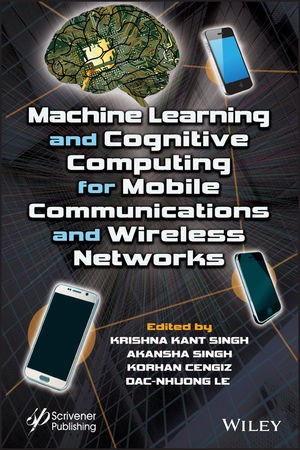
Machine Learning and Cognitive Computing for Mobile Communications and Wireless Networks
Communication and network technology has witnessed recent rapid development and numerous information services and applications have been developed globally. These technologies have high impact on society and the way people are leading their lives. The advancement in technology has undoubtedly improved the quality of service and user experience yet a lot needs to be still done. Some areas that still need improvement include seamless wide-area coverage, high-capacity hot-spots, low-power massive-connections, low-latency and high-reliability and so on. Thus, it is highly desirable to develop smart technologies for communication to improve the overall services and management of wireless communication. Machine learning and cognitive computing have converged to give some groundbreaking solutions for smart machines. With these two technologies coming together, the machines can acquire the ability to reason similar to the human brain. The research area of machine learning and cognitive computing cover many fields like psychology, biology, signal processing, physics, information theory, mathematics, and statistics that can be used effectively for topology management. Therefore, the utilization of machine learning techniques like data analytics and cognitive power will lead to better performance of communication and wireless systems.
AI based Robot Safe Learning and Control
This book mainly focuses on the safe control of robot manipulators. The control schemes are mainly developed based on dynamic neural network, which is an important theoretical branch of deep reinforcement learning.
