



الصفحة 1
الصفحة 1

National Systems of Innovation in Comparison : Structure and Performance Indicators for Knowledge Societies
The book documents major elements of the joint work of eight leading German institutes, elaborated in the context of a regular annual report on Germany's technological performance. It provides much more than the pure compilation of quantitative indicators for international benchmarking, but gives support to an appropriate interpretation of the referring results and suggests relevant conclusions for innovation policy. A special focus is on Germany; so the book also aims at non-German readers interested in specific features of the German innovation system.
Introduction pratique aux bases de données relationnelles = A practical introduction to relational databases
Cet ouvrage introduit le lecteur dans le domaine des bases de données relationnelles en présentant une vaste sélection de sujets portant sur la modélisation des données, les langages de base de données, l'architecture des systèmes et l'évolution post-relationnelle. - Notions fondamentales: le modèle relationnel, les composants d’un système de gestion de bases de données, l’organisation de la mise en œuvre d’une base de données, les tâches de gestion des données. - De l'analyse à la base de données : le modèle entité association, la généralisation et l’agrégation, les dépendances et les formes normales,les contraintes d’intégrité. - Aperçu des langages de requête et de manipulation des données: l’algèbre relationnelle, le calcul des prédicats, SQL, QUEL, QBE, le traitement des valeurs nulles, la protection des données. - Les composants de l'architecture d'un système de bases de données : la compilation, l’interprétation et l’optimisation des requêtes, l’environnement multiutilisateur, le concept de transaction et la sérialisation, les méthodes optimiste et pessimiste, les structures de stockage et les méthodes d’accès. L’intégration et la migration des bases de données: l’exploitation des bases de données hétérogènes, les bases de données sur le Web, les règles de conversion pour effectuer l’intégration et la migration, les variantes de migration des bases de données hétérogènes, la planification de l’intégration et de la migration.
Implementation and Application of Functional Languages ; 19th International Workshop, IFL 2007, Freiburg, Germany, September 27-29, 2007. Revised Selected Papers
This book constitutes the thoroughly refereed post-proceedings of the 19th International Workshop on Implementation and Applications of Functional Languages, IFL 2007, held in Freiburg, Germany in September 2007.The 15 revised full papers presented went through two rounds of reviewing and improvement and were selected from 33 submissions. The papers address all current theoretical and methodological issues on functional and function-based languages such as type checking, contract checking, compilation, parallelism, development and debugging, data structures, parsing as well as various performance related concepts.
High performance embedded architectures and compilers ; 3rd International Conference, HiPEAC 2008, Göteborg, Sweden, January 27-29, 2008. Proceedings
This book constitutes the refereed proceedings of the Third International Conference on High Performance Embedded Architectures and Compilers, HiPEAC 2008, held in Göteborg, Sweden, January 27-29, 2008. The 25 revised full papers presented together with 1 invited keynote paper were carefully reviewed and selected from 77 submissions. The papers are organized in topical sections on Multithreaded and Multicore Processors, Reconfigurable - ASIP, Compiler Optimizations, Industrial Processors and Application Parallelization, Power-Aware Techniques, High-Performance Processors, Profiles: Collection and Analysis as well as Optimizing Memory Performance.
High performance embedded architectures and compilers ; 2nd International Conference, HiPEAC 2007, Ghent, Belgium, January 28-30, 2007. Proceedings
This book constitutes the refereed proceedings of the Second International Conference on High Performance Embedded Architectures and Compilers, HiPEAC 2007, held in Ghent, Belgium, in January 2007. The 19 revised full papers presented together with one invited keynote paper were carefully reviewed and selected from 65 submissions.
High performance embedded architectures and compilers ; 1st International Conference, HiPEAC 2005, Barcelona, Spain, November 17-18, 2005, Proceedings
The ProgramCommittee received a total of 84 submissions; only 17 were selected for presentation as full-length papers and another one as an invited paper. Each paper was rigorously reviewed by three ProgramCommittee members and at least one external referee. Many reviewers spent a great amount of e?ort to provide detailed feedback. In many cases, such feedback along with constructive shepherding resulted in dramatic improvement in the quality of accepted papers. The names of the Program Committee m- bers and the referees are listed in the proceedings. The net result of this team e?ort is that the symposium proceedings include outstanding contributions by authors from nine countries in three continents. In addition to paper presentations, this ?rst HiPEAC conference featured two keynotes delivered by prominent researchers from industry and academia.

Handbook of Nature-Inspired and Innovative Computing : Integrating Classical Models with Emerging Technologies
This comprehensive handbook, the first of its kind to address the connection between nature-inspired and traditional computational paradigms, is a repository of case studies dealing with different problems in computing and solutions to these problems based on nature-inspired paradigms. The "Handbook of Nature-Inspired and Innovative Computing: Integrating Classical Models with Emerging Technologies" is an essential compilation of models, methods, and algorithms for researchers, professionals, and advanced-level students working in all areas of computer science, IT, biocomputing, and network engineering.

Formal approaches to software testing ; Vol. 3395 ; 4th International workshop, FATES 2004, Linz, Austria, September 21, 2004, Revised Selected Papers
Testing often accounts for more than 50% of the required e?ort during system development.Thechallengeforresearchistoreducethesecostsbyprovidingnew methods for the speci?cation and generation of high-quality tests. Experience has shown that the use of formal methods in testing represents a very important means for improving the testing process. Formal methods allow for the analysis andinterpretationofmodelsinarigorousandprecisemathematicalmanner.The use of formal methods is not restricted to system models only. Test models may alsobeexamined.Analyzingsystemmodelsprovidesthepossibilityofgenerating complete test suites in a systematic and possibly automated manner whereas examining test models allows for the detection of design errors in test suites and their optimization with respect to readability or compilation and execution time. Due to the numerous possibilities for their application, formal methods have become more and more popular in recent years. The Formal Approaches in Software Testing (FATES) workshop series also bene?ts from the growing popularity of formal methods. After the workshops in Aalborg (Denmark, 2001), Brno (Czech Republic, 2002) and Montr´ eal (Canada, 2003), FATES 2004 in Linz (Austria) was the fourth workshop of this series. Similar to the workshop in 2003, FATES 2004 was organized in a?liation with the IEEE/ACM Conference on Automated Software Engineering (ASE 2004). FATES 2004 received 41 submissions. Each submission was reviewed by at least three independent reviewers from the Program Committee with the help of some additional reviewers. Based on their evaluations, 14 full papers and one wo- in-progress paper from 11 di?erent countries were selected for presentation.

Data structure and algorithms using C++ : A practical implementation
Intended to flow from the basic concepts of C++ to technicalities of the programming language, its approach and debugging. The chapters of the book flow with the formulation of the problem, it's designing, finding the step-by-step solution procedure along with its compilation, debugging and execution with the output. Keeping in mind the learner’s sentiments and requirements, the exemplary programs are narrated with a simple approach so that it can lead to creation of good programs that not only executes properly to give the output, but also enables the learners to incorporate programming skills in them. The style of writing a program using a programming language is also emphasized by introducing the inclusion of comments wherever necessary to encourage writing more readable and well commented programs. As practice makes perfect, each chapter is also enriched with practice exercise questions so as to build the confidence of writing the programs for learners.

Languages and Compilers for Parallel Computing ; Vol. 2481 : 15th Workshop, LCPC 2002, College Park, MD, USA, July 25-27, 2002, Revised Papers
LCPC 2002 brought together over 60 researchers from academia and research institutions from many countries. The program of 26 papers was selected from 32 submissions. Each paper was reviewed by at least three Program Committee members and sometimes by additional reviewers. Prior to the workshop, revised versions of accepted papers were informally published on the workshop’s website and in a paper proceedings that was distributed at the meeting. This year, the workshopwas organizedinto sessions of papers on related topics, and each session consisted of two to three 30-minute presentations.Based on feedback from the workshop,the papers were revised and submitted for inclusion in the formal proceedings published in this volume. Two papers were presented at the workshop but later withdrawn from the ?nal proceedings by their authors. We were very lucky to have Bill Carlson from the Department of Defense give the LCPC 2002 keynote speech on “UPC: A C Language for Shared M- ory Parallel Programming.” Bill gave an excellent overview of the features and programming model of the UPC parallel programming language.

Languages and Compilers for Parallel Computing ; 19th International Workshop, LCPC 2006, New Orleans, LA, USA, November 2-4, 2006, Revised Papers
The 19th Workshop on Languages and Compilers for Parallel Computing was heldinNovember2006inNewOrleans,LouisianaUSA.Morethan40researchers from around the world gathered together to present their latest results and to exchange ideas on topics ranging from parallel programming models, code generation,compilationtechniques,paralleldatastructureandparallelexecution models,toregisterallocationandmemorymanagementinparallelenvironments.

Compiler construction ; Vol. 3923 : 15th International Conference, CC 2006, Held as Part of the Joint European Conferences on Theory and Practice of Software, ETAPS 2006, Vienna, Austria, March 30-31, 2006, Proceedings
ETAPS 2006 was the ninth instance of the European Joint Conferences on Theory and Practice of Software. ETAPS is an annual federated conference that was established in 1998 by combining a number of existing and new conferences. The events that comprise ETAPS address various aspects of the system devel- ment process, including speci?cation, design, implementation, analysis and impro- ment. The languages, methodologies and tools which support these activities are all well within its scope. Di?erent blends of theory and practice are represented, with an inclination towards theory with a practical motivation on the one hand and soundly based practice on the other.

Compiler construction ; Vol. 3443 : 14th International Conference, CC 2005, Held as Part of the Joint European Conferences on Theory and Practice of Software, ETAPS 2005, Edinburgh, UK, April 4-8, 2005. Proceedings
"This book constitutes the refereed proceedings of 14th International Conference, CC 2005, Held as Part of the Joint European Conferences on Theory and Practice of Software, ETAPS 2005, including Topics Programming Languages, Compilers, Interpreters Logics and Meanings of Programs / Mathematical Logic and Formal Languages / Software Engineering / Artificial Intelligence"

Compiler construction ; 16th International Conference, CC 2007, Held as Part of the Joint European Conferences on Theory and Practice of Software, ETAPS 2007, Braga, Portugal, March 26-30, 2007, Proceedings
This book covered Theory and Practice of Software. The sections includes architecture, garbage collection and program analysis, register allocation, and program analysis.
Autonomous Robots and Agents
This book deals with the theoretical and methodological aspects of incorporating intelligence in Autonomous Robots and Agents. Challenges faced in the real world to accomplish complex tasks, which require collaborative efforts, and methods to overcome them, are detailed. Several informative articles deal with navigation, localization and mapping of mobile robots, a problem that engineers and researchers are grappling with all the time.This edited volume is targeted to present the latest state-of-the-art methodologies in Robotics. It is a compilation of the extended versions of the very best papers selected from the many that were presented at the 3rd International Conference on Autonomous Robots and Agents (ICARA 2006) which was held at Palmerston North, New Zealand from 11-14 December, 2006. Scientists and engineers who work with mobile robots will find this book very useful and stimulating.
Agent-oriented software engineering V ; 5th International workshop, AOSE 2004, New York, NY, USA, July 2004, revised selected papers
The explosive growth of application areas such as electronic commerce, ent- prise resource planning and mobile computing has profoundly and irreversibly changed our views on software systems. Nowadays, software is to be based on open architectures that continuously change and evolve to accommodate new components and meet new requirements. Software must also operate on di?- ent platforms, without recompilation, and with minimal assumptions about its operating environment and its users. Furthermore, software must be robust and ¨ autonomous, capable of serving a naive user with a minimum of overhead and interference. Agent concepts hold great promise for responding to the new realities of software systems. They o?er higher-level abstractions and mechanisms which address issues such as knowledge representation and reasoning, communication, coordination, cooperation among heterogeneous and autonomous parties, p- ception, commitments, goals, beliefs, and intentions, all of which need conceptual modelling. On the one hand, the concrete implementation of these concepts can lead to advanced functionalities.
Ada 2005 Reference Manual. Language and Standard Libraries : International Standard ISO/IEC 8652/1995(E) with Technical Corrigendum 1 and Amendment 1
The Ada 2005 Reference Manual incorporates these changes in the overall standard text and thus will replace the former versions as an indispensable working companion for anybody using Ada professionally or learning and studying the language systematically. In naming this version, we have chosen the vernacular term Ada 2005 used by the Ada community to refer to the interesting extensions made to the language Ada by the Amendment 1.
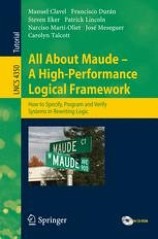
A High-Performance Logical Framework -- All About Maude : How to Specify, Program, and Verify Systems in Rewriting Logic
This book gives a comprehensive account of Maude, a language and system based on rewriting logic. Many examples are used throughout the book to illustrate the main ideas and features of Maude, and its many possible uses. Maude modules are rewrite theories. Computation with such modules is - cient deduction by rewriting. Because of its logical basis and its initial model semantics,aMaude module defines a precise mathematical model.This means that Maude and its formal tool environment can be used in three, mutually reinforcing ways: • as a declarative programming language; • as an executable formal specification language; and • as a formal verification system. Maude’s rewriting logic is simple, yet very expressive. This gives Maude good representational capabilities as a semantic framework to formally represent a wide range of systems, including models of concurrency, distributed al- rithms, network protocols, semantics of programming languages, and models of cell biology. Rewriting logic is also an expressive universal logic,making Maude a fiexible logical framework in which many difierent logics and - ference systems can be represented and mechanized. This makes Maude a useful metatool to build many other tools, including those in its own formal tool environment. Thanks to the logic’s simplicity and the use of advanced semi-compilation techniques, Maude has a high-performance implementation, making it competitive with other declarative programming languages.
