



الصفحة 1
الصفحة 1

Multimedia big data computing for IoT applications : Concepts, paradigms and solutions
This book considers all aspects of managing the complexity of Multimedia Big Data Computing (MMBD) for IoT applications and develops a comprehensive taxonomy. It also discusses a process model that addresses a number of research challenges associated with MMBD, such as scalability, accessibility, reliability, heterogeneity, and Quality of Service (QoS) requirements, presenting case studies to demonstrate its application. Further, the book examines the layered architecture of MMBD computing and compares the life cycle of both big data and MMBD. Written by leading experts, it also includes numerous solved examples, technical descriptions, scenarios, procedures, and algorithms.

Modern socio-technical perspectives on privacy
This book provides researchers and professionals with a foundational understanding of online privacy as well as insight into the socio-technical privacy issues that are most pertinent to modern information systems, covering several modern topics (e.g., privacy in social media, IoT) and underexplored areas (e.g., privacy accessibility, privacy for vulnerable populations, cross-cultural privacy).

Modern front-end architecture : Optimize your front-end development with components, storybook, and mise en place philosophy
Learn how to build front-end applications that can help you ship applications faster with fewer defects. Many software projects fail because they are not planned well, or lack organization. Applying strategies from other industries can help you create better software. Explores the “mise en place” technique from cooking and reveals how you can apply it to the art of creating software. Describes to how to structure your code base for reuse, and how to communicate the code’s intent to other developers. You’ll develop your components in isolation and test these building blocks for quality at a granular level. Then compose these components as building blocks in increasingly complicated features. Finally, you’ll apply some strategies not directly related to code to ensure maximum quality and efficiency. You will : Structure an application as a series of components / Build a component library that others in an organization can leverage / Ensure quality and accessibility at a component level rather than a page or app level / Test code in a way that gives the maximum amount of confidence while providing an excellent developer experience / Automate repeatable tasks

Mobile Information Systems II ; IFIP Working Conference on Mobile Information Systems, MOBIS 2005, Leeds, UK, December 6-7, 2005
Contains the proceedings of the second IFIP TC8 Working Conference on Mobile Information Systems which was held in December 2005 in Leeds, UK and sponsored by the International Federation of Information Processing (IFIP). Mobile Information Systems II aims to: · Clarify differences and similarities between the development of mobile and more traditional information systems. · Investigate the organizational impact of mobile information systems. · Investigate the 'e to m shift' , for example in m-Commerce relative to e-Commerce. · Investigate mobile commerce applications combined with the advantages of mobile communications technologies, the drivers of which have been identified as ubiquity, accessibility, security, convenience, localization, instant connectivity, and personalization. · Evaluate existing and newly developed approaches for the analysis, design, implementation, and evolution of mobile information systems. · Investigate technical issues and the constraints they impose on mobile information systems functionalities and design.
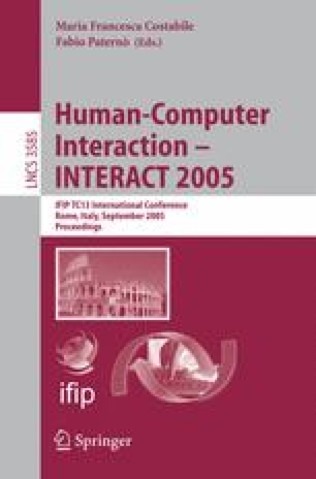
Human-computer interaction – INTERACT 2005 ; IFIP TC 13 International Conference, Rome, Italy, September 12-16, 2005, Proceedings
We will be, sooner or later, not only handling personal computers but also mul- purpose cellular phones, complex personal digital assistants, devices that will be context-aware, and even wearable computers stitched to our clothes…we would like these personal systems to become transparent to the tasks they will be performing. In fact the best interface is an invisible one, one giving the user natural and fast access to the application he (or she) intends to be executed. The working group that organized this conference (the last of a long row!) tried to combine a powerful scientific program (with drastic refereeing) with an entertaining cultural program, so as to make your stay in Rome the most pleasant one all round: I do hope that this expectation becomes true. July 2005 Stefano Levialdi, IEEE Life Fellow INTERACT 2005 General Chairman [1] Peter J. Denning, ACM Communications, April 2005, vol. 48, N° 4, pp. 27-31. Editors’ Preface INTERACT is one of the most important conferences in the area of Human-Computer Interaction at the world-wide level. We believe that this edition, which for the first time takes place in a Southern European country, will strengthen this role, and that Rome, with its history and beautiful setting provides a very congenial atmosphere for this conference. The theme of INTERACT 2005 is Communicating Naturally with Computers.

HCI related papers of Interacción 2004 ; Conference proceedings
The present book contains a collection of the best papers presented at the 5th International Conference on Interacción Persona Ordenador (IPO) (which is Human Computer Interaction in Spanish), which took place in th th Lleida on May 5 -7 , 2004. . The main goals of Interacción 2004 were: To expand the conference scope with internationally recognised invited speakers. The plenary talks were presented by Alan Dix, Yvonne Rogers, Geritt van der Veer, and Angel Puerta. To open the participation to Spanish speaker worldwide in order to be a point of reference of this discipline not only in Spain but also in the wider Spanish speaking community. This goal was reached through a very diverse program which included panels and posters sessions, where many different aspect of the Human Computer Interaction (HCI) were presented. All through the program, research from outside Spain was reflected through the contributions from people of other countries.

HCI and usability for education and work ; 4th Symposium of the Workgroup Human-Computer Interaction and Usability Engineering of the Austrian Computer Society, USAB 2008, Graz, Austria, November 20-21, 2008. Proceedings
This book constitutes the refereed proceedings of the 4th Usability Symposium of the Human-Computer Interaction and Usability Engineering Workgroup of the Austrian Computer Society, USAB 2008, held in Graz, Austria, in November 2008.The 7 revised full papers and 26 revised short papers presented were carefully reviewed and selected from 85 submissions. The papers are organized in topical sections on cognitive processes and end user experience, social software and collaborative knowledge development, knowledge processing, assessment and human performance.

Haptic and Audio Interaction Design ; 2nd International Workshop, HAID 2007 Seoul, Korea, November 29-30, 2007 Proceedings
This book constitutes the refereed proceedings of the Second International Workshop on Haptic and Audio Interaction Design, HAID 2007 held in Seoul, South Korea, in November 2007. The papers are organized in topical sections on tactile displays, communication and games, accessibility and navigation, as well as design.

Foundation Web Design with Dreamweaver 8
Dreamweaver is Macromedia's bestselling web design/development environment. Dreamweaver has the capability to generate dynamic website code using server-side languages like ASP, PHP, and ASP.NET. We know that you don't always require a full database-driven site though, so this book focuses on using version 8 of Dreamweaver to design and create usable, standards-compliant websites using XHTML and CSS. One of the highlights of this version is much closer, tighter CSS/XHTML. This book will show you how to make the most of that feature. After a brief introduction to the latest version of Dreamweaver, and how CSS and XHTML fit into it, Craig Grannell looks at using the software for your web design projects in a hands-on, task based manner.

Deepfake detection
Recently, various techniques of manipulating the video content have become available to everyone – online, one can find free applications e.g., for face swapping in videos. Such universal accessibility carries a notable risk of flooding online content with false information, affecting not only the greats of this world, but also the whole societies, also the rapid progress in synthetic image generation and manipulation has now come to a point where it raises significant concerns for the implications towards society. It is therefore necessary to develop a verification tool that will help assess the authenticity of the videos posted on the internet. This project describes the approach of using artificial intelligence solutions to detect doctored videos.

Data Warehousing and Data Mining Techniques for Cyber Security
It provide techniques for collecting information from distributed databases and for performing data analysis. The ever expanding, tremendous amount of data collected and stored in large databases has far exceeded our human ability to comprehend--without the proper tools. There is a critical need for data analysis that can automatically analyze data, summarize it and predict future trends. In the modern age of Internet connectivity, concerns about denial of service attacks, computer viruses and worms are extremely important. Data Warehousing and Data Mining Techniques for Cyber Security contributes to the discipline of security informatics. The author discusses topics that intersect cyber security and data mining, while providing techniques for improving cyber security. Since the cost of information processing and internet accessibility is dropping, an increasing number of organizations are becoming vulnerable to cyber attacks. This volume introduces techniques for applications in the area of retail, finance, and bioinformatics, to name a few.

Cooperative Design, Visualization, and Engineering ; 4th International Conference, CDVE 2007, Shanghai,China, September 16-20, 2007
The cooperative design, visualization and engineering community sensed the economic pulse of a new giant economy where cooperation is vital for its success. This year we received a large number of papers from all over the world.From a technical point of view, as a major trend in cooperative design, vi- alization, engineering and other applications, advanced Web-based cooperation technology stands out by itself. Web-based cooperative working applications have been emerging strongly since the wide availability and accessibility of the WWW. It is a form of sharing and collaborating by its nature.
Computers helping people with special needs ; 17th International Conference, ICCHP 2020, Lecco, Italy, September 9–11, 2020, Proceedings, Part II
The two-volume set LNCS 12376 and 12377 constitutes the refereed proceedings of the 17th International Conference on Computers Helping People with Special Needs, ICCHP 2020, held in Lecco, Italy, in September 2020. The conference was held virtually due to the COVID-19 pandemic.

Computers helping people with special needs ; 17th International Conference, ICCHP 2020, Lecco, Italy, September 9–11, 2020, Proceedings, Part I
The two-volume set LNCS 12376 and 12377 constitutes the refereed proceedings of the 17th International Conference on Computers Helping People with Special Needs, ICCHP 2020, held in Lecco, Italy, in September 2020. The conference was held virtually due to the COVID-19 pandemic.

Computers Helping People with Special Needs ; 11th International Conference, ICCHP 2008, Linz, Austria, July 9-11, 2008. Proceedings
This book constitutes the refereed proceedings of the 11th International Conference on Computers Helping People with Special Needs, ICCHP 2008, held in Linz, Austria in July 2008.
Computer-Human Interaction ; 8th Asia-Pacific Conference, APCHI 2008 Seoul, Korea, July 6-9, 2008 Proceedings
This book constitutes the refereed proceedings of the 8th Asia Pacific Conference on Computer Human Interaction, APCHI 2008, held in Seoul, Korea, in July 2008.

Changing Television Environments ; 6th European Conference, EUROITV 2008, Salzburg, Austria, July 3-4, 2008 Proceedings
This book constitutes the refereed proceedings of the 6th European Conference on Interactive Television, EuroITV 2008, held in Salzburg, Austria, in July 2008.
Beginning HTML with CSS and XHTML : Modern Guide and Reference
Beginning HTML with CSS and XHTML: Modern Guide and Reference incorporates practical examples that will show you how to structure your data correctly using (X)HTML, along with styling and layout basics using Cascading Style Sheets (CSS). Youll also learn how to add dynamic behavior to your data using the JavaScript™ language.
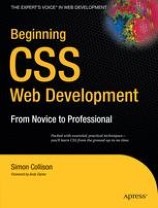
Beginning CSS web development : From novice to professional
There are many books out there on CSS, but Beginning CSS Web Development is different—it doesn't waste time discussing theory, and it delves straight into the practical matter. It provides you with what you need to know, faster. It is also completely up to date, covering the most modern CSS standards and design techniques. In addition to the essential CSS basics, this book covers advanced techniques like accessibility, hacks, and filters. The book concludes with a case study, and features a CSS reference section that allows you to look up required syntax as quickly as possible.

Applications and Usability of Interactive TV; 8th Iberoamerican Conference, jAUTI 2019, Rio de Janeiro, Brazil, October 29–November 1, 2019, Revised Selected Papers
This book constitutes the refereed proceedings of the 8th Iberoamerican Conference on Applications and Usability of Interactive Television, jAUTI 2019, in Rio de Janeiro, Brazil, in October 2019. The 10 full papers presented were carefully reviewed and selected from 35 submissions. The papers are organized in topical sections on Design and Development; Second Screen and Crossmedia; Interaction Techniques and Technologies; Accessibility; User Experience.
