



الصفحة 9
الصفحة 9

Formal techniques for computer systems and business processes ; European performance engineering workshop, EPEW 2005 and International workshop on web services and formal methods, WS-FM 2005, Versailles, France, September 1-3, 2005, Proceedings
This book constitutes the refereed proceedings of two colocated international workshops EPEW 2005 (European Performance Engineering Workshop) and WS-FM 2005 (Web Services and Formal Methods) held in Versailles, France in September 2005. The 20 revised full papers presented were carefully reviewed and selected from 59 submissions. For EPEW 2005 only 10 papers - of the 32 submitted - were accepted for presentation; they deal with queueing theory, bounding techniques, stochastic model checking, communication schemes analysis for high-speed LAN, QOS analysis in wireless ad-hoc networks and optical networks analysis. The main topics of the 10 papers accepted for WS-FM 2005 - from 27 submissions - include: protocols and standards for WS (SOAP, WSDL, UDDI, etc.); languages and description methodologies for Choreography/Orchestration/Workflow (BPML, XLANG and BizTalk, WSFL, WS-BPEL, etc.); coordination techniques for WS (transactions, agreement, coordination services, etc.); semantics-based dynamic WS discovery services (based on Semantic Web/Ontology Techniques or other semantic theories); security, performance evaluation and quality of service of WS; semi-structured data and XML related technologies; comparisons with different related technologies/approaches.

Formal Methods for Open Object-Based Distributed Systems ; Vol. 4037 ; 8th IFIP WG 6.1 International Conference, FMOODS 2006, Bologna, Italy, June 14-16, 2006, Proceedings
This book constitutes the refereed proceedings of the 8th IFIP WG 6.1 International Conference on Formal Methods for Open Object-Based Distributed Systems, FMOODS 2006, held in Bologna, Italy, June 2006. The book presents 16 revised full papers together with an invited paper and abstracts of 2 invited talks. Coverage includes component- and model-based design, service-oriented computing, software quality, modeling languages implementation, formal specification, verification, validation, testing, and service-oriented systems.
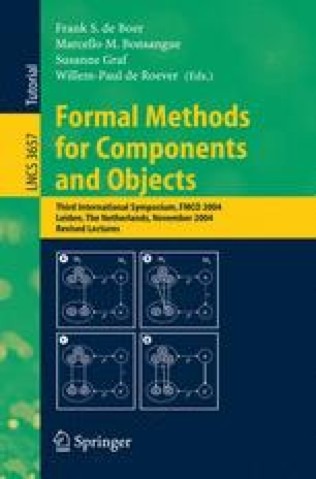
Formal Methods for Components and Objects ; Vol. 3657 ; 3rd International Symposium, FMCO 2004, Leiden, The Netherlands, November 2-5, 2004, Revised Lectures
This book presents revised tutorial lectures given by invited speakers at the Third International Symposium on Formal Methods for Components and Objects, FMCO 2004, held in Leiden, The Netherlands, in November 2004. The 14 revised lectures by leading researchers present a comprehensive account of the potential of formal methods applied to large and complex software systems such as component-based systems and object systems. The book provides an unique combination of ideas on software engineering and formal methods that reflect the expanding body of knowledge on modern software systems.

Formal methods applications and technology ; 11th International workshop on formal methods for industrial critical systems, FMICS 2006, and 5th International Workshop on parallel and distributed methods in verification, PDMC 2006, Bonn, Germany, August 26-27, and August 31, 2006, Revised Selected
The workshop program included two invited talks, by Anna Slobodova from Intel on “Challenges for Formal Veri?cation in an Industrial Setting” and by Edward A. Lee from the University of California at Berkeley on “Making C- currency Mainstream.” The former full paper can be found in this volume.

Formal Approaches to Agent-Based Systems ; 3rd International Workshop, FAABS 2004, Greenbelt, MD, April 26-27, 2004, Revised Selected Papers
The 3rd Workshop on Formal Approaches to Agent-Based Systems (FAABS-III) was held at the Greenbelt Marriott Hotel (near NASA Goddard Space Flight Center) in April 2004 in conjunction with the IEEE Computer Society. The first FAABS workshop was help in April 2000 and the second in October 2002. Interest in agent-based systems continues to grow and this is seen in the wide range of conferences and journals that are addressing the research in this area as well as the prototype and developmental systems that are coming into use. Our third workshop, FAABS-III, was held in April, 2004. This volume contains the revised papers and posters presented at that workshop. The Organizing Committee was fortunate in having significant support in the planning and organization of these events, and were privileged to have wor- renowned keynote speakers Prof. J Moore (FAABS-I), Prof. Sir Roger Penrose (FAABS-II), and Prof. John McCarthy (FAABS-III), who spoke on the topic of se- aware computing systems, auguring perhaps a greater interest in autonomic computing as part of future FAABS events. We are grateful to all who attended the workshop, presented papers or posters, and participated in panel sessions and both formal and informal discussions to make the workshop a great success. Our thanks go to the NASA Goddard Space Flight Center, Codes 588 and 581 (Software Engineering Laboratory) for their financial support and to the IEEE Computer Society (Technical Committee on Complexity in Computing) for their sponsorship and organizational assistance.

FM 2005: Formal Methods ; International Symposium of Formal Methods Europe, Newcastle, UK, July 18-22, 2005, Proceedings
This volume contains the proceedings of Formal Methods 2005, the 13th InternationalSymposiumonFormalMethodsheldinNewcastleuponTyne,UK, during July 18–22, 2005. Formal Methods Europe (FME, www.fmeurope.org) is an independent association which aims to stimulate the use of, and research on, formal methods for system development. FME conferences began with a VDM Europe symposium in 1987. Since then, the meetings have grown and have been held about once every 18 months. Throughout the years the symposia have been notablysuccessfulinbringingtogetherresearchers,tooldevelopers,vendors,and users, both from academia and from industry. Formal Methods 2005 con?rms this success. We received 130 submissions to the main conference, from all over the world. Each submission was carefully refereed by at least three reviewers. Then, after an intensive, in-depth discussion, the Program Committee selected 31 papers for presentation at the conference. They form the bulk of this volume.

Flexible and Efficient Information Handling ; 23rd British National Conference on Databases, BNCOD 23, Belfast, Northern Ireland, UK, July 18-20, 2006, Proceedings
This book constitutes the refereed proceedings of the 23rd British National Conference on Databases, BNCOD 23, held in Belfast, Northern Ireland, July 2006. The volume presents 12 revised full papers and 6 revised short papers, together with 2 invited lectures and 13 poster papers. Topical sections include data modelling and architectures and transaction management, data integration and interoperability and information retrieval, query processing and optimisation, data mining, data warehousing and more.

Fault Diagnosis and Tolerance in Cryptography ; 3rd International Workshop, FDTC 2006, Yokohama, Japan, October 10, 2006, Proceedings
The sophistication of the underlying cryptographic algorithms, the high complexity of the implementations, and the easy access and low cost of cryptographic devices resulted in increased concerns regarding the reliability and security of crypto-devices. The effectiveness of side channel attacks on cryptographic devices, like timing and power-based attacks, has been known for some time. Several recent investigations have demonstrated the need to develop methodologies and techniques for designing robust cryptographic systems (both hardware and software) to protect them against both accidental faults and maliciously injected faults with the purpose of extracting the secret key. This trend has been particularly motivated by the fact that the equipment needed to carry out a successful side channel attack based on fault injection is easily accessible at a relatively low cost (for example, laser beam technology), and that the skills needed to use it are quite common.
Expert Oracle Database Architecture : 9i and 10g Programming Techniques and Solutions
This is a defining book on the Oracle database for any developer or database administrator who works with Oracle-driven database applications. Tom Kyte has a simple philosophy: you can treat Oracle as a black box and just stick data into it or you can understand how it works and exploit it as a powerful computing environment. If you choose the latter, then you will find that there are few information management problems that you cannot solve quickly and elegantly. Expert Oracle Database Architecture is the first of a three-book series that completely explores and defines the Oracle database. It covers all of the most important Oracle architecture features, including: Files, memory structures and processes / Locking and latching / Transactions, concurrency and multi-versioning / Tables and Indexes / Datatypes / Partitioning and parallelism Each feature is taught in a proof-by-example manner, not only discussing what it is, but also how it works, how to implement software using it, and the common pitfalls associated with it.

Expert Network Time Protocol : An Experience in Time with NTP
Have you ever tried to figure out why your computer clock is off, or why your emails somehow have the wrong timestamp? Most likely, it's due to an incorrect network time synchronization, which can be reset using the Network Time Protocol. Until now, most network administrators have been too paranoid to work with this, afraid that they would make the problem even worse. However, Expert Network Time Protocol: An Experience in Time with NTP takes the mystery out of time, and shows the network administrator how to regain the upper hand. This book is a fascinating look into NTP, and the stories behind the science. Written by Peter Rybaczyk, one of the foremost experts on NTP, this book will show the network administrator how to become more comfortable working with time.

Evolvable systems : From biology to hardware ; 6th International Conference, ICES 2005, Sitges, Spain, September 12-14, 2005, Proceedings
The flying machines proposed by Leonardo da Vinci in the fifteenth century, the se- reproducing automata theory proposed by John von Neumann in the middle of the twentieth century and the current possibility of designing electronic and mechanical systems using evolutionary principles are all examples of the efforts made by humans to explore the mechanisms present in biological systems that permit them to tackle complex tasks. These initiatives have recently given rise to the emergent field of b- inspired systems and evolvable hardware. The inaugural workshop, Towards Evolvable Hardware, took place in Lausanne in October 1995, followed by the successive events of the International Conference on Evolvable Systems: From Biology to Hardware, held in Tsukuba (Japan) in October 1996, in Lausanne (Switzerland) in September 1998, in Edinburgh (UK) in April 2000, in Tokyo (Japan) in October 2001, and in Trondheim (Norway) in March 2003. Following the success of these past events the sixth international conference was aimed at presenting the latest developments in the field, bringing together researchers who use biologically inspired concepts to implement real systems in artificial intelligence, artificial life, robotics, VLSI design, and related domains. The sixth conference consolidated this biennial event as a reference meeting for the community involved in bio-inspired systems research. All the papers received were reviewed by at least three independent reviewers, thus guaranteeing a high-quality bundle for ICES 2005.
Event-Triggered and Time-Triggered Control Paradigms
Event-Triggered and Time-Triggered Control Paradigms presents a valuable survey about existing architectures for safety-critical applications and discusses the issues that must be considered when moving from a federated to an integrated architecture. The book focuses on one key topic--the amalgamation of the event-triggered and the time-triggered control paradigm into a coherent integrated architecture. The architecture provides for the integration of independent distributed application subsystems by introducing multi-criticality nodes and virtual networks of known temporal properties.

Euro-Par 2020 : Parallel Processing ; 26th International Conference on Parallel and Distributed Computing, Warsaw, Poland, August 24–28, 2020, Proceedings
This book constitutes the proceedings of the 26th International Conference on Parallel and Distributed Computing, Euro-Par 2020, held in Warsaw, Poland, in August 2020. The conference was held virtually due to the coronavirus pandemic. The 39 full papers presented in this volume were carefully reviewed and selected from 158 submissions. They deal with parallel and distributed computing in general, focusing on support tools and environments; performance and power modeling, prediction and evaluation; scheduling and load balancing; high performance architectures and compilers; data management, analytics and machine learning; cluster, cloud and edge computing; theory and algorithms for parallel and distributed processing; parallel and distributed programming, interfaces, and languages; multicore and manycore parallelism; parallel numerical methods and applications; and accelerator computing.

Euro-Par 2019 : Parallel Processing Workshops ; Euro-Par 2019 International Workshops, Göttingen, Germany, August 26–30, 2019, Revised Selected Papers
Euro-Par is an annual, international conference in Europe, covering all aspects of parallel and distributed processing. These range from theory to practice, from small to the largest parallel and distributed systems and infrastructures, from fundamental computational problems to full-edged applications, from architecture, compiler, language and interface design and implementation to tools, support infrastructures, and application performance aspects.

Euro-Par 2008 - Parallel Processing ; 14th International Euro-Par Conference, Las Palmas de Gran Canaria, Spain, August 26-29, 2008. Proceedings
This book constitutes the refereed proceedings of the 14th International Conference on Parallel Computing, Euro-Par 2008, held in Las Palmas de Gran Canaria, Spain, in August 2008.The 86 revised papers presented were carefully reviewed and selected from 264 submissions. The papers are organized in topical sections on support tools and environments; performance prediction and evaluation; scheduling and load balancing; high performance architectures and compilers; parallel and distributed databases; grid and cluster computing; peer-to-peer computing; distributed systems and algorithms; parallel and distributed programming.

Euro-Par 2006 Parallel Processing ; CoreGRID 2006, UNICORE Summit 2006, Petascale Computational Biology and Bioinformatics, Dresden, Germany, August 29-September 1, 2006, Revised Selected Papers
This book contiants Petascale Computational Biology and Bioinformatics.
Euro-Par 2006 Parallel Processing ; 12th International Euro-Par Conference, Dresden, Germany, August 28-September 1, 2006, Proceedings
This book constitutes the refereed proceedings of the 12th International Conference on Parallel Computing, Euro-Par 2006. parallel and distributed databases, data mining and knowledge discovery; grid and cluster computing: models, middleware and architectures; parallel computer architecure and instruction-level parallelism.

Euro-Par 2005 Parallel Processing ; 11th International Euro-Par Conference, Lisbon, Portugal, August 30 - September 2, 2005, Proceedings
This book constitutes the refereed proceedings of the 11th International Conference on Parallel Computing, Euro-Par 2005, held in Lisbon, Portugal, in August/September 2005. The 120 revised papers presented together with 4 invited papers were carefully reviewed and selected from 388 submissions. The papers are organized in topical sections on support tools and environments, performance prediction and evaluation, scheduling and load balancing, compilers for high performance, parallel and distributed databases, data mining and knowledge discovery, grid and cluster computing: models, middleware and architectures, parallel computer architecture and instruction distributed systems and algorithms, parallel programming: models, methods, and languages, parallel numerical algorithms.

Establishing The Foundation Of Collaborative Networks ; IFIP TC 5 Working Group 5.5 Eighth IFIP Working Conference on Virtual Enterprises September 10-12, 2007, Guimarães, Portugal
While today production and service provision constitute the main areas of application for Collaborative Networks (CNs) worldwide, during the last decade the paradigm is extending to many new application areas. These developments emphasize the need for establishing a sounder foundation for collaborative networks, namely in terms of theoretical principles and formal models, capturing the concepts, entities, behaviors, and operations of the CNs, and developing technology-independent infrastructure architectures, tools and methodologies. This book includ represent a comprehensive overview of recent advances in various domains and lines of research and development on collaborative networks. There is a special emphasis on the CN topics related to trust aspects, performance and value systems, VO breeding environments, VO creation, e-contracting, collaborative architectures and frameworks, professional virtual communities, interoperability issues, business benefits, and case studies and applications in industry and services.

Essentials of Computer Organization and Architecture
Addresses all necessary organization and architecture topics, but concise enough to be appropriate for a single-term course. Its focus on real-world examples and practical applications encourages students to develop a “big-picture” understanding of how essential organization and architecture concepts are applied in the computing world. In addition to direct correlation with the ACM/IEEE guidelines for computer organization and architecture, the text exposes readers to the inner workings of a modern digital computer through an integrated presentation of fundamental concepts and principles.
