



الصفحة 9
الصفحة 9

Bioinformatics research and applications ; 3rd International Symposium,ISBRA 2007, Atlanta, GA, USA, May 7-10, 2007, Proceedings
This book including clustering and classification, gene expression analysis, gene networks, genome analysis, motif finding, pathways, protein structure prediction, protein domain interactions, phylogenetics, and software tools.

Bioinformatics research and applications : 4th International Symposium, ISBRA 2008, Atlanta, GA, USA, May 6-9, 2008. Proceedings
This book constitutes the refereed proceedings of the Fourth International Symposium on Bioinformatics Research and Applications, ISBRA 2008, held in Atlanta, GA, USA in May 2008.

Bioinformatics and Computational Biology Solutions Using R and Bioconductor
Bioconductor is a widely used open source and open development software project for the analysis and comprehension of data arising from high-throughput experimentation in genomics and molecular biology. Bioconductor is rooted in the open source statistical computing environment R. This volume's coverage is broad and ranges across most of the key capabilities of the Bioconductor project, including: Importation and preprocessing of high-throughput data from microarray, proteomic, and flow cytometry platforms / Curation and delivery of biological metadata for use in statistical modeling and interpretation. / Statistical analysis of high-throughput data, including machine learning and visualization,modeling and visualization of graphs and networks. This book is a dynamic document. Code underlying all of the computations that are shown is made available on a companion website, and readers can reproduce every number, figure, and table on their own computers.

Bioinformatics : Problem Solving Paradigms
This book highlights basic paradigms of problem analysis and algorithm design in the context of core bioinformatics problems. Mathematically demanding themes are put across to the reader by properly chosen representations with the aid of lots of illustrations.

Bioinformatics
In this textbook present mathematical models in bioinformatics and they describe the biological problems that inspire the computer science tools used to handle the enormous data sets involved. The first part of the book covers the mathematical and computational methods, while the practical applications are presented in the second part. The mathematical presentation is descriptive and avoids unnecessary formalism, and yet remains clear and precise. Emphasis is laid on motivation through biological problems and cross applications. Each of the four chapters in the first part is accompanied by exercises and problems to support an understanding of the techniques presented. Each of the six chapters of the second part is devoted to some specific application domain: sequence alignment, molecular phylogenetics and coalescence theory, genomics, proteomics, RNA, and DNA microarrays. Each chapter concludes with a problems and projects section, to deepen the reader's understanding and to allow for the design of derived methods. Many of the projects involve publicly available software and/or Web-based bioinformatics depositories. Finally, the book closes with a thorough bibliography, reaching from classic research results to very recent findings, providing many pointers for future research.Overall, this volume is ideally suited for a senior undergraduate or graduate course on bioinformatics, with a strong focus on its mathematical and computer science background.

Autonomous intelligent systems : Agents and data mining ; International workshop, AIS-ADM 2005
This book constitutes the refereed proceedings of the International Workshop on Autonomous Intelligent Systems: Agents and Data Mining, AIS-ADM 2005, held in St. Petersburg, Russia in June 2005. The 17 revised full papers presented together with 5 invited papers and the abstract of an invited talk were carefully reviewed and selected from 29 submissions. The papers are organized in topical sections on agent-based data mining issues, ontologies and Web mining, and applications and case studies.

Artificial neural networks in Pattern Recognition ; 3d IAPR Workshop, ANNPR 2008 Paris, France, July 2-4, 2008 Proceedings
Constitutes the refereed proceedings of the Third TC3 IAPR Workshop on Artificial Neural Networks in Pattern Recognition, ANNPR 2008, held in Paris, France, in July 2008.

Artificial neural networks in Pattern Recognition ; 2nd IAPR Workshop, ANNPR 2006, Ulm, Germany, August 31-September 2, 2006, Proceedings
This book constitutes the refereed proceedings of the Second IAPR Workshop on Artificial Neural Networks in Pattern Recognition, ANNPR 2006, held in Ulm, Germany in August/September 2006. The 26 revised papers presented were carefully reviewed and selected from 49 submissions. The papers are organized in topical sections on unsupervised learning, semi-supervised learning, supervised learning, support vector learning, multiple classifier systems, visual object recognition, and data mining in bioinformatics

Artificial neural networks : Formal Models and Their Applications – ICANN 2005 ; 15th International Conference, Warsaw, Poland, September 11-15, 2005, Proceedings, Part II
The second volume contains 162 contributions related to Formal Models and their Applications and deals with new neural network models, supervised learning algorithms, ensemble-based learning, unsupervised learning, recurent neural networks, reinforcement learning, bayesian approaches to learning, learning theory, artificial neural networks for system modeling, decision making, optimalization and control, knowledge extraction from neural networks, temporal data analysis, prediction and forecasting, support vector machines and kernel-based methods, soft computing methods for data representation, analysis and processing, data fusion for industrial, medical and environmental applications, non-linear predictive models for speech processing, intelligent multimedia and semantics, applications to natural language processing, various applications, computational intelligence in games, and issues in hardware implementation.

Artificial neural networks : Biological Inspirations – ICANN 2005 ; 15th International Conference, Warsaw, Poland, September 11-15, 2005, Proceedings, Part I
The two volume set LNCS 3696 and LNCS 3697 constitutes the refereed proceedings of the 15th International Conference on Artificial Neural Networks, ICANN 2005, held in Warsaw, Poland in September 2005. The over 600 papers submitted to ICANN 2005 were thoroughly reviewed and carefully selected for presentation. The first volume includes 106 contributions related to Biological Inspirations; topics addressed are modeling the brain and cognitive functions, development of cognitive powers in embodied systems spiking neural networks, associative memory models, models of biological functions, projects in the area of neuroIT, evolutionary and other biological inspirations, self-organizing maps and their applications, computer vision, face recognition and detection, sound and speech recognition, bioinformatics, biomedical applications, and information- theoretic concepts in biomedical data analysis.

Artificial neural networks – ICANN 2007 ; 17th International Conference, Porto, Portugal, September 9-13, 2007, Proceedings, Part II
It features contributions related to computational neuroscience, neurocognitive studies, applications in biomedicine and bioinformatics, pattern recognition, self-organization, text mining and internet applications, signal and times series processing, vision and image processing, robotics, control, and more.

Artificial neural networks - ICANN 2006 ; Vol.4132 : 16th International Conference, Athens, Greece, September 10-14, 2006, Proceedings, Part II
This book includes the proceedings of the International Conference on Artificial Neural Networks (ICANN 2006) held on September 10-14, 2006 in Athens, Greece, with tutorials being presented on September 10, the main conference taking place during September 11-13 and accompanying workshops on perception, cognition and interaction held on September 14, 2006. The ICANN conference is organized annually by the European Neural Network Society in cooperation with the International Neural Network Society, the Japanese Neural Network Society and the IEEE Computational Intelligence Society. It is the premier European event covering all topics concerned with neural networks and related areas.

Artificial neural networks - ICANN 2006 ; Vol.4131 : 16th International Conference, Athens, Greece, September 10-14, 2006, Proceedings, Part I
This book includes the proceedings of the International Conference on Artificial Neural Networks (ICANN 2006) held on September 10-14, 2006 in Athens, Greece, with tutorials being presented on September 10, the main conference taking place during September 11-13 and accompanying workshops on perception, cognition and interaction held on September 14, 2006. The ICANN conference is organized annually by the European Neural Network Society in cooperation with the International Neural Network Society, the Japanese Neural Network Society and the IEEE Computational Intelligence Society. It is the premier European event covering all topics concerned with neural networks and related areas.

Artificial intelligence applications and innovations II; IFIP TC12 and WG12.5 ; 2nd IFIP conference on artificial intelligence applications and innovations (AIAI-2005), Sept. 7-9, 2005, Beijing, China
Artificial Intelligence is one of the oldest and most exciting subfields of computing, covnering such areas as intelligent robotics, intelligent planning and scheduling, model-based reasoning, fault diagnosis, natural language processing, maching translation, knowledge representation and reasoning, knowledge-based systems, knowledge engineering, intelligent agents, machine learning, neural nets, genetic algorithms and knowledge management. The papers in this volume comprise the refereed proceedings of the Second International Conference on Artificial Intelligence Applications and Innovations,held in Beijing, China in 2005.

Artificial intelligence and soft computing ; 19th International conference, ICAISC 2020, Zakopane, Poland, October 12-14, 2020, Proceedings, Part II
The two-volume set LNCS 12415 and 12416 constitutes the refereed proceedings of of the 19th International Conference on Artificial Intelligence and Soft Computing, ICAISC 2020, held in Zakopane, Poland*, in October 2020. The 112 revised full papers presented were carefully reviewed and selected from 265 submissions. The papers included in the first volume are organized in the following six parts: neural networks and their applications; fuzzy systems and their applications; evolutionary algorithms and their applications; pattern classification; bioinformatics, biometrics and medical applications; artificial intelligence in modeling and simulation. The papers included in the second volume are organized in the following four parts: computer vision, image and speech analysis; data mining; various problems of artificial intelligence; agent systems, robotics and control.

Artificial intelligence and soft computing ; 19th International Conference, ICAISC 2020, Zakopane, Poland, October 12-14, 2020, Proceedings, Part I
The two-volume set LNCS 12415 and 12416 constitutes the refereed proceedings of of the 19th International Conference on Artificial Intelligence and Soft Computing, ICAISC 2020, held in Zakopane, Poland*, in October 2020. The 112 revised full papers presented were carefully reviewed and selected from 265 submissions. The papers included in the first volume are organized in the following six parts: neural networks and their applications; fuzzy systems and their applications; evolutionary algorithms and their applications; pattern classification; bioinformatics, biometrics and medical applications; artificial intelligence in modeling and simulation. The papers included in the second volume are organized in the following four parts: computer vision, image and speech analysis; data mining; various problems of artificial intelligence; agent systems, robotics and control.

Artificial intelligence and soft computing - ICAISC 2008 ; 9th International Conference Zakopane, Poland, June 22-26, 2008 Proceedings
This book constitutes the refereed proceedings of the 9th International Conference on Artificial Intelligence and Soft Computing, ICAISC 2008, held in Zakopane, Poland, in June 2008.
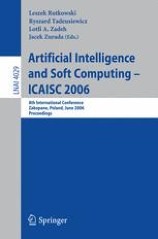
Artificial intelligence and soft computing – ICAISC 2006 ; 8th International Conference, Zakopane, Poland, June 25-29, 2006, Proceedings
This book constitutes the refereed proceedings of the 8th International Conference on Artificial Intelligence and Soft Computing, ICAISC 2006, held in Zakopane, Poland, in June 2006. The 128 revised contributed papers presented are organized in topical sections on neural networks and their applications, fuzzy systems and their applications, evolutionary algorithms and their applications, rough sets, classification and clustering, image analysis and robotics, bioinformatics and medical applications, various problems of artificial intelligence.

Artificial immune systems ; Vol. 4163 : 5th International conference, ICARIS 2006, Oeiras, Portugal, September 4-6, 2006, Proceedings
ICARIS 2006 is the ?fth instance of a series of conferences dedicated to the comprehension and the exploitation of immunological principles through their translation into computational terms.Their axis of research tries to stabilize an on-going identity somewhere in the crossroad of engineering (building useful artifacts), natural sciences (biologyor psychology— improving the comprehension and prediction of natural phenomena) and t- oretical computer sciences (developing and mastering the algorithmic world). Accordingly and depending on which of these perspectives receives more s- port, they attempt at attracting di?erent kinds of scientists and at stimul- ing di?erent kinds of scienti?c attitudes. For many years and in the previous ICARIS conferences, it was clearly the “engineering.

Artificial immune systems ; Vol. 3627 ; 4th International conference, ICARIS 2005, Banff, Alberta, Canada, August 14-17, 2005, Proceedings
Your immune system is unique. It is in many ways as complex as your brain, butit is not centred in one location, like the brain. It is not a single organ—it consistsof many different cell types, diverse methods of intercellular communication, andmany different organs. Its functionality is blurred throughout you—we can’textract the immune system, or point to where it begins and ends. The immunesystem is not separable from the system it protects. It has integral links to everyorgan of our bodies.This has radical implications for the field of Artificial Immune Systems (AIS),that we are only now beginning to comprehend. One of the first insights is thatmodelling the immune system, or developing any kind of immune algorithm, isdifficult. The immune system is one aspect of biology that we find difficult toapply simple reductionist explanations to. We can very successfully extract sub-processes of the whole and create immune algorithms based on those processes.
