



الصفحة 87
الصفحة 87

Artifical intelligence for human computing ; ICMI 2006 and IJCAI 2007 International Workshops, Banff, Canada, November 3, 2006 Hyderabad, India, January 6, 2007 Revised Selceted Papers
This book contains the thoroughly refereed post-proceedings of two events discussing AI for Human Computing.It presented a vision of the future of computing technology in which AI, in particular machine learning and agent technology, plays an essential role.

Articulated Motion and Doformable Objects ; 4th International Conference, AMDO 2006, Port d'Andratx, Mallorca, Spain, July 11-14, 2006, Proceedings
The subject of the conference was ongoing research in articulated motionon a sequence of images and sophisticated models for deformable objects. Thegoals of these areas are to understand and interpret the motion of complexobjects that can be found in sequences of images in the real world. The maintopics considered as priority were: geometric and physical deformable models,motion analysis, articulated models and animation, modelling and visualizationof deformable models, deformable models applications, motion analysis applica-tions, single or multiple human motion analysis and synthesis, face modelling,tracking, recovering and recognition models, virtual and augmentedreality, haptics devices, biometrics techniques.

Articulated motion and deformable objects ; 5th International Conference, AMDO 2008, Port d’Andratx, Mallorca, Spain, July 9-11, 2008. Proceedings
This book constitutes the refereed proceedings of the 5th International Conference on Articulated Motion and Deformable Objects, AMDO 2008, held in Port d'Andratx, Mallorca, Spain, in July 2008.

Argumentation in multi-agent systems ; Vol. 4049 ; 2nd International Workshop, ArgMAS 2005, Utrecht, Netherlands, July 26, 2005, revised selected and invited papers
This book constitutes the thoroughly refereed post-proceedings of the Second International Workshop on Argumentation in Multi-Agent Systems held in Utrecht, Netherlands in July 2005 as an associated event of AAMAS 2005, the main international conference on autonomous agents and multi-agent systems. The 10 revised full papers presented together with an invited paper were carefully reviewed and selected from 17 submissions. The papers are organized in topical sections on foundations, negotiation, protocols, deliberation and coalition formation, and consensus formation.

Argumentation in multi-agent systems ; Vol. 3366 ; 1st International Workshop, ArgMAS 2004, New York, NY, USA, July 19, 2004, revised selected and invited papers
The theory of argumentation is a rich, interdisciplinary area of research lying across philosophy, communication studies, linguistics, and psychology (at least). Its techniques and results have found a wide range of applications in both t- oretical and practical branches of arti'cial intelligence and computer science. Several theories of argumentation with various semantics have been proposed in the literature. Multi-agent systems theory has picked up argument-inspired approaches and speci'cally argumentation-theoretic results from many di'erent areas. The community of researchers in argumentation and multi-agent systems is currently presented with a unique opportunity to integrate the various und- standings of argument into a coherent and core part of the functioning of - tonomouscompu...

Argumentation in multi-agent systems ; Third International Workshop, ArgMAS 2006, Hakodate, Japan, May 8, 2006, revised selected and invited papers
Argumentation provides tools for designing, implementing and analyzing sophisticated forms of interaction among rational agents. It has made a solid contribution to the practice of multiagent dialogues. Application domains include: legal disputes, business negotiation, labor disputes, team formation, scientific inquiry, deliberative democracy, ontology reconciliation, risk analysis, scheduling, and logistics.
Argumentation in multi-agent systems ; 4th International Workshop, ArgMAS 2007, Honolulu, HI, USA, May 15, 2007, revised selected and invited papers
This volume presents the latest developments in the growing area of research at the interface of argumentation theory and multiagent systems. Argumentation provides tools for designing, implementing and analyzing sophisticated forms of interaction among rational agents.
Architecture of advanced numerical analysis systems: designing a scientific computing system using ocaml
Applies the functional OCaml programming language to numerical or computational weighted data science, engineering, and scientific applications. This book is based on the authors' first-hand experience building and maintaining Owl, an OCaml-based numerical computing library. You'll first learn the various components in a modern numerical computation library. Then, you will learn how these components are designed and built up and how to optimize their performance. After reading and using this book, you'll have the knowledge required to design and build real-world complex systems that effectively leverage the advantages of the OCaml functional programming language.

Architecture description languages ; IFIP TC-2 workshop on architecture description languages (WADL), World Computer Congress, Aug. 22-27, 2004, Toulouse, France
These proceedings record the papers presented at the Workshop onArchitecture Description Languages held in the city of Toulouse in thesouth of France.The aim of an ADL (Architecture Description Language) is to formallydescribe software and hardware architectures. Usually, an ADL describescomponents, their interfaces, their structures, their interactions (structureof data flow and control flow) and the mappings to hardware systems. Amajor goal of such descriptions is to allow analysis with respect to severalaspects like timing, safety, reliability, ...

Architecting Systems with Trustworthy Components ; International Seminar, Dagstuhl Castle, Germany, December 12-17, 2004. Revised Selected Papers
This book constitutes the thoroughly refereed post-proceedings of the International Dagstuhl-Seminar on Architecting Systems with Trustworthy Components, held in Dagstuhl Castle, Germany, in December 2004. The 10 revised full papers presented together with 5 invited papers contributed by outstanding researchers were carefully selected and included in the book reflecting ongoing impovement from the seminar. Core problems addressed by the seminar are measurement and normalization of non-functional properties, modular reasoning over non-functional properties, capture of component requirements in interfaces and protocols, interference and synergy of top-down and bottom-up aspects, duality of componentization and architecture, system properties, and opportunities for correctness by construction/static checking.
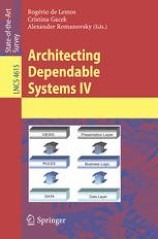
Architecting dependable systems IV
As software systems become ubiquitous, the issues of dependability become more and more crucial. Given that solutions to these issues must be considered from the very beginning of the design process, it is reasonable that dependability is addressed at the architectural level. It also contains sections on architectural description languages, architectural components and patterns, architecting distributed systems, and architectural assurances for dependability.
Arakelov Geometry and Diophantine Applications
Bridging the gap between novice and expert, the aim of this book is to present in a self-contained way a number of striking examples of current diophantine problems to which Arakelov geometry has been or may be applied. Arakelov geometry can be seen as a link between algebraic geometry and diophantine geometry.The first chapters provide some background and introduction to the subject. These are followed by a presentation of different applications to arithmetic geometry. The final part describes the recent application of Arakelov geometry to Shimura varieties and the proof of an averaged version of Colmez's conjecture. This book thus blends initiation to fundamental tools of Arakelov geometry with original material corresponding to current research.
Arabic and Chinese Handwriting Recognition ; SACH 2006 Summit College Park, MD, USA, September 27-28, 2006 Selected Papers
Cheriet provides an overview of the problems of Arabic recognition and how systems can use natural language processing techniques to correct errors in lexicon-based systems.

Arabic AI-generated adverts = إعلانات عربية مولدة بالذكاء الاصطناعي
In the ever-evolving landscape of digital marketing, our groundbreaking platform emerges, harnessing the power of artificial intelligence to revolutionize the creation of marketing campaigns. This innovative solution seamlessly combines neural networks, natural language generation, and multimedia processing capabilities to generate comprehensive and personalized marketing assets from a single product image. At its core, the platform leverages deep learning models that analyze the visual characteristics of the uploaded product image and identifies key features and attributes to define the product category, this enables the generation of compelling and persuasive marketing content tailored to the specific product. The platform's multi-faceted approach encompasses three distinct components: text generation, poster creation, and video advertisement production. Utilizing advanced natural language generation techniques, it crafts engaging marketing text that captures the essence and unique selling points of the product. Simultaneously, its image processing capabilities produce visually stunning promotional posters that blend the product image with eye-catching graphics and typography. along with creating captivating video advertisements optimized for social media and online advertising campaigns.

Approximation and Online Algorithms ; 4th International Workshop, WAOA 2006, Zurich, Switzerland, September 14-15, 2006, Revised Papers
It focuses on the design and analysis of algorithms for online and computationally hard problems. Both kinds of problems have a large number of applications

Applied Parallel Computing ; 6th International Conference, PARA 2002, Espoo, Finland, June 15-18, 2002. Proceeding
These proceedings contain the papers presented at PARA 2002, the Sixth In-ternational Conference on Applied Parallel Computing. PARA 2002 was held inEspoo, Finland, June 15–18, 2002, and hosted by CSC, the Finnish informationtechnology center for science. The general theme of the conference was advancedscientific computing.The conference demonstrated the ability of advanced scientific computing tosolve real-world problems, and highlighted methods, instruments, and trends infuture scientific computing. The conference began with a one-day tutorial sessionon Grid programming.The conference focused on an application-oriented, multi-disciplinary, andmulti-scale approach. A wide variety of scientific computing applications wereintroduced, from semiconductor processing and behavior of the human body tooceanic and atmospheric phenomena.

Applied Informatics; Third International Conference, ICAI 2020, Ota, Nigeria, October 29–31, 2020, Proceedings
This book constitutes the thoroughly refereed papers of the Second International Conference on Applied Informatics, ICAI 2020, held in Ota, Nigeria, in October 2020. The 35 full papers were carefully reviewed and selected from 101 submissions. The papers are organized in topical sections on artificial intelligence; business process management; cloud computing; data analysis; decision systems; health care information systems; human-computer interaction; image processing; learning management systems; software design engineering.
Applied Deep Learning with TensorFlow 2 : Learn to Implement Advanced Deep Learning Techniques with Python
Focuses on the fundamental concepts and at the same time on practical aspects of implementing neural networks and deep learning for your research projects. This book is designed so that you can focus on the parts you are interested in. You will explore topics as regularization, optimizers, optimization, metric analysis, and hyper-parameter tuning. In addition, you will learn the fundamentals ideas behind autoencoders and generative adversarial networks. All the code presented in the book will be available in the form of Jupyter notebooks which would allow you to try out all examples and extend them in interesting ways. A companion online book is available with the complete code for all examples discussed in the book and additional material more related to TensorFlow and Keras. All the code will be available in Jupyter notebook format and can be opened directly in Google Colab (no need to install anything locally) or downloaded on your own machine and tested locally. You will: Understand the fundamental concepts of how neural networks work / Learn the fundamental ideas behind autoencoders and generative adversarial networks / Be able to try all the examples with complete code examples that you can expand for your own projects / Have available a complete online companion book with examples and tutorials.

Applied cryptography and network security ; Vol. 3989 : 4th International Conference, ACNS 2006, Singapore, June 6-9, 2006, Proceedings
The 4th International Conference on Applied Cryptography and Network Security(ACNS 2006)washeldin Singapore,during June6-9,2006.ACNS 2006 brought together individuals from academia and industry involved in multiple research disciplines of cryptography and security to foster exchange of ideas. This volume (LNCS 3989) contains papers presented in the academic track. ACNS was set a high standard when it was initiated in 2003. There has been a steady improvement in the quality of its program in the past 4 years: ACNS 2003 (Kunming, China), ACNS 2004 (Yellow Mountain, China), ACNS 2005 (New York, USA), ACNS 2006 (Singapore). The average acc- tance rate is kept at around 16%. We wish to receive the continued support from the community of cryptographyand security worldwide to further improve its quality and make ACNS one of the leading conferences.
Applied cryptography and network security ; 6th International Conference, ACNS 2008, New York, NY, USA, June 3-6, 2008. Proceedings
This book constitutes the refereed proceedings of the 6th International Conference on Applied Cryptography and Network Security, ACNS 2008, held in New York, NY, USA, in June 2008.
