



الصفحة 81
الصفحة 81

Critical Infrastructure Protection
This book is dedicated to advancing research, development and implementation efforts focused on infrastructure protection.

Critical Information Infrastructures : Resilience and Protection
Starting with some basic definitions and assumptions on the topic, this book explores various aspects of Critical Infrastructures throughout the world – including the technological, political, economic, strategic and defensive. This book will be of interest to the CEO and Academic alike as they grapple with how to prepare Critical Information Infrastructures for new challenges.

Critical Information Infrastructured Security ; 1st International Workshop, CRITIS 2006, Samos Island, Greece, August 31 - September 1, 2006
This volume contains the proceedings of the 1st International Workshop on Critical Information Infrastructure Security (CRITIS 2006), that was held between August 31 and September 1, 2006 on Samos, Greece, and was hosted by the University of the Aegean, Department of Information and Communication Systems Engineering, Laboratory of Information and Communication Systems Security (Info-Sec-Lab). In response to the CRITIS 2006 call for papers, 57 papers were submitted.

Crime detection camera
This paper presents a comprehensive crime detection system that uses a combination of hardware and software to monitor homes and communities in real time. The system consists of a Raspberry Pi 4B, a Raspberry Pi Camera V2, a flame sensor, an MQ-6 gas sensor, and a microphone, which are all connected to a database management system powered by MySQL. The data collected from these devices is analyzed by machine learning algorithms to detect crimes, such as theft or robbery, as well as fires and gas leaks. The system also includes a mobile app, ‘Safe Home’ which provides live video monitoring and real-time notifications to users, and an employee dashboard to monitor all statistics and manage all implemented systems.

Creative applications of artificial intelligence in education
Explores the synergy between AI and education, highlighting its potential impact on pedagogical practices. It navigates the evolving landscape of AI-powered educational technologies and suggests practical ways to personalise instruction, nurture human-AI co-creativity, and transform the learning experience. Spanning from primary to higher education, this short and engaging volume proposes concrete examples of how educational stakeholders can be empowered in their AI literacy to foster creativity, inspire critical thinking, and promote problem-solving by embracing AI as a tool for expansive learning. Structured in three parts, the book starts developing the creative engagement perspective for learning and teaching to then present practical applications of AI in K-12 and higher education, covering different fields (teacher education, professional education, business education) as well as different types of AI supported tools (games, chatbots, and AI assisted assessment).

Creating Web-based Laboratories
Remote web-based experimentation, enabling students and researchers to access the laboratory anytime via the Internet, is becoming an increasingly attractive way to complement or even replace traditional laboratory sessions. Placing a video camera & microphone before the equipment and apparatus to capture what is actually happening in the laboratory allows the images and audio data to be streamed to the client side. Researchers in different countries can share equipment and conduct research cooperatively and remotely. The authors summarise their research and discuss the development of the 5 web-based laboratories launched from the National University of Singapore. The principles, structure, and technologies required for the creation of Internet remote experimentation systems are discussed with particular emphasis on the integration of hardware and software systems. Also highlighted is the design and development of interfaces and components for use in typical web-based laboratories or similar web-control applications.

Creating New Learning Experiences on a Global Scale ; 2nd European Conference on Technology Enhanced Learning, EC-TEL 2007, Crete, Greece, September 17-20, 2007, Proceedings
It is holding more than 500 pages of combined wisdom on Technology Enhanced Learning (TEL) in your hands! With the advance of metadata, standards, learning objects, Web 2. 0 approaches to rip, mix and burn learning, wikis, blogs, syndication, user-generated content, W- based video, games and the ubiquitous availability of computing devices we can and have to offer more flexible learning services on a global scale.It provided a unique forum for all research related to technology enhanced learning, including its interactions with knowledge management, business processes and work environments.

Creating Mobile Games : Using Java™ ME Platform to Put the Fun into Your Mobile Device and Cell Phone
Creating Mobile Games: shows you how to create a basic game and make it a professional one (by adding a pro look-and-feel by writing your own menus or using the open source J2ME Polish, and enabling marketing/billing from your own web site). Demonstrates Wireless Messaging and other optional APIs (using SMS, PIM, File Connection, Bluetooth, and so forth in a multiplayer game).

Creating Flash Widgets with Flash CS4 and ActionScript 3.0
Creating Flash Widgets with Flash CS4 and ActionScript 3.0 is an introduction to developing widgets for the Internet using the features of Flash CS4 and ActionScript 3.0. Many social-networking sites, blogs, and personal home pages have adopted the use of widgets and Flash developers can create and distribute their own widgets for others to use. A step-by-step example demonstrates how to design and develop your own Flash widgets and integrate them with XML. In addition, publishing, promoting, and capitalizing on your Flash widgets is discussed.
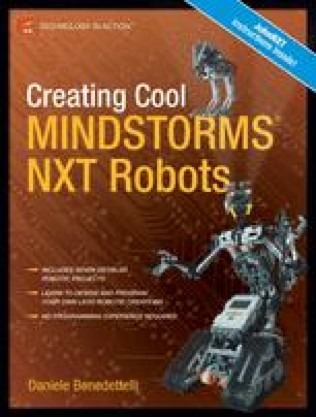
Creating Cool MINDSTORMS® NXT Robots
Build and program MINDSTORM NXT robots with Daniele Benedettelli, one of the world's most respected NXT robot builders. He shows you how to build and program them from scratch, starting with the simplest robots and progressing in difficulty to a total of seven award–winning robots! You can download all the code, along with low–resolution videos that show how your robot works when it's finished. You don't need to be a programmer to develop these cool robots, because all the code is provided, but advanced developers will enjoy seeing the secrets of Benedettelli's code and techniques revealed.

Creating Client Extranets with SharePoint 2003
Creating Client Extranets with SharePoint 2003 is a guide for creating client-facing extranets using SharePoint 2003. This book serves as a how-to for building full-featured extranets using SharePoint 2003 and .NET technologies. If you already have experience developing and deploying business applications in .NET, then this book will help you master the intricacies of SharePoint 2003 development and customization. This is the only book of its kind—one designed to help you build a functioning client extranet from start to finish, avoiding many inherent traps in SharePoint development. It contains numerous valuable tips, tricks, and traps. And it offers various working code samples to help you get up to speed quickly using the SharePoint object model and Web Services. It uniquely focuses on SharePoint as a corporate development platform, while other books tend to focus only on end-user features.

CPU Design : Answers to Frequently Asked Questions
Chandra’s book provides a practical overview of Microprocessor and high end ASIC design as practiced today. It is a valuable addition to the literature on CPU design, and is made possible by Chandra’s unique combination of extensive hands-on CPU design experience at companies such as AMD and Sun Microsystems and a passion for writing

Covid-19 tracking application with user helping features
The era of mobile technology opens the windows to the mobile apps. The websites are vanishing and the mobile phones are emerging. In light of the development of applications on mobile and their widespread spread, especially Service (SOA) ones. It’s the time to change from conventional websites to apps, which has become the part of our daily routine. We are introducing “Covid 19 Tracker” “Covid 19 Tracker” is an interactive App used to assist the Ministry of Health to provide protection and health care for citizens and residents referred to domestic isolation or quarantine; to ensure their safety and enhance their recovery procedures.

Countering Counterfeit Trade : Illicit Market Insights, Best-Practice Strategies, and Management Toolbox
The book constitutes a unique combination of in-depth insights into the counterfeit market, best-practice strategies, novel management tools, and product protection technologies.
COTS-Based software systems ; 4th International Conference, ICCBSS 2005, Bilbao, Spain, February 7-11, 2005, Proceedings
The theme “Build and Conquer” : software development is an engineering discipline, and not an artistic expression. Once we are ready to “build” our software systems using pieces previously builtin (similar to any other technology manufacturer), we will be able to “conquer” the software engineering process. If we take a look at other engineering disciplines such as car manufacturing, house appliances or aeronautics, we see that the final products are built through the integration of multiprovider commercial components. These components are successfully integrated and constitute an important part of the final product. Most software-related organizations still build software from scratch, omitting thousands of ready-built commercially available software components that could be used very effectively during the development phase. This year ICCBSS moves to Europe for the first time since the first conference took place in Orlando, FL, USA in 2002. The conference scope has enlarged over the years to include the Open Source community and Web Services technologies. so many of the characteristics of COTS are also applied to Open Source and Web Services.

Cost-Based Oracle Fundamentals
In Cost-Based Oracle Fundamentals, the first book in a series of three, Jonathan Lewis—one of the foremost authorities in this field—describes the most commonly used parts of the model, what the optimizer does with your statistics, and why things go wrong. With this information, you'll be in a position to fix entire problem areas, not just single SQL statements, by adjusting the model or creating more truthful statistics.

Correct hardware design and verification methods
Constitutes the refereed proceedings of the 13th IFIP WG 10.5 Advanced Research Working Conference on Correct Hardware Design and Verification Methods, CHARME 2005, held in Saarbrucken, Germany, in October 2005.

Core Java ; Vol. I : Fundamentals ; 12th ed.
The definitive guide to writing robust, maintainable code. Whatever version of Java you are using—up to and including Java 17—this book will help you achieve a deep and practical understanding of the language and APIs. With hundreds of realistic examples, Cay S. Horstmann reveals the most powerful and effective ways to get the job done.

Coordination, organizations, institutions, and norms in agent systems II ; AAMAS 2006 and ECAI 2006 International Workshops, COIN 2006 Hakodate, Japan, May 9, 2006 Riva del Garda, Italy, August 28, 2006, Revised Selected Papers
In recent years, social and organizational aspects of agency have become major research topics in MAS. Recent applications of MAS on Web services, grid c- puting and ubiquitous computing highlight the need for using these aspects in order to ensure social order within such environments. Openness, heterogeneity, and scalability of MAS, in turn, pose new demands on traditional MAS int- action models and bring forward the need to look into the environment where agents interact and at di?erent ways of constraining or regulating interactions.it provide theoretically demanding and interdisciplinary research questions at d- ferent levels of abstraction.

Coordination, organizations, institutions, and norms in agent system III ; COIN 2007 International Workshops COIN@AAMAS 2007, Honolulu, HI, USA, May 14, 2007 COIN@MALLOW 2007, Durham, UK, September 3-4, 2007 Revised Selected Papers
This book constitutes the refereed post-workshop proceedings of the International Workshop on Coordination, Organization, Institutions and Norms in Agent Systems, COIN 2007.
