



الصفحة 80
الصفحة 80
Adaptive Multimedial Retrieval : Retrieval, User, and Semantics ; 5th International Workshop, AMR 2007, Paris, France, July 5-6, 2007 Revised Selected Papers
This book constitutes the thoroughly refereed post-workshop proceedings of the 5th International Workshop on Adaptive Multimedia Retrieval, AMR 2007, held in Paris, France, in July 2007.
Adaptive Multimedia Retrieval : User, Context, and Feedback ; Third International Workshop, AMR 2005, Glasgow, UK, July 28-29, 2005, Revised Selected Papers
This book is an extended collection of revised contributions that were initially submitted to the International Workshop on Adaptive Multimedia Retrieval (AMR 2005). This workshop was organized during July 28-29, 2005, at the U- versity of Glasgow, UK, as part of an information retrieval research festival and in co-location with the 19th International Joint Conference on Arti?cial Int- ligence (IJCAI 2005). AMR 2005 was the third and so far the biggest event of the series of workshops that started in 2003 with a workshop during the 26th German Conference on Arti?cial Intelligence (KI 2003) and continued in 2004 as part of the 16th European Conference on Arti?cial Intelligence (ECAI 2004).
Adaptive Multimedia Retrieval : User, Context, and Feedback ; 4th International Workshop, AMR 2006, Geneva, Switzerland, July, 27-28, 2006, Revised Selected Papers
This book constitutes the thoroughly refereed post-proceedings of the 4th International Workshop on Adaptive Multimedia Retrieval, AMR 2006, held in Geneva, Switzerland in July 2006. this book provides a good and conclusive overview of the current research in the area of adaptive information retrieval.

Adaptive and Natural Computing Algorithms ; 8th International Conference, ICANNGA 2007, Warsaw, Poland, April 11-14, 2007, Proceedings, Part II
The ICANNGA series of conferences has been organized since 1993 and has a long history of promoting the principles and understanding of computational intelligence paradigms within the scientifc community. the ICANNGA series has established itself as a reference for scientists and practitioners in this area. The series has also been of value to young researchers wishing both to extend their knowledge and experience and to meet experienced professionals in their ?elds. In a rapidly advancing world, where technology and engineering change d- matically, new challenges in computer science compel us to broaden the c- ference scope in order to take into account new developments.
Adaptive and Natural Computing Algorithms ; 8th International Conference, ICANNGA 2007, Warsaw, Poland, April 11-14, 2007, Proceedings, Part I
Constitutes the refereed proceedings of the 8th International Conference on Adaptive and Natural Computing Algorithms, ICANNGA 2007, held in Warsaw, Poland, in April 2007. The 178 revised full papers presented were carefully reviewed and selected from a total of 474 submissions. The 94 papers of the first volume are organized in topical sections on evolutionary computation, genetic algorithms, particle swarm optimization, learning, optimization and games, fuzzy and rough systems, just as classification and clustering. The second volume contains 84 contributions related to neural networks, support vector machines, biomedical signal and image processing, biometrics, computer vision, as well as to control and robotics.
Adaptive agents and multi-agent systems II : Adaptation and multi-agent learning
Adaptive agents and multi-agent systems is an emerging and exciting interdisciplinary area of research and development involving artificial intelligence, software engineering, and developmental biology, as well as cognitive and social science. This book presents 17 revised and carefully reviewed papers taken from two workshops on the topic as well as 2 invited papers by leading researchers in the area. The papers deal with various aspects of machine learning, adaptation, and evolution in the context of agent systems and autonomous agents.

Adapting Proofs-as-Programs : The Curry--Howard Protocol
This book nuds new things to do with an old idea. The proofs-as-programs paradigm constitutes a set of approaches to developing programs from proofs in constructive logic. there is increasingly active research in applying constructive techniques to industrial-scale, complex software engineering problems. Thismonographdetailsseveralimportantadvancesinthisdirectionofpr- tical proofs-as-programs. One of the central themes of the book is a general, abstract framework for developing new systems of program synthesis by adapting proofs-as-programs to new contexts. Framework-oriented approaches that facilitate analogous - proaches to building systems for solving particular problems have been popular and successful. Thesemethodsarehelpful asthey providea formal toolbox that enablesa“roll-your-own”approachtodevelopingsolutions.Itishopedthatour framework will have a similar impact. The framework is demonstrated by example. We will give two novel - plications of proofs-as-programs to large-scale, coarse-grain software engine- ing problems: contractual imperative program synthesis and structured p- gram synthesis.
Active Networks : IFIP TC6 6th International Working Conference, IWAN 2004, Lawrence, KS, USA, October 27-29, 2004, Revised Papers
The proceedings of the sixth Annual International Working Conference on Active Networks, which took place in October 2004 at The Information and Telecommunications Technology Center, The University of Kansas, USA. The proceedings of IWAN 2004 mark a transition between the funded active networking programs in Europe, Japan, and the United States and a strong, continued interest in the architectures of programmable networks.The papers are organized into sections on active network systems and architectures, security in active networking, active network applications, mobile active networks and active network management.
Active Knowledge Modeling of Enterprises
An AKM solution is about exploiting the Web as a knowledge engineering medium, and developing knowledge-model-based families of platforms, model-configured workplaces and services.
Active Conceptual Modeling of Learning : Next Generation Learning-Base System Development
This volume contains a collection of the papers presented during the 1st International ACM-L Workshop, which was held on November 8, 2006 during the 25th International Conference on Conceptual Modeling, ER 2006, held November 6–9,2006, in Tucson, Arizona, plus several invited papers.These papers plus the invited papers represent the current thinking in conceptual modeling research, The active model can only be realized through technology integration (e.g., AI, software engineering, information technology,cognitive science, art and sciences, philosophy, etc.)
Action Research in Software Engineering: Theory and Applications
This book addresses action research (AR), one of the main research methodologies used for academia-industry research collaborations. It elaborates on how to find the right research activities and how to distinguish them from non-significant ones. Further, it details how to glean lessons from the research results, no matter whether they are positive or negative. Lastly, it shows how companies can evolve and build talents while expanding their product portfolio.

Achievements in European Research on Grid Systems ; CoreGRID Integration Workshop 2006 (Selected Papers)
Achievements in European Research on Grid Systems comprises the edited proceedings of the 2006 CoreGRID Integration Workshop (CGIW'2006), held October 2006 in Krakow, Poland.
Access Control Models and Architectures For IoT and Cyber Physical Systems
Presents cybersecurity aspects of ubiquitous and growing IoT and Cyber Physical Systems. It also introduces a range of conceptual, theoretical, and foundational access control solutions. This was developed by the authors to provide an overall broader perspective and grounded approach to solve access control problems in IoT and CPS.

Accelerator Programming Using Directives ; 6th International Workshop, WACCPD 2019, Denver, CO, USA, November 18, 2019, Revised Selected Papers
This book constitutes the refereed post-conference proceedings of the 6th International Workshop on Accelerator Programming Using Directives, WACCPD 2019, held in Denver, CO, USA, in November 2019. The 7 full papers presented have been carefully reviewed and selected from 13 submissions. The papers share knowledge and experiences to program emerging complex parallel computing systems. They are organized in the following three sections: porting scientific applications to heterogeneous architectures using directives; directive-based programming for math libraries; and performance portability for heterogeneous architectures.
Accelerated GWT : Building Enterprise Google Web Toolkit Applications
Ajax is a web development technique that takes advantage of JavaScript to display and interact dynamically with information embedded into a web page. Its emergence has made it possible to create web applications that closely resemble their desktop–based brethren. With this exciting new ability came several challenges; not only did developers have to learn JavaScript, but they were also forced to use inefficient development processes, not to mention deal with cross–platform and browser difficulties. But with the release of Google Web Toolkit (GWT), Java developers are able to continue using their favorite language to write powerful Ajax applications while using not only the Java language, but also the very same development tools they're already using on a daily basis!
Abstract Computing Machines : A Lambda Calculus Perspective
The book addresses ways and means of organizing computations, highlighting the relationship between algorithms and the basic mechanisms and runtime structures necessary to execute them using machines. It completely abstracts from concrete programming languages and machine architectures, taking instead the lambda calculus as the basic programming and program execution model to design various abstract machines for its correct implementation. The emphasis is on fully normalizing machines based on full-fledged beta-reductions as essential prerequisites for symbolic computations that treat functions and variables truly as first-class objects. Their weakly normalizing counterparts are shown to be functional abstract machines that sacrifice the flavors of full beta-reductions for decidedly simpler runtime structures and improved runtime efficiency. Further downgrading of the lambda calculus leads to classical imperative machines that permit side-effecting operations on the runtime environment.
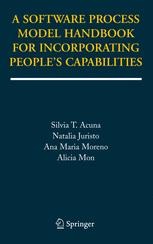
A software process model handbook for incorporating peoples capabilities
Offers the most advanced approach to date, empirically validated at software development organizations. This handbook adds a valuable contribution to the much-needed literature on people-related aspects in software engineering. The primary focus is on the particular challenge of extending software process definitions to more explicitly address people-related considerations. The capability concept is not present nor has it been considered in most software process models. The authors have developed a capabilities-oriented software process model, which has been formalized in UML and implemented as a tool. A Software Process Model Handbook for Incorporating People's Capabilities guides readers through the incorporation of the individual’s capabilities into the software process. Structured to meet the needs of research scientists and graduate-level students in computer science and engineering, A Software Process Model Handbook for Incorporating People's Capabilities is also suitable for practitioners in industry.
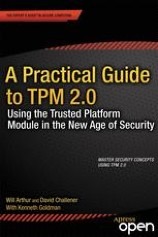
A Practical Guide to TPM 2.0 : Using the New Trusted Platform Module in the New Age of Security
A Practical Guide to TPM 2.0: Using the Trusted Platform Module in the New Age of Security is a straight-forward primer for developers. It shows security and TPM concepts, demonstrating their use in real applications that the reader can try out. Simply put, this book is designed to empower and excite the programming community to go out and do cool things with the TPM. The approach is to ramp the reader up quickly and keep their interest.A Practical Guide to TPM 2.0: Using the Trusted Platform Module in the New Age of Security explains security concepts, describes the TPM 2.0 architecture, and provides code and pseudo-code examples in parallel, from very simple concepts and code to highly complex concepts and pseudo-code.
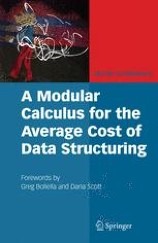
A Modular Calculus for the Average Cost of Data Structuring
This volume, with forewords by Greg Bollella and Dana Scott, presents novel programs based on the new advances in this area, including the first randomness-preserving version of Heapsort. Programs are provided, along with derivations of their average-case time, to illustrate the radically different approach to average-case timing. The automated static timing tool applies the Modular Calculus to extract the average-case running time of programs directly from their MOQA code.
A Guide to Graph Algorithms
Offers high-quality content in the research area of graph algorithms and explores the latest developments in graph algorithmics. The reader will gain a comprehensive understanding of how to use algorithms to explore graphs. It is a collection of texts that have proved to be trend setters and good examples of that. The book aims at providing the reader with a deep understanding of the structural properties of graphs that are useful for the design of efficient algorithms. These algorithms have applications in finite state machine modelling, social network theory, biology, and mathematics. The book contains many exercises, some up at present-day research-level. The exercises encourage the reader to discover new techniques by putting things in a clear perspective.
