



الصفحة 8
الصفحة 8
Intelligent Computing ; Proceedings of the 2021 Computing Conference ; Vol.1
This book is a comprehensive collection of chapters focusing on the core areas of computing and their further applications in the real world. Each chapter is a paper presented at the Computing Conference 2021 held on 15-16 July 2021. Computing 2021 attracted a total of 638 submissions which underwent a double-blind peer review process. Of those 638 submissions, 235 submissions have been selected to be included in this book. The goal of this conference is to give a platform to researchers with fundamental contributions and to be a premier venue for academic and industry practitioners to share new ideas and development experiences.

Intelligence and Security Informatics ; Vol. 3975 ; IEEE International Conference on Intelligence and Security Informatics, ISI 2006, San Diego, CA, USA, May 23-24, 2006.
In the past few years, intelligence and security informatics (ISI) research, which is concerned with the study of the development and use of advanced information te- nologies and systems for national and international security-related applications, has experienced tremendous growth and attracted substantial interest from academic - searchers in related fields as well as practitioners from both government agencies and industry. The ISI community is maturing, and a core set of research methodologies and technical approaches has emerged and is becoming the underpinning of ISI research.

Intelligence and Security Informatics ; Vol. 3917 ; International Workshop, WISI 2006, Singapore, April 9, 2006, Proceedings
Intelligence and security informatics (ISI) can be broadly defined as the study of the development and use of advanced information technologies and systems for national and international security-related applications. The First and Second Symposiums on ISI were held in Tucson, Arizona, in 2003 and 2004, respectively. In 2005, the IEEE International Conference on ISI was held in Atlanta, Georgia. These ISI conferences brought together academic researchers, law enforcement and intelligence experts, information technology consultants and practitioners to discuss their research and practice related to various ISI topics including ISI data management, data and text mining for ISI applications, terrorism informatics, deception detection, terrorist and criminal social network analysis, crime analysis, monitoring and surveillance, policy studies and evaluation, and information assurance, among others. We continued these stream of ISI conferences by organizing the Workshop on Intelligence and Security Informatics (WISI 2006) in conjunction with the Pacific Asia Conference on Knowledge Discovery and Data Mining (PAKDD 2006).

Intelligence and security informatics ; Vol. 3495 : IEEE International Conference on Intelligence and Security Informatics, ISI 2005, Atlanta, GA, USA, May 19-20, 2005, Proceedings
Intelligence and security informatics (ISI) can be broadly defined as the study of the development and use of advanced information technologies and systems for national and international security-related applications, through an integrated technological, organizational, and policy-based approach. In the past few years, ISI research has experienced tremendous growth and attracted substantial interest from academic researchers in related fields as well as practitioners from both government agencies and industry. The first two meetings (ISI 2003 and ISI 2004) in the ISI symposium and conference series were held in Tucson, Arizona, in 2003 and 2004, respectively. They provided a stimulating intellectual forum for discussion among previously disparate communities: academic researchers in information technologies, computer science, public policy, and social studies; local, state, and federal law enforcement and intelligence experts; and information technology industry consultants and practitioners.

Integration of AI and OR Techniques in Constraint Programming for Combinatorial Optimization Problems ; 5th International Conference, CPAIOR 2008 Paris, France, May 20-23, 2008 Proceedings
The 5th International Conference on Integration of AI and OR Techniques in Constraint Programming for Combinatorial Optimization Problems (CPAIOR 2008) was held in Paris, France May 20–23, 2008. The purpose of this conference series is to bring together researchers in the felds of constraint programming, artifcial intelligence, and operations research to explore ways of solving large-scale, practical optimization problems through integration and hybridization of the felds’ diferent techniques. Through the years, this research community is discovering that the felds have much in c- mon, and there has been tremendous richness in the resulting cross-fertilization of felds.

Integrating Data Science and Earth Science : Challenges and Solutions
This book presents the results of three years collaboration between earth scientists and data scientist, in developing and applying data science methods for scientific discovery. The book will be highly beneficial for other researchers at senior and graduate level, interested in applying visual data exploration, computational approaches and scientifc workflows.

Integrated Science in Digital Age ; ICIS 2019
The ICIS 2019 received roughly 50 contributions, by authors hailing from six countries. Following a peer-review process, the Scientific Committee – a multidisciplinary group of 110 experts from 38 countries around the globe – selected roughly 60% for publication. The main topics covered include: Artificial Intelligence Research; Digital Business & Finance; Educational Sciences; Health Management Informatics; Public Administration in the Digital Age; and Social Problem-solving.

Integrated Graphic and Computer Modelling
Full colour throughout, the book explores programming language developments from machine code to more natural language forms, and the basic display operations and commands needed to create effective computer graphic systems. As the visual presentation of real and virtual environments becomes more and more the norm in application systems, a clear understanding of the theory that underpins these techniques is required of all students and practitioners studying and working on large computer systems.

Integrated formal methods ; 3rd International Conference, IFM 2002, Turku, Finland, May 15-18, 2002. Proceedings.
IFM 2002 explored the relations between formal methods and graphical notations, especially the industrial standard language for software design, the Unified Modeling Language (UML). The themes of IFM 2002 reflect what we believe is a growing trend in the Formal Methods and Software Engineering research communities. Over the last threedecades,computer scientists have developed a range of formalisms focusing on particular aspects of behavior or analysis, such as sequential program structures, concurrent program structures, data and information structures, temporal reasoning, deductive proof, and model checking. Much effort is now being devoted to integrating these methods in order to combine their advantages and ensure they scale up to industrial needs. Graphical notations are now widely used in software engineering and there is growing recognition of the importance of providing these with the for mal underpinnings and form alanalysis capabilities found in formal methods.
Integrated Circuit and System Design. Power and Timing Modeling, Optimization and Simulation ; Vol. 4148 ; 16th International Workshop, PATMOS 2006, Montpellier, France, September 13-15, 2006, Proceedings
Welcome to the proceedings of PATMOS 2006, the 16th in a series of international workshops. PATMOS 2006 was organized by LIRMM with CAS technical - sponsorship and CEDA sponsorship. Over the years, the PATMOS workshop has evolved into an important European event, where researchers from both industry and academia discuss and investigate the emerging challenges in future and contemporary applications, design methodologies, and tools required for the development of upcoming generations of integrated circuits and systems. The technical program of PATMOS 2006 contained state-of-the-art technical contributions, three invited talks, a special session on hearing-aid design, and an embedded tutorial. The technical program focused on timing, performance and power consumption, as well as architectural aspects with particular emphasis on modeling, design, characterization, analysis and optimization in the nanometer era. The Technical Program Committee, with the assistance of additional expert reviewers, selected the 64 papers presented at PATMOS. The papers were organized into 11 technical sessions and 3 poster sessions. As is always the case with the PATMOS workshops, full papers were required, and several reviews were received per manuscript.
Integrated Circuit and System Design. Power and Timing Modeling, Optimization and Simulation ; Vol. 3728 ; 15th International Workshop, PATMOS 2005, Leuven, Belgium, September 21-23, 2005, Proceedings
Welcome to the proceedings of PATMOS 2005, the 15th in a series of international workshops.PATMOS2005wasorganizedbyIMECwithtechnicalco-sponsorshipfrom the IEEE Circuits and Systems Society. Over the years, PATMOS has evolved into an important European event, where - searchers from both industry and academia discuss and investigate the emerging ch- lenges in future and contemporary applications, design methodologies, and tools - quired for the developmentof upcominggenerationsof integrated circuits and systems. The technical program of PATMOS 2005 contained state-of-the-art technical contri- tions, three invited talks, a special session on hearing-aid design, and an embedded - torial. The technical program focused on timing, performance and power consumption, as well as architectural aspects with particular emphasis on modeling, design, char- terization, analysis and optimization in the nanometer era. The Technical Program Committee, with the assistance of additional expert revi- ers, selected the 74 papers to be presented at PATMOS. The papers were divided into 11 technical sessions and 3 poster sessions. As is always the case with the PATMOS workshops, the review process was anonymous, full papers were required, and several reviews were carried out per paper. Beyond the presentations of the papers, the PATMOS technical program was - riched by a series of speeches offered by world class experts, on important emerging research issues of industrial relevance. Prof. Jan Rabaey, Berkeley, USA, gave a talk on “Traveling the Wild Frontier of Ulta Low-Power Design”, Dr. Sung Bae Park, S- sung, gave a presentation on “DVL (Deep Low Voltage): Circuits and Devices”, Prof.

Integer Programming and Combinatorial Optimization ; 11th International IPCO Conference, Berlin, Germany, June 8-10, 2005, Proceedings
Since its start in 1990, the IPCO conference series (held under the auspices of theMathematicalProgrammingSociety)hasbecomeanimportantforumforthe presentation of recent results in Integer Programming and Combinatorial Op- mization. This volume compiles the papers presented at IPCO XI, the eleventh conference in this series, held June 8–10, 2005, at the Technische Universit¨ at Berlin. The high interest in this conference series is evident in the large number of submissions. For IPCO XI, 119 extended abstracts of up to 10 pages were submitted. During its meeting on January 29–30, 2005, the Program Committee carefully selected 34 contributions for presentation in non-parallel sessions at the conference. The ?nal choices were not easy at all, since, due to the limited number of time slots, many very good papers could not be accepted. During the selection process the contributions were refereed according to the standards of refereed conferences. As a result of this procedure, you have in your hands a volume that contains papers describing high-quality research e?orts. The page limit for contributions to this proceedings volume was set to 15. You may ?nd full versions of the papers in scienti?c journals in the near future. We thank all the authors who submitted papers. Furthermore, the Program Committee is indebted to the many reviewers who, with their speci?c expertise, helped a lot in making the decisions.

Instrumaster
Experiments with different neural network structures and algorithms in order to achieve musical note recognition as well as musical instrument recognition, all bundled in a mobile application. It also aims to create the most effective music-learning application that works completely offline, which is hard to find in modern music applications. The paper also explores why the instrument identifying AI is solely based on Multi-Layer Perceptron (MLP) and why the note-identifying AI system was chosen to be a ML system over CNN or other deep-learning trained AI. The paper presents feature extraction methods for audio signals and files and dives deep into the process, such as FFT, MFCCs, Wavelengths, sampling rates, etc. It also touches on Logistic Regression Algorithms, their limitations, and their performance with the different use cases in the application. All these techniques are then compared side by side for maximally added value, making this research paper a good reference for any future developers looking to find optimal neural networks techniques when it comes to audio processing and analysis.

Inside deep learning : Math, algorithms, models
Journey through the theory and practice of modern deep learning, and apply innovative techniques to solve everyday data problems. In Inside Deep Learning, you will learn how to: Implement deep learning with PyTorch Select the right deep learning components Train and evaluate a deep learning model Fine tune deep learning models to maximize performance Understand deep learning terminology Adapt existing PyTorch code to solve new problems Inside Deep Learning is an accessible guide to implementing deep learning with the PyTorch framework. It demystifies complex deep learning concepts and teaches you to understand the vocabulary of deep learning so you can keep pace in a rapidly evolving field. No detail is skipped--you'll dive into math, theory, and practical applications. Everything is clearly explained in plain English.
Innovative Internet Community Systems ; Vol. 3908 ; 5th International Workshop, IICS 2005, Paris, France, June 20-22, 2005. Revised Papers
Traditionally, there are topics discussed in three main aspects. All of them must be considered in a united manner in order to investigate and understand the emergence and evolution of communities in the Internet: knowledge about networking, content and text processing as well as theory. The goal of the I2CS workshop is to bring researchers from both industry and academic fields together to discuss current progress and future developments in these areas and to eliminate the gap between theory and application. At this point, we want to express immense gratitude to all the authors of the submitted papers and to the members of the international Program Committee for their contribution to the success of the event and a program of high quality. In a peer-to-peer review process, 17 papers were selected out of 27 submissions.
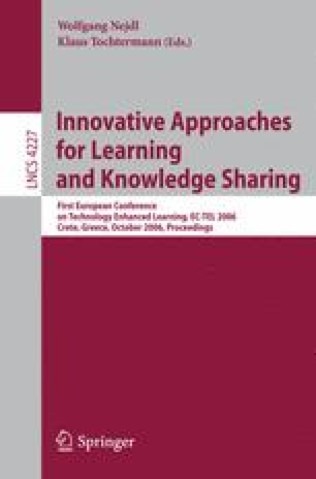
Innovative approaches for learning and knowledge sharing ; 1st European Conference on Technology Enhanced Learning, EC-TEL 2006, Crete, Greece, October 1-4, 2006, Proceedings
This book constitutes the refereed proceedings of the First European Conference on Technology Enhanced Learning, EiTEL 2006, held in Crete, Greece in October 2006. The 32 revised full papers, 13 revised short papers and 31 poster papers presented together with 2 keynote talks were carefully reviewed and selected from 192 submissions. The conference provides a unique forum for all research related to technology-enhanced learning, as well as its interactions with knowledge management, business processes and work environments. Topics addressed are collaborative learning, personalized learning, multimedia content, semantic web, metadata and learning, workplace learning, learning repositories and infrastructures for learning, as well as experience reports, assesment, and case studies.
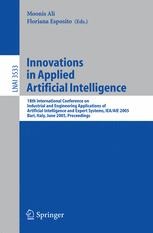
Innovations in Applied Artificial Intelligence ; 18th International Conference on Industrial and Engineering Applications of Artificial Intelligence and Expert Systems, IEA/AIE 2005, Bari, Italy, June 22-24, 2005, Proceedings
The contributions oriented to the technological aspects of AI and the quality of the papers are witness to a research activity clearly aimed at consolidating the theoretical results that have already been achieved. The c- ference program also included two invited lectures, by Katharina Morik and Roberto Pieraccini. Many people contributed in different ways to the success of the conference and to this volume. The authors who continue to show their enthusiastic interest in applied intelligence research are a very important part of our success. We highly appreciate the contribution of the members of the Program Committee, as well as others who reviewed all the submitted papers with eficiency and dedication.

Information Systems Security ; Vol. 3803 : 1st International conference, ICISS 2005, Kolkata, India, December 19-21, 2005, Proceedings
The 1st InternationalConference on Information Systems Security (ICISS 2005) was held December 19–21, 2005 at Jadavpur University, Kolkata, India. The objectives of the conference were to discuss in depth the current state of the research and practice in information systems security, enable participants to bene?tfrompersonalcontactwithotherresearchersandexpandtheirknowledge, and disseminate the research results. This volumecontains 4 invitedpapers,19refereedpapersthat werepresented at the conference, and 5 ongoing project summaries. The refereed papers, which were selected from the 72 submissions, were rigorouslyreviewed by the Program Committee members. The volume provides researcherswith a broad perspective of recent developments in information systems security. A special note of than...

Information Systems Reengineering and Integration
This text takes a practical approach to re-engineering existing systems and looks at data integration, and focuses on proven methods and tools for: •the conversion of hierarchical or network database systems into relational database technology, or from relational to object-oriented and XML databases •the integration of database systems and expert systems to produce MIS and EIS systems Taking a very practical approach, the book describes in detail database conversion techniques, reverse engineering and forward engineering, and re-engineering methodology for information systems, offering a systematic software engineering approach for reusing existing database systems built with "old" technology. Many examples, illustrations and case studies are used, making the methodology easy to follow.

Information systems management
Intended for the technical reader who works with large volumes of data. Written by experts in information systems management, the book includes chapters on software development, cloud implementation, networking, and handling large datasets, among other topics. Blockchain and artificial intelligence (AI) are the foundations of automated systems and the authors provide their viewpoints on information management by using these fundamental domains of information technology.
