



الصفحة 8
الصفحة 8

Cognitive engineering : A distributed approach to machine intelligence
Cognitive Engineering: A Distributed Approach to Machine Intelligence explores the design issues of intelligent engineering systems. Beginning with the foundations of psychological modeling of the human mind, the main emphasis is given to parallel and distributed realization of intelligent models for application in reasoning, learning, planning and multi-agent co-ordination problems. The last two chapters provide case studies on human-mood detection and control, and behavioral co-operation of mobile robots. This is the first comprehensive text of its kind, bridging the gap between Cognitive Science and Cognitive Systems Engineering. Each chapter includes plenty of numerical examples and exercises with sufficient hints, so that the reader can solve the exercises on their own. Computer simulations are also included in most chapters to give a clear idea about the application of the algorithms undertaken in the book. In addition, mathematical analysis on convergence and stability of the neuro-fuzzy models will enable the reader to pursue their research career in cognitive engineering.

Code : The Hidden Language of Computer Hardware and Software ; 2nd ed
The classic guide to how computers work, updated with new chapters and interactive graphics Computers are everywhere --- most obviously in our laptops and smartphones, but also our cars, televisions, microwave ovens, alarm clocks, robot vacuum cleaners, and other smart appliances. Have you ever wondered what goes on inside these devices to make our lives easier but occasionally more infuriating? Explores more deeply the bit-by-bit, gate-by-gate construction of the heart of every smart device ― the central processing unit that combines the simplest of basic operations to perform the most complex of feats. Along with new chapters, Petzold created a new website, CodeHiddenLanguage.com, that uses animated interactive graphics to make computers even easier to comprehend.

Mathematical Foundations of Computer Science 2008 ; 33rd International Symposium, MFCS 2008, Toru´n, Poland, August 25-29, 2008. Proceedings
Constitutes the refereed proceedings of the 33rd International Symposium on Mathematical Foundations of Computer Science, MFCS 2008, held in Torun, Poland, in August 2008.The 45 revised full papers presented together with 5 invited lectures were carefully reviewed and selected from 119 submissions. All current aspects in theoretical computer science and its mathematical foundations are addressed, ranging from algorithmic game theory, algorithms and data structures, artificial intelligence, automata and formal languages, bioinformatics, complexity, concurrency and petrinets, cryptography and security, logic and formal specifications, models of computations, parallel and distributed computing, semantics and verification.

Mastering VMware Horizon 8 : An Advanced Guide to Delivering Virtual Desktops and Virtual Apps
Learn all about designing, installing, configuring, and managing VMware Horizon, with a core focus on how to deliver virtual desktops using Horizon. This book allows you to follow the complete process for deploying VMware Horizon and covers the design, deployment, and management of solutions. You will: See the core components of VMware Horizon and their functionality / Design and install a Horizon environment / Deliver the best end-user experience / Manage the deployed solution / Use VMware reference architectures to create real-life scenario examples / Review the minimum requirements for designing a solution
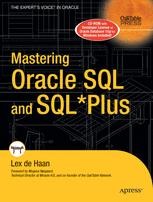
Mastering Oracle SQL and SQL*Plus
This exceptional book explains fundamentals in detail, supported by realistic examples, while most other books on the market do not properly cover such basics. If you work with relational databases you need to understand the SQL language. And you will gain full competence to define, access, and manipulate data in an Oracle database, if you do so following this book's guidance.

Making Globally Distributed Software Development a Success Story : International Conference on Software Process, ICSP 2008 Leipzig, Germany, May 10-11, 2008 Proceedings
This volume contains papers presented at the International Conference on Software Process (ICSP 2008) held in Leipzig, Germany, during May 10-11, 2008. ICSP 2008 was the second conference of the ICSP series. The theme of ICSP 2008 was “Making Globally Distributed Software Development a Success Story. ” Software developers work in a dynamic context of frequently changing technologies and with limited resources. Globally distributed development teams are under ev- increasing pressure to deliver their products more quickly and with higher levels of qu- ity. At the same time, global competition is forcing software development organizations to cut costs by rationalizing processes, outsourcing part of or all development activities, reusing existing software in new or modified applications, and evolving existing systems to meet new needs, while still minimizing the risk of projects failing to deliver.

Machines, Computations, and Universality ; 4th International Conference, MCU 2004, Saint Petersburg, Russia, September 21-24, 2004, Revised Selected Papers
Constitutes the post-proceedings of the 4th International Conference on Machines, Computations, and Universality, MCU 2004, held in St Petersburg, Russia in September 2004. This book covers a variety of foundational aspects in theoretical computer science such as cellular automata, molecular computing, quantum computing, and formal languages

Machine Learning for Multimodal Interaction ; Vol.3361 : 1st International Workshop, MLMI 2004, Martigny, Switzerland, June 21-23, 2004, Revised Selected Papers
his book contains a selection of refereed papers presented at the 1st Wo- shop on Machine Learning for Multimodal Interaction (MLMI 2004), held at the “Centre du Parc,” Martigny, Switzerland, during June 21–23, 2004. The workshop was organized and sponsored jointly by three European projects, – AMI, Augmented Multiparty Interaction, http://www.amiproject.org – PASCAL, Pattern Analysis, Statistical Modeling and Computational Learning, http://www.pascal-network.org – M4, Multi-modal Meeting Manager, http://www.m4project.org as well as the Swiss National Centre of Competence in Research (NCCR): – IM2: Interactive Multimodal Information Management, http://www.im2.ch MLMI 2004 was thus sponsored by the European Commission and the Swiss National Science Foundation.

Machine Learning and Knowledge Extraction ; 5th IFIP TC 5, TC 12, WG 8.4, WG 8.9, WG 12.9 International Cross-Domain Conference, CD-MAKE 2021, Virtual Event, August 17–20, 2021, Proceedings
Constitutes the refereed proceedings of the 5th IFIP TC 5, TC 12, WG 8.4, WG 8.9, WG 12.9 International Cross-Domain Conference, CD-MAKE 2021, held in virtually in August 2021. The 20 full papers and 2 short papers presented were carefully reviewed and selected from 48 submissions. The cross-domain integration and appraisal of different fields provides an atmosphere to foster different perspectives and opinions; it will offer a platform for novel ideas and a fresh look on the methodologies to put these ideas into business for the benefit of humanity.

Machine Learning and Data Mining in Pattern Recognition ; 5th International Conference, MLDM 2007, Leipzig, Germany, July 18-20, 2007, Proceedings
MLDM / ICDM Medaillie Meissner Porcellan, the “White Gold” of King August the Strongest of Saxonia Gottfried Wilhelm von Leibniz. This was the fifth MLDM in Pattern Recognition event held in Leipzig (www.mldm.de). This meeting from the very first event has focused on aspects of machine learning and data mining in pattern recognition problems.

Machine Learning and Data Mining in Pattern Recognition ; 4th International Conference, MLDM 2005, Leipzig, Germany, July 9-11, 2005, Proceedings
Today, artificial intelligence deals with large amounts of data and knowledge and finds new information using machine learning and data mining. Machine learning and data mining are irreplaceable subjects and tools for the theory of pattern recognition and in applications of pattern recognition such as bioinformatics and data retrieval. This was the fourth edition of MLDM in Pattern Recognition which is the main event of Technical Committee 17 of the International Association for Pattern Recognition; it started out as a workshop and continued as a conference in 2003. Today, there are many international meetings which are titled “machine learning” and “data mining”, whose topics are text mining, knowledge discovery, and applications. This meeting from the first focused on aspects of machine learning and data mining in pattern recognition problems. We planned to reorganize classical and well-established pattern recognition paradigms from the viewpoints of machine learning and data mining. Though it was a challenging program in the late 1990s, the idea has inspired new starting points in pattern recognition and effects in other areas such as cognitive computer vision.

Long-Term Preservation of Digital Documents : Principles and Practices
Key to our culture is that we can disseminate information, and then maintain and access it over time. While we are rapidly advancing from vulnerable physical solutions to superior, digital media, preserving and using data over the long term involves complicated research challenges and organization efforts. Uwe Borghoff and his coauthors address the problem of storing, reading, and using digital data for periods longer than 50 years. They briefly describe several markup and document description languages like TIFF, PDF, HTML, and XML, explain the most important techniques such as migration and emulation, and present the OAIS (Open Archival Information System) Reference Model. To complement this background information on the technology issues the authors present the most relevant international preservation projects, such as the Dublin Core Metadata Initiative, and experiences from sample projects run by the Cornell University Library and the National Library of the Netherlands. A rated survey list of available systems and tools completes the book.
Literature-based Discovery
When Don Swanson hypothesized a connection between Raynaud’s phenomenon and dietary fish oil, the field of literature-based discovery (LBD) was born. During the subsequent two decades a steady stream of researchers have published articles about LBD and the field has made steady progress in laying foundations and creating an identity. LBD is an inherently multi-disciplinary enterprise where collaborations between the information and biomedical sciences are readily encountered. It is the hope and intention that this volume will plant a flag in the ground and inspire new researchers to the LBD challenge.
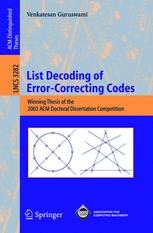
List decoding of error-correcting codes : Winning thesis of the 2002 ACM doctoral dissertation competition
Presents some spectacular new results in the area of decoding algorithms for error-correcting codes. Specifically, it shows how the notion of “list-decoding” can be applied to recover from far more errors, for a wide variety of err- correcting codes, than achievable before. A brief bit of background : error-correcting codes are combinatorial str- tures that show how to represent (or “encode”) information so that it is - silient to a moderate number of errors. Speci?cally, an error-correcting code takes a short binary string, called the message, and shows how to transform it into a longer binary string, called the codeword, so that if a small number of bits of the codewordare ?ipped, the resulting string does not look like any other codeword. The maximum number of errorsthat the code is guaranteed to detect, denoted d, is a central parameter in its design. A basic property of such a code is that if the number of errors that occur is known to be smaller than d/2, the message is determined uniquely. This poses a computational problem, called the decoding problem : compute the message from a corrupted codeword, when the number of errors is less than d/2.

Leveraging Applications of Formal Methods ; 1st International Symposium, ISoLA 2004, Paphos, Cyprus, October 30 - November 2, 2004, Revised Selected Papers
This book constitutes the thoroughly refereed post-proceedings of the First International Symposium on Leveraging Applications of Formal Methods, ISoLA 2004, held in Paphos, Cyprus in October/November 2004. The 12 revised full papers presented were carefully selected from more than 70 submissions. The papers discuss issues related to the adoption and use of rigorous tools and methods for the specification, analysis, verification, certification, construction, test, and maintenance of systems. In particular, by discussing common problems, requirements, algorithms, methodologies, and practices, ISoLA aims at supporting researchers in their quest to improve the utility, reliability, flexibility, and efficiency of tools for building systems, and users in their search for adequate solutions to their problems.

Learning Theory ; Vol. 3559 : 18th Annual Conference on Learning Theory, COLT 2005, Bertinoro, Italy, June 27-30, 2005, Proceedings
The technical program contained 45 papers selected from 120 submissions, 3 open problems selected from among 5 contributed, and 2 invited lectures. The invited lectures were given by Sergiu Hart on “Uncoupled Dynamics and Nash Equilibrium”, and by Satinder Singh on “Rethinking State, Action, and Reward in Reinforcement Learning”. These papers were not included in this volume. The Mark Fulk Award is presented annually for the best paper co-authored by a student. The student selected this year was Hadi Salmasian for the paper titled “The Spectral Method for General Mixture Models” co-authored with Ravindran Kannan and Santosh Vempala. The number of papers submitted to COLT this year was exceptionally high. In addition to the classical COLT topics, we found an increase in the number of submissions related to novel classi?cation scenarios such as ranking. This - crease re?ects a healthy shift towards more structured classi?cation problems, which are becoming increasingly relevant to practitioners.

Learning and Adaption in Multi-Agent Systems ; 1st International Workshop, LAMAS 2005, Utrecht, The Netherlands, July 25, 2005, Revised Selected Papers
Contains selected and revised papers of the International Workshop on Lea- ing and Adaptation in Multi-Agent Systems (LAMAS 2005), held at the AAMAS 2005 Conference in Utrecht, The Netherlands, July 26. An important aspect in multi-agent systems (MASs) is that the environment evolves over time, not only due to external environmental changes but also due to agent int- actions. For this reason it is important that an agent can learn, based on experience, and adapt its knowledge to make rational decisions and act in this changing environment autonomously. Machine learning techniques for single-agent frameworks are well established. Agents operate in uncertain environments and must be able to learn and act - tonomously. This task is, however, more complex when the agent interacts with other agents that have potentially different capabilities and goals. The single-agent case is structurally different from the multi-agent case due to the added dimension of dynamic interactions between the adaptive agents. Multi-agent learning, i.e., the ability of the agents to learn how to cooperate and compete, becomes crucial in many domains. Autonomous agents and multi-agent systems (AAMAS) is an emerging multi-disciplinary area encompassing computer science, software engineering, biology, as well as cognitive and social sciences. A t- oretical framework, in which rationality of learning and interacting agents can be - derstood, is still under development in MASs, although there have been promising ?

Languages and Compilers for Parallel Computing ; 20th International Workshop, LCPC 2007, Urbana, IL, USA, October 11-13, 2007, Revised Selected Papers
This book constitutes the thoroughly refereed post-conference proceedings of the 20th International Workshop on Languages and Compilers for Parallel Computing, LCPC 2007, held in Urbana, IL, USA, in October 2007.The 23 revised full papers presented were carefully reviewed and selected from 49 submissions. The papers are organized in topical sections on reliability, languages, parallel compiler technology, libraries, run-time systems and performance analysis, and general compiler techniques.
Knowledge Sharing in the Integrated Enterprise : Interoperability Strategies for the Enterprise Architect
The IFIP series publishes state-of-the-art results in the sciences and technologies of information and communication. The scope of the series includes: foundations of computer science; software theory and practice; education; computer applications in technology; communication systems; systems modeling and optimization; information systems; computers and society; computer systems technology; security and protection in information processing systems; artificial intelligence; and human-computer interaction. Proceedings and post-proceedings of referred international conferences in computer science and interdisciplinary fields are featured. These results often precede journal publication and represent the most current research. The principal aim of the IFIP series is to encourage education and the dissemination and exchange of information about all aspects of computing.
Competitive Programming in Python : 128 Algorithms to Develop your Coding Skills
Learn all the algorithmic techniques and programming skills you need from two experienced coaches, problem setters, and jurors for coding competitions. The authors highlight the versatility of each algorithm by considering a variety of problems and show how to implement algorithms in simple and efficient code. What to expect: * Master 128 algorithms in Python. * Discover the right way to tackle a problem and quickly implement a solution of low complexity.
