



الصفحة 8
الصفحة 8

MCITP self-paced training Kit (Exam 70-444) : Optimizing and maintaining a database administration solution microsoft SQL server 2005
Designed to help you make the most of your study time. Maximize your performance on the exam by learning to: * Monitor and troubleshoot queries, databases, and servers * Help defend against injection attacks, denial of service attacks, worms, and viruses * Manage security strategies and perform audits * Detect and resolve data conflicts * Diagnose faults and recover from database failures and disasters * Optimize database availability with failover clustering, database mirroring, log shipping, and replication * Customize a maintenance strategy and automate routine tasks * Build, debug, and deploy SQL Server Integration Services packages PRACTICE TESTS Assess your skills with practice tests on CD. You can work through hundreds of questions using multiple testing modes to meet your specific learning needs. You get detailed explanations for right and wrong answers-including a customized learning path that describes how and where to focus your studies. Your training kit includes: Details inside. * Official self-paced study guide. * Practice tests with multiple, customizable testing options and a learning plan based on your results. *400+ practice and review questions. * Case scenarios, practice exercises, and best practices. *180-day evaluation version of Microsoft SQL Server 2005 Enterprise Edition. * Fully searchable eBook of this guide.
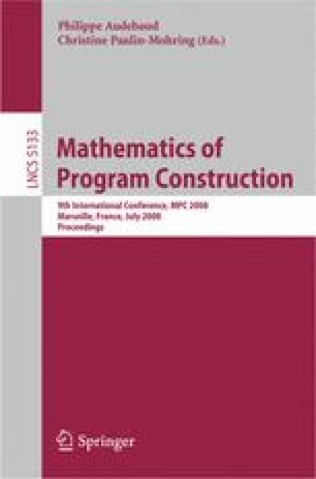
Mathematics of Program Construction ; 9th International Conference, MPC 2008, Marseille, France, July 15-18, 2008. Proceedings
This book constitutes the refereed proceedings of the 9th International Conference on Mathematics of Program Construction, MPC 2008, held in Marseille, France in July 2008.The 18 revised full papers presented together with 1 invited talk were carefully reviewed and selected from 41 submissions. Issues addressed range from algorithmics to support for program construction in programming languages and systems. Topics of special interest are type systems, program analysis and transformation, programming language semantics, program logics.

Mathematical Morphology : 40 Years On ; Proceedings of the 7th International Symposium on Mathematical Morphology, April 18-20, 2005
Mathematical Morphology is a speciality in Image Processing and Analysis, which considers images as geometrical objects, to be analyzed through their interactions with other geometrical objects. It relies on several branches of mathematics, such as discrete geometry, topology, lattice theory, partial differential equations, integral geometry and geometrical probability. It has produced fast and efficient algorithms for computer analysis of images, and has found applications in bio-medical imaging, materials science, geoscience, remote sensing, quality control, document processing and data analysis. This book contains the 43 papers presented at the 7th International Symposium on Mathematical Morphology, held in Paris on April 18-20, 2005. It gives a lively state of the art of current research topics in this field. It also marks a milestone, the 40 years of uninterrupted development of this ever-expanding domain.

IOT control and surveillance system
An automated system is a combination of both software and hardware which is designed and programmed to work automatically without the need of any human operator to provide inputs and instructions for each operation. The Internet of Things (IoT) is a network of connected things. These ‘things’ (devices) communicate with each other using machine to machine communication (M2M). Information is traversed between devices so that processes can be automated, without the need for human intervention. By reducing the number of people involved in a business process, several advantages arise, including improved accuracy and up-time. We will build an IoT automated system to control access of humans and vehicles to a warehouse based on biometrics and image recognition techniques.

IoT and AI Technologies for Sustainable Living : A Practical Handbook
Brings together all the latest methodologies, tools and techniques related to the Internet of Things and Artificial Intelligence in a single volume to build insight into their use in sustainable living. The areas of application include agriculture, smart farming, healthcare, bioinformatics, self-diagnosis systems, body sensor networks, multimedia mining, and multimedia in forensics and security. Provides a comprehensive discussion of modeling and implementation in water resource optimization, recognizing pest patterns, traffic scheduling, web mining, cyber security and cyber forensics. It will help develop an understanding of the need for AI and IoT to have a sustainable era of human living. The tools covered include genetic algorithms, cloud computing, water resource management, web mining, machine learning, block chaining, learning algorithms, sentimental analysis and Natural Language Processing (NLP).

Inventive communication and computational technologies ; Proceedings of ICICCT 2020
This book gathers selected papers presented at the 4th International Conference on Inventive Communication and Computational Technologies (ICICCT 2020), held on 28–29 May 2020 at Gnanamani College of Technology, Tamil Nadu, India. The respective contributions highlight recent research efforts and advances in a new paradigm called ISMAC (IoT in Social, Mobile, Analytics and Cloud contexts). The topics covered include the Internet of Things, Social Networks, Mobile Communications, Big Data Analytics, Bio-inspired Computing and Cloud Computing. Given its scope, the book is chiefly intended for academics and practitioners working to resolve practical issues in this area.

Intrusion Detection and Correlation : Challenges and Solutions
Challenges and Solutions presents intrusion detection systems (IDSs) and addresses the problem of managing and correlating the alerts produced. This volume discusses the role of intrusion detection in the realm of network security with comparisons to traditional methods such as firewalls and cryptography. Challenges and Solutions analyzes the challenges in interpreting and combining (i.e., correlating) alerts produced by these systems. In addition, existing academic and commercial systems are classified; their advantage and shortcomings are presented, especially in the case of deployment in large, real-world sites. Challenges and Solutions is designed for a professional audience composed of researchers and practitioners in industry. This book is also suitable for graduate-level students in computer science.

Introduction to Video Search Engines
Their book has a practical emphasis with the goal of bringing readers up to date on the state of the art in multimedia search technologies and systems. It explains the overall process of video content acquisition, indexing and retrieval with browsing, it provides overviews of constituent technologies such as information retrieval, Internet video systems, video and multimedia processing to extract index data, and it gives examples of research prototypes and existing commercial systems and describes their features.

Introduction to PHP for Scientists and Engineers : Beyond JavaScript
This text presents key information needed to write your own online science and engineering applications, including reading, creating and manipulating data files stored as text on a server, thereby overcoming the limitations of a client-side language.

Introduction to Machine Learning with Applications in Information Security
Provides a classroom-tested introduction to a wide variety of machine learning and deep learning algorithms and techniques, reinforced via realistic applications. The book is accessible and doesn't prove theorems, or dwell on mathematical theory. The goal is to present topics at an intuitive level, with just enough detail to clarify the underlying concepts. The book covers core classic machine learning topics in depth, including Hidden Markov Models (HMM), Support Vector Machines (SVM), and clustering. Additional machine learning topics include k-Nearest Neighbor (k-NN), boosting, Random Forests, and Linear Discriminant Analysis (LDA). The fundamental deep learning topics of backpropagation, Convolutional Neural Networks (CNN), Multilayer Perceptrons (MLP), and Recurrent Neural Networks (RNN) are covered in depth. A broad range of advanced deep learning architectures are also presented, including Long Short-Term Memory (LSTM), Generative Adversarial Networks (GAN), Extreme Learning Machines (ELM), Residual Networks (ResNet), Deep Belief Networks (DBN), Bidirectional Encoder Representations from Transformers (BERT), and Word2Vec.

Introduction to Intelligent Construction Technology of Transportation Infrastructure
Expounds on the related technologies of intelligent transportation infrastructure construction. Based on the essential characteristics of intelligent construction, "perception, analysis, decision-making, and execution," the basic structure of intelligent construction technology (ICT) is established. With the integration of engineering construction technologies, the analyses of the essence of intelligent algorithms and the feasibility of Artificial Intelligence (AI) are provided. The book introduces the essential characteristics of Big Data and the Internet of Things and their relationship with engineering construction. On this basis, the feasibility and implementation plan of intelligent technology applications in design, construction, and maintenance are analyzed and demonstrated with engineering examples.
Introduction to development engineering
Introduces the emerging field of development engineering and its constituent theories, methods, and applications. It is both an instructional text for students and a resource for researchers and practitioners involved in the design and scaling of technologies for low-resource communities. The scope is broad, ranging from the development of mobile applications for low-literacy users to hardware and software solutions for providing electricity and water in remote environments. It is also highly interdisciplinary, drawing on methods and theories from the social sciences as well as engineering and the natural sciences.
Introduction pratique aux bases de données relationnelles = A practical introduction to relational databases
Cet ouvrage introduit le lecteur dans le domaine des bases de données relationnelles en présentant une vaste sélection de sujets portant sur la modélisation des données, les langages de base de données, l'architecture des systèmes et l'évolution post-relationnelle. - Notions fondamentales: le modèle relationnel, les composants d’un système de gestion de bases de données, l’organisation de la mise en œuvre d’une base de données, les tâches de gestion des données. - De l'analyse à la base de données : le modèle entité association, la généralisation et l’agrégation, les dépendances et les formes normales,les contraintes d’intégrité. - Aperçu des langages de requête et de manipulation des données: l’algèbre relationnelle, le calcul des prédicats, SQL, QUEL, QBE, le traitement des valeurs nulles, la protection des données. - Les composants de l'architecture d'un système de bases de données : la compilation, l’interprétation et l’optimisation des requêtes, l’environnement multiutilisateur, le concept de transaction et la sérialisation, les méthodes optimiste et pessimiste, les structures de stockage et les méthodes d’accès. L’intégration et la migration des bases de données: l’exploitation des bases de données hétérogènes, les bases de données sur le Web, les règles de conversion pour effectuer l’intégration et la migration, les variantes de migration des bases de données hétérogènes, la planification de l’intégration et de la migration.

Introducing Robotic Process Automation to Your Organization : A Guide for Business Leaders
Enables you, a novice to RPA, to successfully implement an RPA program at your company. RPA is rapidly growing in use, but is only starting to be taught at a university level. Many mid-level managers will be tasked with introducing an RPA program at their organizations as senior management learns of its efficacy, but will be unfamiliar with how to do so. This book provides you with the skills and information you need to make an informed decision. You will learn: Know the benefits of robotic process automation (RPA) / Understand the limitations of RPA / Ask the right questions to determine whether a process is a good candidate for automation / Obtain buy-in from skeptics at the senior and middle manager levels, and from line workers Be familiar with the structure required for success

Introducing Blockchain with Java : Program, Implement, and Extend Blockchains with Java
Includes numerous exercises and test questions to help you solidify what you have learned as you progress through the book, and provides ideas on expanding the codebase to make it your own. You will have access to a fully-functioning repository with Java code. You will have the knowledge necessary to program your own blockchains with Java and you will have a completed project for your portfolio. You will: Know the most important theoretical concepts of the blockchain / Code the blockchain in Java / Create a user interface with JavaFX / Implement SQLite DB using JDBC Driver / Create a P2P multi-threaded app / Create your own cryptocurrency app with full functionality / Implement blockchain technology on a P2P network from scratch using Java, JavaFX, and SQL

Introducing Blockchain Applications : Understand and Develop Blockchain Applications Through Distributed Systems
Deepen your understanding of blockchain technology and develop your own blockchain applications. This book provides a thorough review of distribution-based systems on blockchain technology, starting from the fundamental concepts that underlie it, all the way through the implementation of a blockchain network for business purposes. ou will: Learn the concept of blockchains by way of a practical example Grasp the connection between distributed systems and blockchain technology Learn the design of blockchain with hyperledger fabric Learn the design of cyber-physical systems in a distributed environment

Internet of things. information processing in an increasingly connected world ; First IFIP International Cross-Domain Conference, IFIPIoT 2018, Held at the 24th IFIP World Computer Congress, WCC 2018, Poznan, Poland, September 18-19, 2018, Revised Selected Papers
This book cover a wide range of topics from a technology to a business perspective and include among others hardware, software and management aspects, process innovation, privacy, power consumption, architecture, applications.

Internet of things, artificial intelligence and blockchain technology
Explores the concepts and techniques of IoT, AI, and blockchain. Also discussed is the possibility of applying blockchain for providing security in various domains. The specific highlight of this book is focused on the application of integrated technologies in enhancing data models, better insights and discovery, intelligent predictions, smarter finance, smart retail, global verification, transparent governance, and innovative audit systems. Explains how blockchain can significantly increase data privacy and security while boosting accuracy and integrity in IoT generated data and AI processed information; Gives insight into blockchain’s numerous potential applications, starting with recent technologies that give users control over sharing and privacy; Shows readers how to employ blockchain in IoT and AI, helping them to understand what they can and cannot do with blockchain.

Internet of things from hype to reality : The road to digitization
Presents updated material on its core content: an end-to-end IoT architecture that is comprised of devices, network, compute, storage, platform, applications along with management and security components. As with the second edition, it is organized into six main parts: an IoT reference model; fog computing and the drivers; IoT management and applications; smart services in IoT; IoT standards; and case studies. This edition’s features include overhaul of the IoT Protocols (Chapter 5) to include an expanded treatment of low-power wide area networks including narrow band IoT (NB-IoT) protocol, updated IoT platforms and capabilities (Chapter 7) to include comparison of commercially available platforms (e.g. AWS IoT Platform, Google Cloud IoT Platform, Microsoft Azure IoT Platform, and PTC ThinkWorx), updated security (Chapter 8) to include approaches for securing IoT devices with examples of IoT devices used in security attacks and associated solutions including MUD and DICE, and finally new Appendix B to include six IoT project detailed for students.

Internet of Things and Machine Learning in Agriculture
Machine Learning (ML) and the Internet of Things (IoT) can play a very promising role in the agricultural industry. Some examples include: an AI-powered drone to monitor the field, an IoT-designed automated crop watering system, sensors embedded in the field to monitor temperature and humidity, etc. The agriculture industry is the largest in the world, but when it comes to innovation there is a lot more to explore. IoT devices can be used to analyze the status of crops. For instance, with soil sensors, farmers can detect any irregular conditions such as high acidity and efficiently tackle these issues to improve their yield. In this book, we will point out the challenges facing the agro-industry that can be addressed by ML and IoT and explore the impacts of these technologies in the agriculture sector.
