



الصفحة 78
الصفحة 78

Cryptography Arithmetic : Algorithms and Hardware Architectures
Modern cryptosystems, used in numerous applications that require secrecy or privacy - electronic mail, financial transactions, medical-record keeping, government affairs, social media etc. - are based on sophisticated mathematics and algorithms that in implementation involve much computer arithmetic. And for speed it is necessary that the arithmetic be realized at the hardware (chip) level. This book is an introduction to the implementation of cryptosystems at that level.

Cryptography and cryptanalysis in Java : Creating and programming advanced algorithms with Java SE 17 LTS and Jakarta EE 10
Includes challenging cryptographic solutions that are implemented in Java 17 and Jakarta EE 10. It provides a robust introduction to Java 17's new features and updates, a roadmap for Jakarta EE 10 security mechanisms, a unique presentation of the "hot points" (advantages and disadvantages) from the Java Cryptography Architecture (JCA), and more. You Will Learn : Develop programming skills for writing cryptography algorithms in Java / Dive into security schemes and modules using Java / Explore “good” vs “bad” cryptography based on processing execution times and reliability / Play with pseudo-random generators, hash functions, etc. / Leverage lattice-based cryptography methods, the NTRU framework library, and more

Cryptography and coding ; 11th IMA International Conference, Cirencester, UK, December 18-20, 2007, Proceedings
This book presented signatures, boolean functions, block cipher cryptanalysis, side channels, linear complexity, public key encryption, curves, and RSA implementation.

Cryptography and coding ; 10th IMA International Conference, Cirencester, UK, December 19-21, 2005, Proceedings
Constitutes the refereed proceedings of the 10th IMA International Conference on Cryptography and Coding, held in Cirencester, UK, in December 2005. This book features papers that are organized in topical sections on coding theory, signatures and signcryption, symmetric cryptography, side channels, algebraic cryptanalysis, and more.

Cryptographics : Exploiting Graphics Cards For Security
CryptoGraphics: Exploiting Graphics Cards for Security explores the potential for implementing ciphers within graphics processing units (GPUs), and describes the relevance of GPU-based encryption and decryption to the security of applications involving remote displays.

Cryptographic hardware and embedded systems - CHES 2008 ; 10th International Workshop, Washington, D.C., USA, August 10-13, 2008. Proceedings
This book constitutes the refereed proceedings of the 10th Interntaional Workshop on Cryptographic Hardware and Embedded Systems, CHES 2008, held in Washington, D.C., USA, during August 10-13, 2008.

Cryptographic hardware and embedded systems - CHES 2007 ; 9th International Workshop, Vienna, Austria, September 10-13, 2007, Proceedings
The papers collected in this volume represent cutting-edge world wide research in the rapidly evolving fields of crypto-hardware, fault-based and side-channel cryptanalysis, and embedded cryptography, at the crossing of academic and - dustrial research. The wide diversity of subjects appearing in these proceedings covers virtually all related areas and shows our e?orts to extend the scope of CHES more than usual.

Cryptographic hardware and embedded systems - CHES 2006 ; 8th International Workshop, Yokohama, Japan, October 10-13, 2006, Proceedings
These are the proceedings of the Eighth Workshop on Cryptographic Hardware and Embedded Systems (CHES 2006) held in Yokohama, Japan, October 10-13, 2006. The CHES workshophas been sponsored by the International Association for Cryptographic Research (IACR) since 2004. The ?rst and the second CHES workshops were held in Worcester in 1999 and 2000, respectively, followed by Paris in 2001, San Francisco Bay Area in 2002, Cologne in 2003, Boston in 2004 and Edinburgh in 2005. This is the ?rst CHES workshop held in Asia.

Cryptographic hardware and embedded systems - CHES 2005 ; 7th International Workshop, Edinburgh, UK, August 29 - September 1, 2005, Proceedings
Constitutes the refereed proceedings of the 7th International Workshop on Cryptographic Hardware and Embedded Systems, CHES 2005, held in Edinburgh, UK in August/September 2005. The papers in this book are organized in topical sections on side channels, arithmetic for cryptanalysis, special purpose hardware, hardware attacks and more.

Cryptanalytic Attacks on RSA
RSA is a public-key cryptographic system, and is the most famous and widely-used cryptographic system in today's digital world. Cryptanalytic Attacks on RSA, a professional book, covers almost all major known cryptanalytic attacks and defenses of the RSA cryptographic system and its variants.
Crowd Simulation
Focuses on methods and techniques for crowd simulation, filling the gap in the professional literature. This survey covers topics that include Modelling of Populations; Virtual Human Animation; Behavioural Animation of Crowds; and, Crowd Rendering and Populated Environments.

Critical Infrastructure Protection
This book is dedicated to advancing research, development and implementation efforts focused on infrastructure protection.

Critical Information Infrastructures : Resilience and Protection
Starting with some basic definitions and assumptions on the topic, this book explores various aspects of Critical Infrastructures throughout the world – including the technological, political, economic, strategic and defensive. This book will be of interest to the CEO and Academic alike as they grapple with how to prepare Critical Information Infrastructures for new challenges.

Critical Information Infrastructured Security ; 1st International Workshop, CRITIS 2006, Samos Island, Greece, August 31 - September 1, 2006
This volume contains the proceedings of the 1st International Workshop on Critical Information Infrastructure Security (CRITIS 2006), that was held between August 31 and September 1, 2006 on Samos, Greece, and was hosted by the University of the Aegean, Department of Information and Communication Systems Engineering, Laboratory of Information and Communication Systems Security (Info-Sec-Lab). In response to the CRITIS 2006 call for papers, 57 papers were submitted.

Creative applications of artificial intelligence in education
Explores the synergy between AI and education, highlighting its potential impact on pedagogical practices. It navigates the evolving landscape of AI-powered educational technologies and suggests practical ways to personalise instruction, nurture human-AI co-creativity, and transform the learning experience. Spanning from primary to higher education, this short and engaging volume proposes concrete examples of how educational stakeholders can be empowered in their AI literacy to foster creativity, inspire critical thinking, and promote problem-solving by embracing AI as a tool for expansive learning. Structured in three parts, the book starts developing the creative engagement perspective for learning and teaching to then present practical applications of AI in K-12 and higher education, covering different fields (teacher education, professional education, business education) as well as different types of AI supported tools (games, chatbots, and AI assisted assessment).

Creating Web-based Laboratories
Remote web-based experimentation, enabling students and researchers to access the laboratory anytime via the Internet, is becoming an increasingly attractive way to complement or even replace traditional laboratory sessions. Placing a video camera & microphone before the equipment and apparatus to capture what is actually happening in the laboratory allows the images and audio data to be streamed to the client side. Researchers in different countries can share equipment and conduct research cooperatively and remotely. The authors summarise their research and discuss the development of the 5 web-based laboratories launched from the National University of Singapore. The principles, structure, and technologies required for the creation of Internet remote experimentation systems are discussed with particular emphasis on the integration of hardware and software systems. Also highlighted is the design and development of interfaces and components for use in typical web-based laboratories or similar web-control applications.

Creating New Learning Experiences on a Global Scale ; 2nd European Conference on Technology Enhanced Learning, EC-TEL 2007, Crete, Greece, September 17-20, 2007, Proceedings
It is holding more than 500 pages of combined wisdom on Technology Enhanced Learning (TEL) in your hands! With the advance of metadata, standards, learning objects, Web 2. 0 approaches to rip, mix and burn learning, wikis, blogs, syndication, user-generated content, W- based video, games and the ubiquitous availability of computing devices we can and have to offer more flexible learning services on a global scale.It provided a unique forum for all research related to technology enhanced learning, including its interactions with knowledge management, business processes and work environments.

Creating Mobile Games : Using Java™ ME Platform to Put the Fun into Your Mobile Device and Cell Phone
Creating Mobile Games: shows you how to create a basic game and make it a professional one (by adding a pro look-and-feel by writing your own menus or using the open source J2ME Polish, and enabling marketing/billing from your own web site). Demonstrates Wireless Messaging and other optional APIs (using SMS, PIM, File Connection, Bluetooth, and so forth in a multiplayer game).

Creating Flash Widgets with Flash CS4 and ActionScript 3.0
Creating Flash Widgets with Flash CS4 and ActionScript 3.0 is an introduction to developing widgets for the Internet using the features of Flash CS4 and ActionScript 3.0. Many social-networking sites, blogs, and personal home pages have adopted the use of widgets and Flash developers can create and distribute their own widgets for others to use. A step-by-step example demonstrates how to design and develop your own Flash widgets and integrate them with XML. In addition, publishing, promoting, and capitalizing on your Flash widgets is discussed.
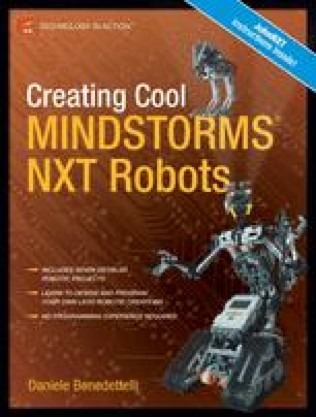
Creating Cool MINDSTORMS® NXT Robots
Build and program MINDSTORM NXT robots with Daniele Benedettelli, one of the world's most respected NXT robot builders. He shows you how to build and program them from scratch, starting with the simplest robots and progressing in difficulty to a total of seven award–winning robots! You can download all the code, along with low–resolution videos that show how your robot works when it's finished. You don't need to be a programmer to develop these cool robots, because all the code is provided, but advanced developers will enjoy seeing the secrets of Benedettelli's code and techniques revealed.
