



الصفحة 7
الصفحة 7

Evolutionary computation in combinatorial optimization ; 8th European Conference, EvoCOP 2008, Naples, Italy, March 26-28, 2008. Proceedings
Metaheuristics have been shown to be e?ective for di?cult combinatorial - timization problems appearing in various industrial, economical, and scientifc domains. Prominent examples of metaheuristics are evolutionary algorithms, tabu search, simulated annealing, scatter search, memetic algorithms, variable neighborhood search, iterated local search, greedy randomized adaptive search procedures, ant colony optimization and estimation of distribution algorithms. Problems solved successfully include scheduling, timetabling, network design, transportation and distribution, vehicle routing, the travelling salesman pr- lem, packing and cutting, satisfability and general mixed integer programming.

Environments for Multi-Agent Systems II ; 2nd International Workshop, E4MAS 2005, Utrecht, The Netherlands, July 25, 2005, Selected Revised and Invited Papers
This book constitutes the thoroughly refereed post-proceedings of the Second International Workshop on Environments for Multiagent Systems, E4MAS 2005, held in July 2005. The 16 revised papers presented were carefully reviewed and selected from the lectures given at the workshop.
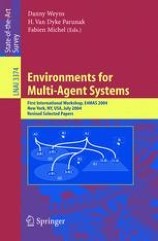
Environments for Multi-Agent Systems ; 1st International Workshop, E4MAS, 2004, New York, NY, July 19, 2004, Revised Selected Papers
The modern ?eld of multiagent systems has developed from two main lines of earlier research. Its practitioners generally regard it as a form of arti?cial intelligence (AI). Some of its earliest work was reported in a series of workshops in the US dating from1980,revealinglyentitled,“DistributedArti?cialIntelligence,”andpioneers often quoted a statement attributed to Nils Nilsson that “all AI is distributed. ” The locus of classical AI was what happens in the head of a single agent, and much MAS research re?ects this heritage with its emphasis on detailed modeling of the mental state and processes of individual agents. From this perspective, intelligenceisultimatelythepurviewofasinglemind,thoughitcanbeampli?ed by appropriate interactions with other minds. These interactions are typically mediated by structured protocols of various sorts, modeled on human conver- tional behavior. But the modern ?eld of MAS was not born of a single parent. A few - searchershavepersistentlyadvocatedideasfromthe?eldofarti?ciallife(ALife). These scientists were impressed by the complex adaptive behaviors of commu- ties of animals (often extremely simple animals, such as insects or even micro- ganisms). The computational models on which they drew were often created by biologists who used them not to solve practical engineering problems but to test their hypotheses about the mechanisms used by natural systems. In the ar- ?cial life model, intelligence need not reside in a single agent, but emerges at the level of the community from the nonlinear interactions among agents. - cause the individual agents are often subcognitive, their interactions cannot be modeled by protocols that presume linguistic competence.
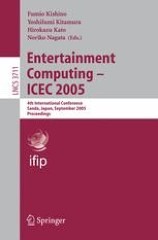
Entertainment Computing - ICEC 2005 ; 4th International Conference, Sanda, Japan, September 19-21, 2005, Proceedings
First of all, we appreciate the hard work of all the authors who contributed to ICEC 2005 by submitting their papers. ICEC 2005 attracted 95 technical paper submissions, 8 poster submissions and 7 demo submissions, in total 110. This number is nearly equal to ICEC 2004. Based on a thorough review and selection process carried out by 76 international experts from academia and industry as members of the senior and international program committees, a high-quality program was compiled. The program committee consisted of experts from all over the world: 1 from Austria, 3 from Bulgaria, 2 from Canada, 4 from China, 1 from Finland, 4 from France, 10 from Germany, 1 from Greece, 1 from Ireland, 1 from Israel, 1 from Italy, 26 from Japan, 1 from Korea, 4 from The Netherlands, 1 from New Zealand, 1 from Norway, 1 from Singapore, 1 from Thailand, 4 from the UK, and 8 from the USA. In this number, reviewers are included. The final decision was made at the senior program committee meeting based on three reviewers' feedback, available online via the conference management tool. Through earnest and fair discussion at the meeting, 25 technical papers were accepted as long papers and 32 technical papers were accepted as short papers from 95 submitted technical papers. Moreover, 3 poster papers and 5 demo papers were accepted.

Enhanced Methods in Computer Security, Biometric and Artificial Intelligence Systems
"Methods of Artificial Intelligence and Intelligent Agents" contains 13 contributions analyzing such areas of AI as fuzzy set theory, predicate logic, neural networks, clustering, data mining and others. It also presents applications of AI as possible solutions for problems like firm bankruptcy, soil erosion, flight control and others. "Information Technology Security" covers three important areas of security engineering in information systems: software security, public key infrastructure and the design of new cryptographic protocols and algorithms. "Biometric Systems" comprises 11 contributions dealing with face picture analysis and recognition systems. This chapter focuses on known methods of biometric problem solution as well as the design of new models.

Engineering Societies in the Agents World VIII ; 8th International Workshop, ESAW 2007, Athens, Greece, October 22-24, 2007, Revised Selected Papers
This book constitutes the thoroughly refereed post-conference proceedings of the 7th International Workshop on Engineering Societies in the Agents World, ESAW 2007, held in Athens, Greece, in October 2007. The 19 revised full papers were carefully reviewed and selected for inclusion in this book. The papers are organized in topical sections on electronic institutions, models of complex distributed systems with agents and societies; interaction in agent societies; engineering social intelligence in multi-agent systems; trust and reputation in agent societies; analysis, design and development of agent societies.

Engineering Societies in the Agents World VII ; 7th International Workshop, ESAW 2006 Dublin, Ireland, September 6-8, 2006 Revised Selected and Invited Papers
It cover main themes: Engineering multi-agent systems, Methodologies for analysis, design, development and verification of agent societies, Interaction and coordination in agent societies, Autonomic agent societies, Trust in agent societies For

Engineering Societies in the Agents World VI ; 6th International Workshop, ESAW 2005, Kusadasi, Turkey, October 26-28, 2005, Revised Selected and Invited Papers
ESAW 2005 took place at the Pine Bay Hotel in Kusadasi, Turkey at the end of the October 2005. It was organized as a stand-alone event as were ESAW 2004and ESAW 2003.Following the initial ESAW vision,which wasset in 1999, by the members of the working group on “Communication, Coordination and Collaboration” of Agentlink, ESAW 2005 continued to focus on the engineering of complex software systems in terms of multi-agent societies, especially the social and environmental aspects of such societies.

Engineering societies in the agents world V : 5th international workshop, ESAW 2004, Toulouse, France, October 20-22, 2004 : revised selected and invited papers
The ?rst workshop “Engineering Societies in the Agents World” (ESAW) was held in August 2000, in conjunction with the 14th European Conference on Arti?cial Intelligence (ECAI 2000) in Berlin. It was launched by a group of - searchers who thought that the design and development of MASs (multi-agent systems) not only needed adequate theoretical foundations but also a call for new techniques, methodologies and infrastructures to develop MASs as arti?cial societies. The second ESAW was co-located with the European Agent Summer School (ACAI 2001) in Prague, and mostly focused on logics and languages, middleware, infrastructures and applications. In Madrid, the third ESAW c- centrated on models and methodologies and took place with the “Cooperative Information Agents” workshop (CIA 2002). The fourth ESAW in London was the ?rst one that ran as a stand-alone event: apart from the usual works on methodologies and models, it also stressed the issues of applications and m- tidisciplinary models. Based on the success of previous ESAWs, and also given that the di?cult challenges in the construction of arti?cial societies are not yet fully addressed, the ?fth ESAW workshop was organized in the same spirit as its predecessors.

Engineering Multi-Agent Systems ; 7th International Workshop, EMAS 2019, Montreal, QC, Canada, May 13–14, 2019, Revised Selected Papers
This book constitutes the thoroughly refereed post-conference proceedings of the 7th International Workshop on Engineering Multi-Agent Systems, EMAS 2019, held in Montreal, QC, Canada, in May 2019. The 13 revised full papers presented in this book were carefully selected and reviewed from 20 submissions. The papers are grouped in the following topical sections: Multi-Agent Interaction and Organization; Simulation; Social Awareness and Explainability; Learning and Reconfiguration; and Implementation Techniques and Tools.

Engineering Interactive Systems ; EIS 2007 Joint Working Conferences, EHCI 2007, DSV-IS 2007, HCSE 2007, Salamanca, Spain, March 22-24, 2007. Selected Papers
This book constitutes the post-conference proceedings of the WG2.7/13.4 10th Conference on Engineering Human Computer Interaction (EHCI 2007), the WG 13.2 First Conference on Human Centred Software Engineering (HCSE 2007), and the 14th Conference on Design Specification and Verification of Interactive Systems (DSV-IS 2007); jointly held as EIS 2007, the international event on Engineering Interactive Systems, in Salamanca, Spain, in March 2007 - under the auspices of IFIP.

Engineering Interactive Systems ; 2nd Conference on Human-Centered Software Engineering, HCSE 2008, and 7th International Workshop on Task Models and Diagrams, TAMODIA 2008, Pisa, Italy, September 25-26, 2008. Proceedings
This book constitutes the combined proceedings of the second working conference on Human-Centred Software Engineering (HCSE 2008) and the 6th International Workshop on TAsk MOdels and DIAgrams (TAMODIA 2008); jointly held as EIS 2008, the international event on Engineering Interactive Systems, in Pisa, Italy, in September 2008.

Engineering human computer interaction and interactive systems ; Joint Working Conferences EHCI-DSVIS 2004, Hamburg, Germany, July 11-13, 2004, Revised Selected Papers
As its name suggests, the EHCI-DSVIS conference has been a special event, merging two different, although overlapping, research communities: EHCI (Engineering for Human-Computer Interaction) is a conference organized by the IFIP 2.7/13.4 working group, started in 1974 and held every three years since 1989. The group’s activity is the scientific investigation of the relationships among the human factors in computing and software engineering. DSVIS (Design, Specification and Verification of Interactive Systems) is an annual conference started in 1994, and dedicated to the use of formal methods for the design of interactive systems. Of course these two research domains have a lot in common, and are informed by each other’s results.

Engineering Environment-Mediated Multi-Agent Systems ; International Workshop, EEMMAS 2007, Dresden, Germany, October 5, 2007. Selected Revised and Invited Papers
This book constitutes the thoroughly refereed proceedings of the International Workshop on Engineering Environment-Mediated Multi-Agent Systems, held in Dresden,The volume includes 16 thoroughly revised papers, selected from the lectures given at the workshop, together with 2 papers resulting from invited talks by prominent researchers in the field. The papers are organized in sections on engineering self-organizing applications, stigmergic interaction, modeling and structuring mediating environments, and environment-based support for context and organizations.

End-to-End Quality of Service Over Heterogeneous Networks
The book presents mechanisms, protocols, and system architectures to achieve end-to-end Quality-of-Service (QoS) over heterogeneous wired/wireless networks in the Internet. Particular focus is on measurement techniques, traffic engineering mechanisms and protocols, signalling protocols as well as transport protocol extensions to support fairness and QoS. It shows how those mechanisms and protocols can be combined into a comprehensive end-to-end QoS architecture to support QoS in the Internet over heterogeneous wired/wireless access networks. Finally, techniques for evaluation of QoS mechanisms such as simulation and emulation are presented.

Empirical Software Engineering Issues Critical Assessment and Future Directions : International Workshop, Dagstuhl Castle, Germany, June 26-30, 2006, Revised Papers
Its goal was to discuss the state of the art of empirical software engineering (ESE) by assessing past accomplishments, raising open questions, and proposing a future research agenda. At the same time, the spectrum of methods applied in ESE has broadened.

Emergence of Communication and Language
This volume brings together studies from diverse disciplines, showing how they can inform and stimulate each other. It includes work in linguistics, psychology, neuroscience, anthropology and computer science. New empirical work is reported on both human and animal communication, using some novel techniques that have only recently become viable. A principal theme is the importance of studies involving artificial agents, their contribution to the body of knowledge on the emergence of communication and language, and the role of simulations in exploring some of the most significant issues. A number of different synthetic systems are described, demonstrating how communication can emerge in natural and artificial organisms. Theories on the origins of language are supported by computational and robotic experiments. Worldwide contributors to this volume include some of the most influential figures in the field, delivering essential reading for researchers and graduates in the area, as well as providing fascinating insights for a wider readership.

Embedded Software and Systems Vol. 3605 ; 1st International Conference, ICESS 2004, Hangzhou, China, December 9-10, 2004, Revised Selected Papers
Welcome to the post proceedings of the First International Conference on Embedded Software and Systems (ICESS 2004), which was held in Hangzhou, P. R. China, 9–10 December 2004. Embedded Software and Systems technology is of increasing importance for a wide range of industrial areas, such as aerospace, automotive, telecommunication, and manufacturing automation. Embedded technology is playing an increasingly dominant role in modern society. This is a natural outcome of amazingly fast developments in the embedded field. The ICESS 2004 conference brought together researchers and developers from academia, industry, and government to advance the science, engineering, and technology in embedded software and systems development, and provided them with a forum to present and exchange their ideas, results, work in progress, and experience in all areas of embedded systems research and development. The ICESS 2004 conference attracted much more interest than expected.
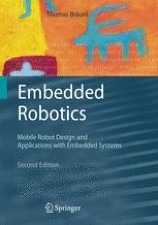
Embedded Robotics : Mobile Robot Design and Applications with Embedded Systems
This book presents a unique examination of mobile robots and embedded systems, from introductory to intermediate level. It is structured in three parts, dealing with Embedded Systems (hardware and software design, actuators, sensors, PID control, multitasking), Mobile Robot Design (driving, balancing, walking, and flying robots), and Mobile Robot Applications (mapping, robot soccer, genetic algorithms, neural networks, behavior-based systems, and simulation).

Embedded Robotics : Mobile Robot Design and Applications with Embedded Systems
The EyeBot controller and mobile robots have evolved over more than a decade. This book gives an in-depth introduction to embedded systems and autonomous mobile robots, using the EyeBot controller (EyeCon) and the EyeBot mobile robot family as application examples. This book combines teaching and research material and can be used for courses in Embedded Systems as well as in Robotics and Automation.
