



الصفحة 7
الصفحة 7

An introduction to ontology engineering
Provides the reader with a comprehensive introductory overview of ontology engineering. A secondary aim is to provide hands-on experience in ontology development that illustrate the theory. The book is divided into three blocks: Block I: logic foundations for ontologies both regarding the languages (mainly First Order predicate Logic, Description Logics, and OWL) and automated reasoning. Block II: developing good ontologies with methods and methodologies, the top-down approach with foundational ontologies, and the bottom-up approach to extract as much useful content as possible from legacy material. Block III: advanced topics with a selection of areas of specialisation, including Ontology-Based Data Access, the interaction between ontologies and natural languages (multilingual ontologies, controlled natural language), and advanced modelling with additional language features (fuzzy and temporal ontologies)

An Introduction to Knowledge Engineering
Knowledge Engineering refers to the development of systems that use knowledge, rather than data, to solve many novel computing problems. This is achieved by the application of computing techniques, closely associated with human cognitive processes, for transforming data into knowledge. An Introduction to Knowledge Engineering presents a simple but detailed exploration of current and established work in the field.

An introduction to description logics
Designed so that domain knowledge can be described and so that computers can reason about this knowledge. DLs have recently gained increased importance since they form the logical basis of widely used ontology languages, in particular the web ontology language OWL. Written by four renowned experts, this is the first textbook on description logics. It is suitable for self-study by graduates and as the basis for a university course. Starting from a basic DL, the book introduces the reader to their syntax, semantics, reasoning problems and model theory and discusses the computational complexity of these reasoning problems and algorithms to solve them.
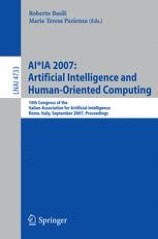
AI*IA 2007 : Artificial intelligence and human-oriented computing ; 10th Congress of the Italian Association for Artificial Intelligence, Rome, Italy, September 10-13, 2007, Proceedings
The book is organized in topical sections on knowledge representation and reasoning, multiagent systems, distributed AIai, knowledge engineering, ontologies and the semantic Web, machine learning, natural language processing, information retrieval and extraction, planning and scheduling, AI and applications. Three special tracks depicting progresses in significant application fields that represent increasingly relevant topics contain 18 additional papers on AI and robotics, AI and expressive media, and intelligent access to multimedia information
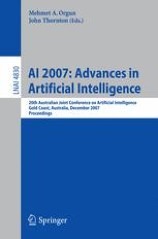
AI 2007: Advances in artificial intelligence ; 20th Australian Joint Conference on Artificial Intelligence, Gold Coast, Australia, December 2-6, 2007, Proceedings
The book is organized in topical sections on machine learning, neural networks, evolutionary computing, constraint satisfaction, satisfiability, automated reasoning, knowledge discovery, robotics, social intelligence, ontologies and semanti.

Agent-oriented software engineering VII ; 7th International Workshop, AOSE 2006, Hakodate, Japan, May 8, 2006, Revised and Invited Papers
Software architectures that contain many dynamically interacting components, each with their own thread of control, and engaging in complex coordination protocols, are difficult to correctly and efficiently engineer. Agent-oriented modelling techniques are important for supporting the design and development of such applications.The book is organized in topical sections on modelling and design of agent systems, modelling open agent systems, formal reasoning about designs, as well as testing, debugging and evolvability.

Agent-oriented software engineering V ; 5th International workshop, AOSE 2004, New York, NY, USA, July 2004, revised selected papers
The explosive growth of application areas such as electronic commerce, ent- prise resource planning and mobile computing has profoundly and irreversibly changed our views on software systems. Nowadays, software is to be based on open architectures that continuously change and evolve to accommodate new components and meet new requirements. Software must also operate on di?- ent platforms, without recompilation, and with minimal assumptions about its operating environment and its users. Furthermore, software must be robust and ¨ autonomous, capable of serving a naive user with a minimum of overhead and interference. Agent concepts hold great promise for responding to the new realities of software systems. They o?er higher-level abstractions and mechanisms which address issues such as knowledge representation and reasoning, communication, coordination, cooperation among heterogeneous and autonomous parties, p- ception, commitments, goals, beliefs, and intentions, all of which need conceptual modelling. On the one hand, the concrete implementation of these concepts can lead to advanced functionalities.

Agent-oriented information systems III ; 7th International bi-conference workshop, AOIS 2005, Utrecht, The Netherlands, July 26, 2005, and Klagenfurt, Austria, October 27, 2005, Revised Selected Papers
In 2005, two AOIS workshops were held internationally. The first was affiliated with the AAMAS 2005 meeting in July in Utrecht in The Netherlands and chaired by Henderson-Sellers and Winikoff and the second with ER 2005 in November in Klagenfurt in Austria and chaired by Kolp and Bresciani. The best papers from these meetings were identified and authors invited to revise and possibly extend their papers in the light of reviewers’ comments and feedback at the workshop. We have grouped these papers loosely under four headings: Agent behavior, communications and reasoning; Methodologies and ontologies; Agent-oriented software engineering; and Applications.

Agent-oriented information systems II ; 6th International bi-conference workshop, AOIS 2004, Riga, Latvia, June 8, 2004 and New York, NY, USA, July 20, 2004, revised selected papers
Information systems have become the backbone of all kinds of organizations - day. In almost every sector – manufacturing, education, health care, government and businesses large and small – information systems are relied upon for - eryday work, communication, information gathering and decision-making. Yet, the in?exibilities in current technologies and methods have also resulted in poor performance, incompatibilities and obstacles to change. As many organizations are reinventing themselves to meet the challenges of global competition and e-commerce, there is increasing pressure to develop and deploy new technologies that are ?exible, robust and responsive to rapid and unexpected change. Agent concepts hold great promise for responding to the new realities of - formation systems. They o?er higher-level abstractions and mechanisms which address issues such as knowledge representation and reasoning, communication, coordination, cooperation among heterogeneous and autonomous parties, p- ception, commitments, goals, beliefs, intentions, etc., all of which need conc- tual modelling. On the one hand, the concrete implementation of these concepts can lead to advanced functionalities.

Advances in proof-theoretic semantics
This volume is the first ever collection devoted to the field of proof-theoretic semantics. Contributions address topics including the systematics of introduction and elimination rules and proofs of normalization, the categorial characterization of deductions, the relation between Heyting's and Gentzen's approaches to meaning, knowability paradoxes, proof-theoretic foundations of set theory, Dummett's justification of logical laws, Kreisel's theory of constructions, paradoxical reasoning, and the defence of model theory.

Advances in Mass Data Analysis of Images and Signals in Medicine, Biotechnology, Chemistry and Food Industry ; 3rd International Conference, MDA 2008 Leipzig, Germany, July 14, 2008 Proceedings
Presents the broad and growing scientific evidence linking mass data analysis with challenging problems in medicine, biotechnology and chemistry.

Advances in data mining : Applications in image mining, medicine and biotechnology, management and environmental control, and telecommunications ; 4th Industrial Conference on Data Mining, ICDM 2004, Leipzig, Germany, July 4-7, 2004, Revised Selected Papers
Constitutes the proceedings of the Industrial Conference on Data Mining ICDM-Leipzig was the fourth meeting in a series of annual events which started in 2000, organized by the Institute of Computer Vision and Applied Computer Sciences (IBaI) in Leipzig. The mission of the conference is to bring together researchers and people from industry in order to discuss together new trends and applications in data mining. This year a broad spectrum of work of different applications was presented ranging from image mining, medicine and biotechnology, management and environmental control, to telecommunications. Besides that an industrial exhibition showed the successful application of data mining methods by industries in different areas such as medical devices, mass data management systems, data mining tools, etc. During the discussion many projects were inspired leading to new and joint work. The fruitful discussions, the exchange of ideas and the spirit of the conference made it a remarkable event for both sides, industry and research.

Advances in Data and Web Management ; Joint 9th Asia-Pacific Web Conference, APWeb 2007, and 8th International Conference on Web-Age Information Management, WAIM 2007, Huang Shan, China, June 16-18, 2007, Proceedings
The rapid prevalence of Web applications requires new technologies for the - sign, implementation and management of Web-based information systems, and for the management and analysis of information on the Web.This book drew research and industrial papers on the theory, design and implementation of Web-based information systems and on the m- agement and analysis of information on the Web.

Advances in computer science - ASIAN 2006. Secure software and related issues ; 11th Asian computing science conference, Tokyo, Japan, December 6-8, 2006, Revised Selected Papers
Cover theory, practice, applications, and experiences related to secure software.

Advances in Case-Based Reasoning ; 9th European Conference, ECCBR 2008 , Trier, Germany, September 1-4, 2008. Proceedings
Constitutes the refereed proceedings of the 9th European Conference on Case-Based Reasoning, ECCBR 2008, held in Trier, Germany, in September 2008.

Advances in Case-Based Reasoning ; 8th European Conference, ECCBR 2006, Fethiye, Turkey, September 4-7, 2006, Proceedings
This book constitutes the refereed proceedings of the 8th European Conference on Case-Based Reasoning, ECCBR 2004, held in Fethiye, Turkey in September 2006. The book presents 31 revised full papers and 5 revised application papers together with 2 invited papers and 2 abstracts of invited talks. The coverage represents snapshot of current current issues in case-based reasoning, ranging from theoretical and methodological issues to advanced applications in various fields.

Advances in Case-Based Reasoning ; 6th European Conference, ECCBR 2002 Aberdeen, Scotland, UK, September 4-7, 2002 Proceedings
The papers collected in this volume were presented at the 6th European C- ference on Case-Based Reasoning (ECCBR 2002) held at The Robert Gordon University in Aberdeen, UK. This conference followed a series of very succe- ful well-established biennial European workshops held in Trento, Italy (2000), Dublin, Ireland (1998), Lausanne, Switzerland (1996), and Paris, France (1994), after the initial workshop in Kaiserslautern, Germany (1993). These meetings have a history of attracting ?rst-class European and international researchers and practitioners in the years interleaving with the biennial international co- terpart ICCBR; the 4th ICCBR Conference was held in Vancouver, Canada in 2001.
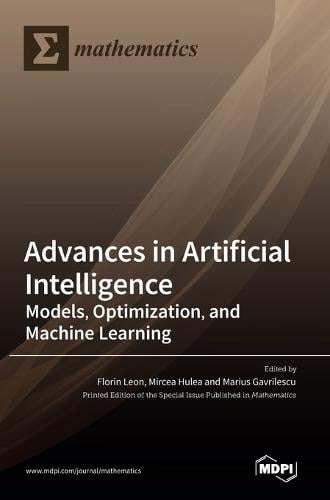
Advances in artificial intelligence: models, optimization, and machine learning
Contains all the articles accepted and published in the Special Issue “Advances in Artificial Intelligence: Models, Optimization, and Machine Learning” of the MDPI Mathematics journal, which covers a wide range of topics connected to the theory and applications of artificial intelligence and its subfields. These topics include, among others, deep learning and classic machine learning algorithms, neural modelling, architectures and learning algorithms, biologically inspired optimization algorithms, algorithms for autonomous driving, probabilistic models and Bayesian reasoning, intelligent agents and multiagent systems.

Advances in Artificial Intelligence ; 21st Conference of the Canadian Society for Computational Studies of Intelligence, Canadian AI 2008 Windsor, Canada, May 28-30, 2008 Proceedings
Constitutes the refereed proceedings of the 21st Conference of the Canadian Society for Computational Studies of Intelligence, Canadian AI 2008, held in Windsor, Canada, in May 2008.

Advances in Artificial Intelligence ; 20th Conference of the Canadian Society for Computational Studies of Intelligence, Canadian AI 2007, Montreal, Canada, May 28-30, 2007, Proceedings
This book cover agents, bioinformatics, classification, constraint satisfaction, data mining, knowledge representation and reasoning, learning, natural language, and planning.
