



الصفحة 6
الصفحة 6

Chinese Computational Linguistics ; 19th China National Conference, CCL 2020, Hainan, China, October 30 – November 1, 2020, Proceedings
This book constitutes the proceedings of the 19th China National Conference on Computational Linguistics, CCL 2020, held in Hainan, China, in October/November 2020. The 32 full and 2 short papers presented in this volume were carefully reviewed and selected from 99 submissions. They were organized in topical sections named: fundamental theory and methods of computational linguistics; information retrieval, dialogue and question answering; text generation and summarization; knowledge graph and information extraction; machine translation and multilingual information processing; minority language information processing; language resource and evaluation; social computing and sentiment analysis; and NLP applications.
Charting a new course : Natural language processing and information retrieval : Essays in Honour of Karen Spärck Jones
This book celebrates the life and work of Karen Spärck Jones in her seventieth year. she is one of the major figures of 20th century and early 21st Century computing and information processing. It book consists of fifteen new and original chapters written by leading international authorities reviewing the state of the art and her influence in the areas in which Karen Spärck Jones has been active. Although she has a publication record which goes back over forty years, it is clear even the very early work reviewed in the book can be read with profit by those working on recent developments in information processing like bioinformatics and the semantic web.

Artificial neural networks : Formal Models and Their Applications – ICANN 2005 ; 15th International Conference, Warsaw, Poland, September 11-15, 2005, Proceedings, Part II
The second volume contains 162 contributions related to Formal Models and their Applications and deals with new neural network models, supervised learning algorithms, ensemble-based learning, unsupervised learning, recurent neural networks, reinforcement learning, bayesian approaches to learning, learning theory, artificial neural networks for system modeling, decision making, optimalization and control, knowledge extraction from neural networks, temporal data analysis, prediction and forecasting, support vector machines and kernel-based methods, soft computing methods for data representation, analysis and processing, data fusion for industrial, medical and environmental applications, non-linear predictive models for speech processing, intelligent multimedia and semantics, applications to natural language processing, various applications, computational intelligence in games, and issues in hardware implementation.
Artificial Intelligence with Python
Introduces readers to various topics and examples of programming in Python, as well as key concepts in artificial intelligence. Python programming skills will be imparted as we go along. Concepts and code snippets will be covered in a step-by-step manner, to guide and instill confidence in beginners. Complex subjects in deep learning and machine learning will be broken down into easy-to-digest content and examples. Artificial intelligence implementations will also be shared, allowing beginners to generate their own artificial intelligence algorithms for reinforcement learning, style transfer, chatbots, speech, and natural language processing.

Artificial intelligence in education ; 21st International conference, AIED 2020, Ifrane, Morocco, July 6–10, 2020, Proceedings, Part II
This two-volume set LNAI 12163 and 12164 constitutes the refereed proceedings of the 21th International Conference on Artificial Intelligence in Education, AIED 2020, held in Ifrane, Morocco, in July 2020.* The 49 full papers presented together with 66 short, 4 industry & innovation, 4 doctoral consortium, and 4 workshop papers were carefully reviewed and selected from 214 submissions. The conference provides opportunities for the cross-fertilization of approaches, techniques and ideas from the many fields that comprise AIED, including computer science, cognitive and learning sciences, education, game design, psychology, sociology, linguistics as well as many domain-specific areas.

Artificial intelligence in education ; 21st International conference, AIED 2020, Ifrane, Morocco, July 6–10, 2020, Proceedings, Part I
This two-volume set LNAI 12163 and 12164 constitutes the refereed proceedings of the 21th International Conference on Artificial Intelligence in Education, AIED 2020, held in Ifrane, Morocco, in July 2020.* The 49 full papers presented together with 66 short, 4 industry & innovation, 4 doctoral consortium, and 4 workshop papers were carefully reviewed and selected from 214 submissions. The conference provides opportunities for the cross-fertilization of approaches, techniques and ideas from the many fields that comprise AIED, including computer science, cognitive and learning sciences, education, game design, psychology, sociology, linguistics as well as many domain-specific areas.

Artificial intelligence for multimedia signal processing
Artificial intelligence technologies are also actively applied to broadcasting and multimedia processing technologies. A lot of research has been conducted in a wide variety of fields, such as content creation, transmission, and security, and these attempts have been made in the past two to three years to improve image, video, speech, and other data compression efficiency in areas related to MPEG media processing technology. Additionally, technologies such as media creation, processing, editing, and creating scenarios are very important areas of research in multimedia processing and engineering. This book contains a collection of some topics broadly across advanced computational intelligence algorithms and technologies for emerging multimedia signal processing as: Computer vision field, speech/sound/text processing, and content analysis/information mining.
Artificial intelligence for customer relationship management : Solving customer problems
This book describes a number of applications of Artificial Intelligence in the field of Customer Relationship Management with the focus of solving customer problems. We design a system that tries to understand the customer complaint, his mood, and what can be done to resolve an issue with the product or service. To solve a customer problem efficiently, we maintain a dialogue with the customer so that the problem can be clarified and multiple ways to fix it can be sought. We introduce dialogue management based on discourse analysis: a systematic linguistic way to handle the thought process of the author of the content to be delivered. We analyze user sentiments and personal traits to tailor dialogue management to individual customers. We also design a number of dialogue scenarios for CRM with replies following certain patterns and propose virtual and social dialogues for various modalities of communication with a customer.

Artificial intelligence for customer relationship management : Keeping customers informed
Providing a forum for the exchange of ideas in AI, this book provides a concise yet comprehensive coverage of methodologies, tools, issues, applications, and future trends for professionals, managers, and researchers in the CRM field together with AI and IT professionals.

Artificial intelligence applications and innovations II; IFIP TC12 and WG12.5 ; 2nd IFIP conference on artificial intelligence applications and innovations (AIAI-2005), Sept. 7-9, 2005, Beijing, China
Artificial Intelligence is one of the oldest and most exciting subfields of computing, covnering such areas as intelligent robotics, intelligent planning and scheduling, model-based reasoning, fault diagnosis, natural language processing, maching translation, knowledge representation and reasoning, knowledge-based systems, knowledge engineering, intelligent agents, machine learning, neural nets, genetic algorithms and knowledge management. The papers in this volume comprise the refereed proceedings of the Second International Conference on Artificial Intelligence Applications and Innovations,held in Beijing, China in 2005.

Artificial intelligence : Methodology, systems, and applications ; 12th International Conference, AIMSA 2006, Varna, Bulgaria, September 12-15, 2006, Proceedings
This book constitutes the refereed proceedings of the 12th International Conference on Artificial Intelligence: Methodology, Systems, and Applications, AIMSA 2006. The 28 revised full papers presented together with the abstracts of 2 invited lectures were carefully reviewed and selected from 81 submissions. The papers are organized in topical sections on agents, constraints and optimization, user concerns, decision support, models and ontologies, machine learning, ontology manipulation, natural language processing, and applications.

Artificial intelligence : Methodology, systems, and applications ; 10th International Conference, AIMSA 2002, Varna, Bulgaria, September 4-6, 2002. Proceedings
The AIMSA conference series was frst conceived in 1984 as a gathering of AI researchers and students from Eastern and Central Europe.Sincethenthecon- rence has followed a biennial schedule of meetings in Bulgaria, attracting parti- pantsfrom awidergeographicalarea.The AIMSA organizers are delighted to present you with another exciting program, coveringmostareasof Artifcial Intelligence.Inkeepingwithitsm- sion to inform the research community and excite the commercial sector, AIMSA presents this year two invited contributions from world-leading European rese- chersworkingoncutting-edgeAIresearch: Prof.CaroleGoble, ontheSemantic Web.
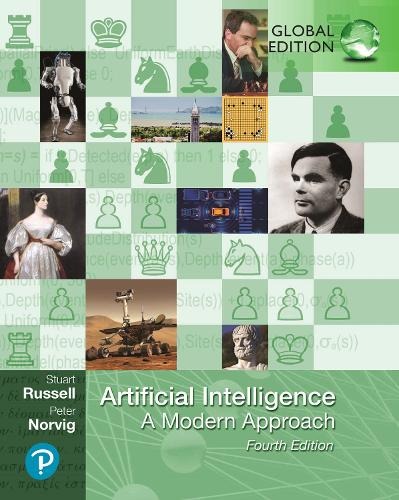
Artificial intelligence : A modern approach ; global ed.
Explores the full breadth and depth of the field of artificial intelligence (AI). The 4th edition brings readers up to date on the latest technologies, presents concepts in a more unified manner, and offers new or expanded coverage of machine learning, deep learning, transfer learning, multi agent systems, robotics, natural language processing, causality, probabilistic programming, privacy, fairness, and safe AI

Argumentation in multi-agent systems ; 4th International Workshop, ArgMAS 2007, Honolulu, HI, USA, May 15, 2007, revised selected and invited papers
This volume presents the latest developments in the growing area of research at the interface of argumentation theory and multiagent systems. Argumentation provides tools for designing, implementing and analyzing sophisticated forms of interaction among rational agents.

Arabic and Chinese Handwriting Recognition ; SACH 2006 Summit College Park, MD, USA, September 27-28, 2006 Selected Papers
Cheriet provides an overview of the problems of Arabic recognition and how systems can use natural language processing techniques to correct errors in lexicon-based systems.

Arabic AI-generated adverts = إعلانات عربية مولدة بالذكاء الاصطناعي
In the ever-evolving landscape of digital marketing, our groundbreaking platform emerges, harnessing the power of artificial intelligence to revolutionize the creation of marketing campaigns. This innovative solution seamlessly combines neural networks, natural language generation, and multimedia processing capabilities to generate comprehensive and personalized marketing assets from a single product image. At its core, the platform leverages deep learning models that analyze the visual characteristics of the uploaded product image and identifies key features and attributes to define the product category, this enables the generation of compelling and persuasive marketing content tailored to the specific product. The platform's multi-faceted approach encompasses three distinct components: text generation, poster creation, and video advertisement production. Utilizing advanced natural language generation techniques, it crafts engaging marketing text that captures the essence and unique selling points of the product. Simultaneously, its image processing capabilities produce visually stunning promotional posters that blend the product image with eye-catching graphics and typography. along with creating captivating video advertisements optimized for social media and online advertising campaigns.
An Intuitive Exploration of Artificial Intelligence : Theory and Applications of Deep Learning
This book develops a conceptual understanding of Artificial Intelligence (AI), Deep Learning and Machine Learning in the truest sense of the word. It is an earnest endeavor to unravel what is happening at the algorithmic level, to grasp how applications are being built and to show the long adventurous road in the future.

An introduction to ontology engineering
Provides the reader with a comprehensive introductory overview of ontology engineering. A secondary aim is to provide hands-on experience in ontology development that illustrate the theory. The book is divided into three blocks: Block I: logic foundations for ontologies both regarding the languages (mainly First Order predicate Logic, Description Logics, and OWL) and automated reasoning. Block II: developing good ontologies with methods and methodologies, the top-down approach with foundational ontologies, and the bottom-up approach to extract as much useful content as possible from legacy material. Block III: advanced topics with a selection of areas of specialisation, including Ontology-Based Data Access, the interaction between ontologies and natural languages (multilingual ontologies, controlled natural language), and advanced modelling with additional language features (fuzzy and temporal ontologies)

An Introduction to Language Processing with Perl and Prolog : An Outline of Theories, Implementation, and Application with Special Consideration of English, French, and German
This book teaches the principles of natural language processing, first covering linguistics issues such as encoding, entropy, and annotation schemes; defining words, tokens and parts of speech; and morphology. It then details the language-processing functions involved, including part-of-speech tagging using rules and stochastic techniques; using Prolog to write phase-structure grammars; parsing techniques and syntactic formalisms; semantics, predicate logic and lexical semantics; and analysis of discourse, and applications in dialog systems. The key feature of the book is the author's hands-on approach throughout, with extensive exercises, sample code in Prolog and Perl, and a detailed introduction to Prolog. The reader is supported with a companion website that contains teaching slides, programs, and additional material.

Algorithmic learning theory ; 19th International Conference, ALT 2008, Budapest, Hungary, October 13-16, 2008. Proceedings
This book constitutes the refereed proceedings of the 19th International Conference on Algorithmic Learning Theory, ALT 2008, held in Budapest, Hungary, in October 2008, co-located with the 11th International Conference on Discovery Science, DS 2008.
