



الصفحة 47
الصفحة 47
Advances in cryptology -- ASIACRYPT 2006 ; 12th International conference on the theory and application of cryptology and information security, Shanghai, China, December 3-7, 2006, Proceedings
This book constitutes the refereed proceedings of the 12th International Conference on the Theory and Application of Cryptology and Information Security, held in Shanghai, China, December 2006. The 30 revised full papers cover attacks on hash functions, stream ciphers, biometrics and ECC computation, id-based schemes, public-key schemes, RSA and factorization, construction of hash function, protocols, block ciphers, and signatures.
Advances in cryptology – ASIACRYPT 2005 ; 11th International conference on the theory and application of cryptology and information security, Chennai, India, December 4-8, 2005, Proceedings
This book constitutes the proceedings of the 11th International Conference on the Theory and Application of Cryptology and Information Security, This conference was organized by the InternationalAssociation for Cryptologic Research (IACR) in cooperation with the IndianInstitute of Technology (IIT), Chennai.This year a total of 237 papers were submitted to Asiacrypt 2005. The submis-sions covered all areas of cryptographic research representing the current state ofwork in the crypto community worldwide, includ : Topics Coding and Information Theory Cryptology / Operating Systems / Algorithm Analysis and Problem Complexity / Management of Computing and Information Systems / Computer Communication Networks"
Advances in cryptology - CRYPTO -87 ; Conference on the theory and applications of cryptographic techniques : Proceedings
Zero-knowledge interactive proofsystems are a new technique which can be used as a cryptographic tool for designing provably secure protocols. Goldwasser, Micali, and Rackoff originally suggested this technique for controlling the knowledge released in an interactive proof of membership in a language, and for classification of languages. In this approach, knowledge is defined in terms of complexity to convey knowledge if it gives a computational advantage to the receiver, theory, and a message is said for example by giving him the result of an intractable computation. The formal model of interacting machines is described in. A proof-system (for a language L) is an interactive protocol by which one user, the prover, attempts to convince another user, the verifier, that a given input x is in L. We assume that the verifier is a probabilistic machine which is limited to expected polynomial-time computation, while the prover is an unlimited probabilistic machine.
Advances in computer graphics and computer vision ; International conferences VISAPP and GRAPP 2006, Setúbal, Portugal, February 25-28, 2006, Revised Selected Papers
Includes selected papers from the first International Conferences on Computer Vision Theory and Applications (VISAPP), and Computer Graphics Theory and Applications (GRAPP),
Advances in Computational Collective Intelligence ; 12th International Conference, ICCCI 2020, Da Nang, Vietnam, November 30 – December 3, 2020, Proceedings
Constitutes refereed proceedings of the 12th International Conference on International Conference on Computational Collective Intelligence, ICCCI 2020, held in Da Nang, Vietnam, in November – December 2020. Due to the the COVID-19 pandemic the conference was held online. The 68 papers were thoroughly reviewed and selected from 314 submissions. The papers are organized according to the following topical sections: data mining and machine learning; deep learning and applications for industry 4.0; recommender systems; computer vision techniques; decision support and control systems; intelligent management information systems; innovations in intelligent systems; intelligent modeling and simulation approaches for games and real world systems; experience enhanced intelligence to IoT; data driven IoT for smart society; applications of collective intelligence; natural language processing; low resource languages processing; computational collective intelligence and natural language processing.
Advances in Brain, Vision, and Artificial Intelligence ; 2nd International Symposium, BVAI 2007, Naples, Italy, October 10-12, 2007, Proceedings
This book address the following main topics: Basic Models in Visual Sciences, Cortical Mechanism of Vision, Color Processing in Natural Vision, Action Oriented Vision, Visual Recognition and Attentive Modulation, Biometric Recognition, Image Segmentation and Recognition, Disparity Calculation and Noise Analysis, Signal Identification in Neural Models, Natural and Artificial Representation Issues in Artificial Intelligence, Meaning-Interaction-Emotion, Robot Navigation and Control.

Advances in biometric person authentication ; Vol. 3781 ; International workshop on biometric recognition systems, IWBRS 2005, Beijing, China, October 22 – 23, 2005, Proceedings
Constitutes the refereed proceedings of the 5th Chinese Conference on Biometric Recognition, SINOBIOMETRICS 2004, held in Guanzhou, China in December 2004. The 60 revised full papers presented together with 14 invited papers by internationally leading researchers were carefully reviewed and selected from 140 submissions. The papers are organized in topical sections on biometrics, best performing biometric engines, face localization, pose estimation, face recognition, 3D based methods, subspace and discriminant analysis, systems and applications, fingerprint preprocessing and minutiae extraction, fingerprint recognition and matching, fingerprint classificaiton, iris recognition, speaker recognition, and other biometric primitives.

Advances in bioinformatics and computational biology ; 1st Brazilian symposium on bioinformatics, BSB 2005, Sao Leopoldo, Brazil, July 27-29, 2005, Proceedings
This book constitutes the refereed proceedings of the Brazilian Symposium on Bioinformatics, BSB 2005, The 15 revised full papers and 10 revised extended abstracts presented together with 3 invited papers were carefully reviewed and selected from 55 submissions. The papers address a broad range of current topics in computational biology and bioinformatics.

Advances in Big Data Analytics : Theory, Algorithms and Practices
Provides a comprehensive and cutting-edge study on big data analytics, based on the research findings and applications developed by the author and his colleagues in related areas. It addresses the concepts of big data analytics and/or data science, multi-criteria optimization for learning, expert and rule-based data analysis, support vector machines for classification, feature selection, data stream analysis, learning analysis, sentiment analysis, link analysis, and evaluation analysis. The book also explores lessons learned in applying big data to business, engineering and healthcare. Lastly, it addresses the advanced topic of intelligence-quotient (IQ) tests for artificial intelligence.
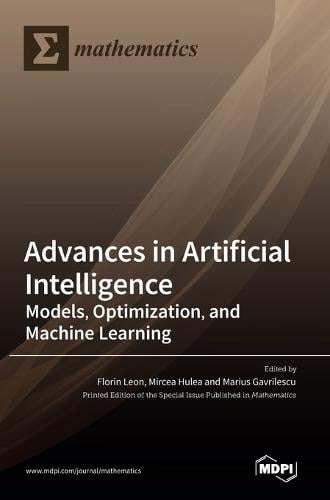
Advances in artificial intelligence: models, optimization, and machine learning
Contains all the articles accepted and published in the Special Issue “Advances in Artificial Intelligence: Models, Optimization, and Machine Learning” of the MDPI Mathematics journal, which covers a wide range of topics connected to the theory and applications of artificial intelligence and its subfields. These topics include, among others, deep learning and classic machine learning algorithms, neural modelling, architectures and learning algorithms, biologically inspired optimization algorithms, algorithms for autonomous driving, probabilistic models and Bayesian reasoning, intelligent agents and multiagent systems.
Advanced Techniques in Knowledge Discovery and Data Mining
This explosion is a result of the growing use of electronic media. But what is data mining (DM)? A Web search using the Google search engine retrieves many (really many) definitions of data mining. We include here a few interesting ones. One of the simpler definitions is: “As the term suggests, data mining is the analysis of data to establish relationships and identify patterns” [1]. It focuses on identifying relations in data. Our next example is more elaborate: An information extraction activity whose goal is to discover hidden facts contained in databases. Using a combination of machine learning, statistical analysis, modeling techniques and database technology, data mining finds patterns and subtle relationships in data and infers rules that allow the prediction of future results. Typical applications include market segmentation, customer profiling, fraud detection, evaluation of retail promotions, and credit risk analysis .

Advanced technique and future perspective for next generation optical fiber communications
Optical fiber communication industry has gained unprecedented opportunities and achieved rapid progress in recent years. However, with the increase of data transmission volume and the enhancement of transmission demand, the optical communication field still needs to be upgraded to better meet the challenges in the future development. Artificial intelligence technology in optical communication and optical network is still in its infancy, but the existing achievements show great application potential. In the future, with the further development of artificial intelligence technology, AI algorithms combining channel characteristics and physical properties will shine in optical communication. This reprint introduces some recent advances in optical fiber communication and optical network, and provides alternative directions for the development of the next generation optical fiber communication technology.
Advanced Methods for Inconsistent Knowledge Management
This book presents a unified and systematic description of a wide class of miscellaneous problems of inconsistent knowledge management, analyzed by traditional mathematical methods using relational and logical representations.

Advanced mathematical science for mobility society
The automotive industry has made steady progress in technological innovations under the names of Connected Autonomous-Shared-Electric (CASE) and Mobility as a Service (MaaS). Needless to say, mathematics and informatics are important to support such innovations. As the concept of cars and movement itself is diversifying, they are indispensable for grasping the essence of the future mobility society and building the foundation for the next generation. This book contains three main contents. 1. Mathematical models of flow 2. Mathematical methodsfor huge data and network analysis 3. Algorithm for mobility society The first one discusses mathematical models of pedestrian and traffic flow, as they are important for preventing accidents and achieving efficient transportation.
Advanced machine learning and deep learning approaches for remote sensing
Provides research on how technologies such as artificial intelligence-based machine learning and deep learning can be applied to remote sensing. Through this, we can see the process of solving the existing problems of image and image signal processing for remote sensing. These techniques are computationally intensive and require the help of high-performance computing devices. With the development of devices such as GPUs, remote sensing technology, and aerial sensing technology, it is possible to monitor the Earth with high-resolution images and to obtain vast amounts of Earth observation data. The papers published in this reprint describe recent advances in big data processing and artificial intelligence-based technologies for remote sensing technology.

Advanced Intelligent Computing Theories and Applications. With Aspects of Theoretical and Methodological Issues ; 4th International Conference on Intelligent Computing, ICIC 2008 Shanghai, China, September 15-18, 2008 Proceedings
This book - in conjunction with the two volumes CCIS 0015 and LNAI 5226 - constitutes the refereed proceedings of the 4th International Conference on Intelligent Computing, ICIC 2008, held in Shanghai, China, in September 2008.

Advanced Intelligent Computing Theories and Applications. With Aspects of Theoretical and Methodological Issues ; 3rd International Conference on Intelligent Computing, ICIC 2007 Qingdao, China, August 21-24, 2007 Proceedings
Provides an annual forum dedicated to the emerging and challenging topics in artificial intelligence, machine learning, bioinformatics, and computational biology, etc. It aims to bring - gether researchers and practitioners from both academia and industry to share ideas, problems and solutions related to the multifaceted aspects of intelligent computing. This year, the conference concentrated mainly on the theories and methodologies as well as the emerging applications of intelligent computing. Its aim was to unify the picture of contemporary intelligent computing techniques as an integral concept that highlights the trends in advanced computational intelligence and bridges theoretical research with applications.

AdvancED Flex Application Development : Building Rich Media X
Many Flex books cover the basics—this book does something different, and goes far further. The authors, leading Flash platform developers at Almer/Blank, working with Adobe User Group communities, are the creators of the Rich Media Exchange (RMX), a social media network for Adobe developers. In covering just how the RMX was built, this book contains all the knowledge you need to build similar large-scale rich Internet applications with Adobe Flex. From the inception of the idea through to deployment, the authors show the techniques needed to plan and build advanced applications. You'll learn how to use forms, styles, validators, video, sound analysis, and framework caching, ensuring you make the most of the features introduced in Flex 3.

Advanced encryption standard - AES ; 4th International Conference, AES 2004, Bonn, Germany, May 10-12, 2004, Revised Selected and Invited Papers
This volume comprises the proceedings of the 4th Conference on Advanced En-cryption Standard, ‘AES — State of the Crypto Analysis,’ which was held inBonn, Germany, 2004.The conference followed a series of events organized by the US National In-stitute of Standards and Technology (NIST) in order to hold an internationalcompetition to decide on an algorithm to serve as the Advanced EncryptionStandard (AES). In 1998, at the first AES conference (AES 1), 15 different algo-rithms were presented, discussed, reviewed and verified. After a further conferencedevoted to verification, testing and examination of the candidate algorithms inorder to prove their performance and security, one winning algorithm remained.The encryption scheme Rijndael, designed by the Belgian cryptographers JoanDaemen and Vincent Rijmen, was selected in 2000 to become the successor tothe famous DES (Data Encryption Standard) and it is now the Advanced En-cryption Standard.

Advanced Data Warehouse Design : From Conventional to Spatial and Temporal Applications
This book serves as an introduction to the state of the art on data warehouse design, with many references to more detailed sources. Providing a clear and a concise presentation of the major concepts and results of data warehouse design, it can also be used as the basis of a graduate or advanced undergraduate course.
