



الصفحة 46
الصفحة 46

Distributed applications and interoperable systems ; Vol. 3543 ; 5th IFIP WG 6.1 International conference, DAIS 2005, Athens, Greece, June 15-17, 2005, Proceedings
ThisvolumecontainstheproceedingsoftheIFIPWG6. 1InternationalWorking Conference on Distributed Applications and Interoperable Systems V held in Athens, Greece, on June 15–17, 2005. The conference program presented the state of the art in research concerning distributed and interoperable systems. The emergence of 4th-generation c- munication systems, the evolution of Internet technologies, the convergence of telecom and datacom, wireless and ?xed communication systems and appli- tions pave the path for ubiquitous service and application provision. Innovative solutions are required for the development, implementation and operation of distributed applications in complex IT environments full of diversity and h- erogeneity. Today, the emerging wide spectrum of distributed systems.

Distributed Applications and Interoperable Systems ; 8th IFIP WG 6.1 International Conference, DAIS 2008, Oslo, Norway, June 4-6, 2008. Proceedings
This volume contains the proceedings of DAIS 2008, the 8th IFIP International Conference on Distributed Applications and Interoperable Systems.

Distributed Applications and Interoperable Systems ; 7th IFIP WG 6.1 International Conference, DAIS 2007, Paphos, Cyprus, June 6-8, 2007, Proccedings
This book presented context-awareness, adaptation, mobility, distributed applications and peer-to-peer computing, all of which relate to the sustainability of distributed applications and integrated systems.

Distributed and Parallel Systems : In Focus : Desktop Grid Computing
In this book contributors investigate parallel and distributed techniques, algorithms, models and applications; present innovative software tools, environments and middleware; focus on various aspects of grid computing; and introduce novel methods for development, deployment, testing and evaluation.
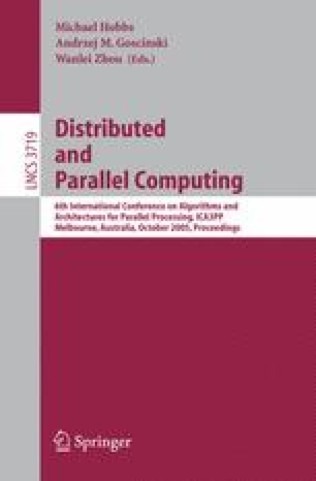
Distributed and parallel computing ; 6th International conference on algorithms and architectures for parallel processing, ICA3PP, Melbourne, Australia, October 2-3, 2005, Proceedings
There are many applications that require parallel and distributed processing to allow complicated engineering, business and research problems to be solved in a reasonable time. Parallel and distributed processing is able to improve company profit, lower costs of design, production, and deployment of new technologies, and create better business environments. The major lesson learned by car and aircraft engineers, drug manufacturers, genome researchers and other specialist is that a computer system is a very powerful tool that is able to help them solving even more complicated problems. That has led computing specialists to new computer system architecture and exploiting parallel computers, clusters of clusters, and distributed systems in the form of grids.

Disruptive trends in automation technology
The industrial sector is being transformed by the convergence of information technology and operational technology. The latter is another name for automation technology and covers established systems such as supervisory control and data acquisition (SCADA), programmable logic controllers (PLC), fieldbuses, and automation and control systems. As this technology is connected to the Internet and 5G networks, some monitoring, control, and analytic functionalities are deployed to the edge or cloud, and researchers are challenged to ensure the security, dependability, real-time performance, and maintainability of the resulting systems. The big data that is accessible from these systems create opportunities for artificial intelligence applications that can further disrupt the established practices in the automation domain.

Discrete Mathematics Using a Computer
Discrete Mathematics Using a Computer offers a new, "hands-on" approach to teaching Discrete Mathematics. Using software that is freely available on Mac, PC and Unix platforms, the functional language Haskell allows students to experiment with mathematical notations and concepts -- a practical approach that provides students with instant feedback and allows lecturers to monitor progress easily.

Discrete geometry for computer imagery ; Vol. 3429 ; 12th International Conference, DGCI 2005, Poitiers, France, April 11-13, 2005, Proceedings
This book constitutes the refereed proceedings of the 12th International Conference on Discrete Geometry for Computer Imagery, DGCI 2005, held in Poitiers, France in April 2005. The 36 revised full papers presented together with an invited paper were carefully reviewed and selected from 53 submissions. The papers are organized in topical sections on applications, discrete hierarchical geometry, discrete tomography, discrete topology, object properties, reconstruction and recognition, uncertain geometry, and visualization.

Discrete Geometry for Computer Imagery ; 14th IAPR International Conference, DGCI 2008, Lyon, France, April 16-18, 2008. Proceedings
This book constitutes the refereed proceedings of the 14th IAPR TC-18 International Conference on Discrete Geometry for Computer Imagery, DGCI 2008, held in Lyon, France, in April 2008.

Discrete and computational geometry; Japanese Conference, JCDCG 2004, Tokyo, Japan, October 8-11, 2004
This book constitutes the thoroughly refereed post-proceedings of the Japanese Conference on Discrete Computational Geometry, JCDCG 2004, held in Tokyo, Japan in October 2004, to honor Janos Pach on his fiftieth year. The 20 revised full papers presented were carefully selected during two rounds of reviewing and improvement from over 60 talks at the conference. All current issues in discrete algorithmic geometry are addressed.

Discovery Science ; 11th International Conference, DS 2008, Budapest, Hungary, October 13-16, 2008. Proceedings
This book constitutes the refereed proceedings of the 11th International Conference on Discovery Science, DS 2008, held in Budapest, Hungary, in October 2008, co-located with the 19th International Conference on Algorithmic Learning Theory, ALT 2008.

Direct Transistor-level Layout for Digital Blocks
The essential flaw in prior efforts is an over-reliance on geometric assumptions from large-scale cell-based layout algorithms. Individual transistors may seem simple, but they do not pack as gates do. Algorithms that ignore these shape-level issues suffer the consequences when thousands of devices are poorly packed. The approach described in this book can pack devices much more densely than a typical cell-based layout

Direct and inverse Sturm-Liouville problems : A method of solution
This book provides an introduction to the most recent developments in the theory and practice of direct and inverse Sturm-Liouville problems on finite and infinite intervals. A universal approach for practical solving of direct and inverse spectral and scattering problems is presented, based on the notion of transmutation (transformation) operators and their efficient construction. Analytical representations for solutions of Sturm-Liouville equations as well as for the integral kernels of the transmutation operators are derived in the form of functional series revealing interesting special features and lending themselves to direct and simple numerical solution of a wide variety of problems.

Digitization of healthcare data using blockchain
Gives a detailed description of the integration of blockchain technology for Electronic Health Records and provides the research challenges to consider in various disciplines such as supply chain, drug discovery, and data management. he aim of the book is to investigate the concepts of blockchain technology and its association with the recent development and advancements in the medical field. Moreover, it focuses on the integration of workflow strategies like NLP, and AI which could be adopted for boosting the clinical documentation and electronic healthcare records (EHR) usage by bringing down the physician EHR data entry. Also, the book covers the usage of smart contracts for securing patient records. Digitization of Healthcare Data Using Blockchain presents the practical implementations that deal with developing a web framework for building highly usable healthcare applications, a simple blockchain-powered EHR system.

Digitally Archiving Cultural Objects
Digitally Archiving Cultural Objects describes thorough research and methods for preserving cultural heritage objects through the use of 3D digital data. These methods were developed through using computer vision and computer graphics technologies.

Digital Watermarking ; Vol. 3710 ; 4th International Workshop, IWDW 2005, Siena, Italy, September 15-17, 2005, Proceedings
We are delighted to welcome the attendees of the Fourth International Wo- shop on Digital Watermarking (IWDW). Watermarking continues to generate strong academic interest. Commercialization of the technology is proceeding at a steadypace. We haveseen watermarkingadoptedfor DVD audio.Fingerpri- ing technology was successfully used to determine the source of pirated video material. Furthermore, a number of companies are using watermarking as an enabling technology for broadcast monitoring services. Watermarking of digital cinema contentis anticipated. Future applications may also come from areas- related to digital rights management. For example, the use of watermarking to enhance legacy broadcast and communication systems is now being considered. IWDW 2005 o?ers an opportunity to re?ect upon the state of the art in digital watermarking as well as discuss directions for future research and applications. This year we accepted 31 papers from 74 submissions. This 42% acceptance rate indicates our commitment to ensuring a very high quality conference.

Digital watermarking ; Vol. 3304 ; 3rd International Workshop, IWDW 2004, Seoul, Korea, October 30 - November 1, 2004, revised selected papers
We are happy to present to you the proceedings of the 3rd International Workshop on Digital Watermarking, IWDW 2004. Since its modern reappearance in the academic community in the early 1990s, great progress has been made in understanding both the capabilities and the weaknesses of digital watermarking. On the theoretical side, we all are now well aware of the fact that digital watermarking is best viewed as a form of communication using side information. In the case of digital watermarking the side information in question is the document to be watermarked. This insight has led to a better understanding of the limits of the capacity and robustness of digital watermarking algorithms. It has also led to new and improved watermarking algorithms, both in terms of capacity and imperceptibility. Similarly, the role of human perception, and models thereof, has been greatly enhanced in the study and design of digital watermarking algorithms and systems. On the practical side, applications of watermarking are not yet abundant. The original euphoria on the role of digital watermarking in copy protection and copyright protection has not resulted in widespread use in practical systems. With hindsight, a number of reasons can be given for this lack of practical applications.

Digital video concepts, methods, and metrics : Quality, compression, performance, and power trade-off analysis
Digital Video Concepts, Methods, and Metrics: Quality, Compression, Performance, and Power Trade-off Analysis is a concise reference for professionals in a wide range of applications and vocations. It focuses on giving the reader mastery over the concepts, methods and metrics of digital video coding, so that readers have sufficient understanding to choose and tune coding parameters for optimum results that would suit their particular needs for quality, compression, speed and power.

Digital twin technology : fundamentals and applications
Provides an in-depth examination of digital twin technology to take you on an enthralling trip across the intersection of the virtual and real worlds. It explores the transformational impact of digital twins, from their roots in engineering to their widespread applications in manufacturing, health care, and other areas. Real-world case studies highlight the practical benefits, while potential hazards are addressed wisely. This book is your guide to comprehending the present and visualizing a future where digital twins transform innovation, efficiency, and connectedness in our increasingly complicated world. Begin this illuminating trip and embrace the possibilities that exist at the intersection of the physical and digital worlds.

Digital twin : Architectures, networks, and applications
Offers comprehensive, self-contained knowledge on digital twin (DT), which is a very promising technology for achieving digital intelligence in the next-generation wireless communications and computing networks. DT is a key technology to connect physical systems and digital spaces in Metaverse. The objectives of this book are to provide the basic concepts of DT, to explore the promising applications of DT integrated with emerging technologies, and to give insights into the possible future directions of DT. For easy understanding, this book also presents several use cases for DT models and applications in different scenarios. The book starts with the basic concepts, models, and network architectures of DT. Then, we present the new opportunities when DT meets edge computing, Blockchain and Artificial Intelligence, and distributed machine learning (e.g., federated learning, multi-agent deep reinforcement learning).
