



الصفحة 43
الصفحة 43

Artificial intelligence in theory and practice II : IFIP 20th World Computer Congress, TC 12 : IFIP AI 2008 Stream, September 7-10, 2008, Milano, Italy
The IFIP series publishes state-of-the-art results in the sciences and technologies of information and communication. The principal aim of the IFIP series is to encourage education and the dissemination and exchange of information about all aspects of computing.
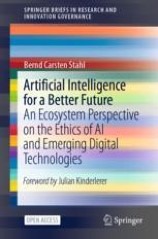
Artificial Intelligence for a better future : An ecosystem perspective on the ethics of AI and emerging digital technologies
This book proposes a novel approach to Artificial Intelligence (AI) ethics. AI offers many advantages: better and faster medical diagnoses, improved business processes and efficiency, and the automation of boring work.
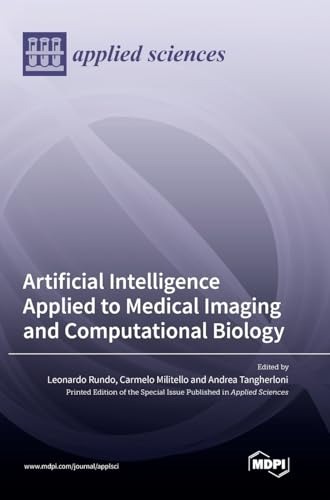
Artificial intelligence applied to medical imaging and computational biology
Medical imaging and computational biology continuously pose new fundamental medical and biological questions that often give rise to novel challenges in Artificial Intelligence. These research fields present an increasing need for the application of cutting-edge computational approaches that generally involve machine learning or computational intelligence techniques, which can effectively perform bioimage and biosignal processing in different clinical areas.

Artificial intelligence and security ; 6th International Conference, ICAIS 2020, Hohhot, China, July 17–20, 2020, Proceedings, Part II
This two-volume set LNCS 12239-12240 constitutes the refereed proceedings of the 6th International Conference on Artificial Intelligence and Security, ICAIS 2020, which was held in Hohhot, China, in July 2020. The conference was formerly called “International Conference on Cloud Computing and Security” with the acronym ICCCS. The total of 142 full papers presented in this two-volume proceedings was carefully reviewed and selected from 1064 submissions. The papers were organized in topical sections as follows: Part I: Artificial intelligence and internet of things. Part II: Internet of things, information security, big data and cloud computing, and information processing.

Artificial intelligence and security ; 6th International Conference, ICAIS 2020, Hohhot, China, July 17–20, 2020, Proceedings, Part I
This two-volume set LNCS 12239-12240 constitutes the refereed proceedings of the 6th International Conference on Artificial Intelligence and Security, ICAIS 2020, which was held in Hohhot, China, in July 2020. The conference was formerly called “International Conference on Cloud Computing and Security” with the acronym ICCCS. The total of 142 full papers presented in this two-volume proceedings was carefully reviewed and selected from 1064 submissions. The papers were organized in topical sections as follows: Part I: Artificial intelligence and internet of things. Part II: Internet of things, information security, big data and cloud computing, and information processing.
Artificial intelligence and national security
Analyses the implications of the technical, legal, ethical and privacy challenges as well as challenges for human rights and civil liberties regarding Artificial Intelligence (AI) and National Security. It also offers solutions that can be adopted to mitigate or eradicate these challenges wherever possible. As a general-purpose, dual-use technology, AI can be deployed for both good and evil. The use of AI is increasingly becoming of paramount importance to the governments mission to keep their nations safe. However, the design, development and use of AI for national security poses a wide range of legal, ethical, moral and privacy challenges. This book explores national security uses for Artificial Intelligence (AI) in Western Democracies and its malicious use. This book also investigates the legal, political, ethical, moral, privacy and human rights implications of the national security uses of AI in the aforementioned democracies. It illustrates how AI for national security purposes could threaten most individual fundamental rights, and how the use of AI in digital policing could undermine user human rights and privacy.
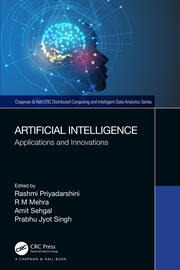
Artificial Intelligence : Applications and innovations
It's about the science of artificial intelligence (AI). AI is the study of the design of intelligent computational agents. This book provides a valuable resource for researchers, scientists, professionals, academicians and students dealing with the new challenges and advances in the areas of AI and innovations. This book also covers a wide range of applications of machine learning such as fire detection, structural health and pollution monitoring and control. Provides insight into prospective research and application areas related to industry and technology / Discusses industry- based inputs on success stories of technology adoption / Discusses technology applications from a research perspective in the field of AI / Provides a hands- on approach and case studies for readers of the book to practice and assimilate learning
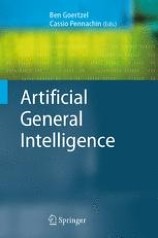
Artificial general intelligence
This book focused on engineering general intelligence – autonomous, self-reflective, self-improving, commonsensical intelligence.Each author explains a specific aspect of AGI in detail in each chapter, while also investigating the common themes in the work of diverse groups, and posing the big, open questions in this vital area.

Artificial evolution ; 8th International Conference, Evolution artificielle, EA 2007, Tours, France, October 29-31, 2007, revised selected papers
This book constitutes the thoroughly refereed post-conference proceedings of the 8th International Conference on Artificial Evolution, EA 2007, held in Tours, France in October 2007.

Artificial evolution ; 7th International Conference, Evolution artificielle, EA 2005, revised selected papers
This book constitutes the thoroughly refereed post-proceedings of the 7th International Conference on Artificial Evolution, EA 2005, held in Lille, France, in October 2005. They cover all aspects of artificial evolution: genetic programming, machinelearning, combinatorial optimization, co-evolution, self-assembling, artificial lifeand bioinformatics.In addition, the program included an invited talk by David Corne on “Evolu-tionary Computation in Bioinformatics: How to Save Lives and Make ScientificBreakthrough.

Arithmetic of finite fields ; 2nd International Workshop, WAIFI 2008 Siena, Italy, July 6-9, 2008 Proceedings
This book constitutes the refereed proceedings of the Second International Workshop on the Arithmetic of Finite Fields, WAIFI 2008, held in Siena, Italy, in July 2008.
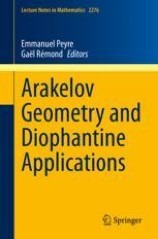
Arakelov Geometry and Diophantine Applications
Bridging the gap between novice and expert, the aim of this book is to present in a self-contained way a number of striking examples of current diophantine problems to which Arakelov geometry has been or may be applied. Arakelov geometry can be seen as a link between algebraic geometry and diophantine geometry.The first chapters provide some background and introduction to the subject. These are followed by a presentation of different applications to arithmetic geometry. The final part describes the recent application of Arakelov geometry to Shimura varieties and the proof of an averaged version of Colmez's conjecture. This book thus blends initiation to fundamental tools of Arakelov geometry with original material corresponding to current research.

Arabic talking heads
The need for someone to talk to about what is going on inside us while ensuring privacy has become a necessary requirement, especially since some people in our Arab societies judge people who visit a psychiatrist as mentally ill. Therefore, in this project, we propose a solution to the previous problem, where an Arabic-speaking robot, through an interactive chat application can mitigate the psychological and negative effects that humans are exposed to in various cases.

Arabic AI-generated adverts = إعلانات عربية مولدة بالذكاء الاصطناعي
In the ever-evolving landscape of digital marketing, our groundbreaking platform emerges, harnessing the power of artificial intelligence to revolutionize the creation of marketing campaigns. This innovative solution seamlessly combines neural networks, natural language generation, and multimedia processing capabilities to generate comprehensive and personalized marketing assets from a single product image. At its core, the platform leverages deep learning models that analyze the visual characteristics of the uploaded product image and identifies key features and attributes to define the product category, this enables the generation of compelling and persuasive marketing content tailored to the specific product. The platform's multi-faceted approach encompasses three distinct components: text generation, poster creation, and video advertisement production. Utilizing advanced natural language generation techniques, it crafts engaging marketing text that captures the essence and unique selling points of the product. Simultaneously, its image processing capabilities produce visually stunning promotional posters that blend the product image with eye-catching graphics and typography. along with creating captivating video advertisements optimized for social media and online advertising campaigns.
Applied Deep Learning with TensorFlow 2 : Learn to Implement Advanced Deep Learning Techniques with Python
Focuses on the fundamental concepts and at the same time on practical aspects of implementing neural networks and deep learning for your research projects. This book is designed so that you can focus on the parts you are interested in. You will explore topics as regularization, optimizers, optimization, metric analysis, and hyper-parameter tuning. In addition, you will learn the fundamentals ideas behind autoencoders and generative adversarial networks. All the code presented in the book will be available in the form of Jupyter notebooks which would allow you to try out all examples and extend them in interesting ways. A companion online book is available with the complete code for all examples discussed in the book and additional material more related to TensorFlow and Keras. All the code will be available in Jupyter notebook format and can be opened directly in Google Colab (no need to install anything locally) or downloaded on your own machine and tested locally. You will: Understand the fundamental concepts of how neural networks work / Learn the fundamental ideas behind autoencoders and generative adversarial networks / Be able to try all the examples with complete code examples that you can expand for your own projects / Have available a complete online companion book with examples and tutorials.

Applied cryptography and network security Workshops ; ACNS 2020 Satellite Workshops, AIBlock, AIHWS, AIoTS, Cloud S&P, SCI, SecMT, and SiMLA, Rome, Italy, October 19–22, 2020, Proceedings
This book constitutes the proceedings of the satellite workshops held around the 18th International Conference on Applied Cryptography and Network Security, ACNS 2020, in Rome, Italy, in October 2020.

Applied cryptography and network security ; 19th International Conference, ACNS 2021, Kamakura, Japan, June 21–24, 2021, Proceedings, Part I
The two-volume set LNCS 12726 + 12727 constitutes the proceedings of the 19th International Conference on Applied Cryptography and Network Security, ACNS 2021, which took place virtually during June 21-24, 2021. The 37 full papers presented in the proceedings were carefully reviewed and selected from a total of 186 submissions. They were organized in topical sections as follows: Part I: Cryptographic protocols; secure and fair protocols; cryptocurrency and smart contracts; digital signatures; embedded system security; lattice cryptography; Part II: Analysis of applied systems; secure computations; cryptanalysis; system security; and cryptography and its applications.

Applied cryptography and network security ; 18th International Conference, ACNS 2020, Rome, Italy, October 19–22, 2020, Proceedings, Part II
This two-volume set of LNCS 12146 and 12147 constitutes the refereed proceedings of the 18th International Conference on Applied Cryptography and Network Security, ACNS 2020, held in Rome, Italy, in October 2020.The conference was held virtually due to the COVID-19 pandemic. The 46 revised full papers presented were carefully reviewed and selected from 214 submissions. The papers were organized in topical sections named: cryptographic protocols cryptographic primitives, attacks on cryptographic primitives, encryption and signature, blockchain and cryptocurrency, secure multi-party computation, post-quantum cryptography.

Applied Cryptography and Network Security ; 18th International Conference, ACNS 2020, Rome, Italy, October 19–22, 2020, Proceedings, Part I
This two-volume set of LNCS 12146 and 12147 constitutes the refereed proceedings of the 18th International Conference on Applied Cryptography and Network Security, ACNS 2020, held in Rome, Italy, in October 2020. The conference was held virtually due to the COVID-19 pandemic. The 46 revised full papers presented were carefully reviewed and selected from 214 submissions. The papers were organized in topical sections named: cryptographic protocols cryptographic primitives, attacks on cryptographic primitives, encryption and signature, blockchain and cryptocurrency, secure multi-party computation, post-quantum cryptography.
Applied and computational mathematics for digital environments
Contains the 11 papers that were accepted and published in the Special Issue “Applied and Computational Mathematics for Digital Environments” of the MDPI Mathematics journal. The topics of interest include, among others, scientific research, applied tasks, and problems in the following areas: The construction of mathematical and information models of intelligent computer systems for monitoring and controlling the parameters of digital environments; The development of intelligent optimization algorithms that search for optimal parameter values of mathematical and information models in digital environments; Software and mathematical technologies in the implementation of intelligent monitoring and computer control of the parameters of digital environments; The development and application of mathematical and information models, machine learning methods, and artificial intelligence for the analysis and processing of big data in digital environments.
