



الصفحة 43
الصفحة 43

Cryptology and Network Security ; 6th International Conference, CANS 2007, Singapore, December 8-10, 2007, Proceedings
This book presented signatures, network security, secure keyword search and private information retrieval, public key encryption, intrusion detection, email security, denial of service attacks, and authentication.

Cryptography, information theory, and error-correction : A handbook for the 21st century ; 2nd ed.
A rich examination of the technologies supporting secure digital information transfers from respected leaders in the field. Is an indispensable resource for anyone interested in the secure exchange of financial information. Identity theft, cybercrime, and other security issues have taken center stage as information becomes easier to access. Three disciplines offer solutions to these digital challenges: cryptography, information theory, and error-correction, all of which are addressed in this book. The book also: Shares vital, new research in the field of information theory / Provides quantum cryptography updates / Includes over 350 worked examples and problems for greater understanding of ideas.

Cryptography Arithmetic : Algorithms and Hardware Architectures
Modern cryptosystems, used in numerous applications that require secrecy or privacy - electronic mail, financial transactions, medical-record keeping, government affairs, social media etc. - are based on sophisticated mathematics and algorithms that in implementation involve much computer arithmetic. And for speed it is necessary that the arithmetic be realized at the hardware (chip) level. This book is an introduction to the implementation of cryptosystems at that level.

Cryptography and cryptanalysis in Java : Creating and programming advanced algorithms with Java SE 17 LTS and Jakarta EE 10
Includes challenging cryptographic solutions that are implemented in Java 17 and Jakarta EE 10. It provides a robust introduction to Java 17's new features and updates, a roadmap for Jakarta EE 10 security mechanisms, a unique presentation of the "hot points" (advantages and disadvantages) from the Java Cryptography Architecture (JCA), and more. You Will Learn : Develop programming skills for writing cryptography algorithms in Java / Dive into security schemes and modules using Java / Explore “good” vs “bad” cryptography based on processing execution times and reliability / Play with pseudo-random generators, hash functions, etc. / Leverage lattice-based cryptography methods, the NTRU framework library, and more

Cryptographic hardware and embedded systems - CHES 2007 ; 9th International Workshop, Vienna, Austria, September 10-13, 2007, Proceedings
The papers collected in this volume represent cutting-edge world wide research in the rapidly evolving fields of crypto-hardware, fault-based and side-channel cryptanalysis, and embedded cryptography, at the crossing of academic and - dustrial research. The wide diversity of subjects appearing in these proceedings covers virtually all related areas and shows our e?orts to extend the scope of CHES more than usual.

Cryptographic hardware and embedded systems - CHES 2006 ; 8th International Workshop, Yokohama, Japan, October 10-13, 2006, Proceedings
These are the proceedings of the Eighth Workshop on Cryptographic Hardware and Embedded Systems (CHES 2006) held in Yokohama, Japan, October 10-13, 2006. The CHES workshophas been sponsored by the International Association for Cryptographic Research (IACR) since 2004. The ?rst and the second CHES workshops were held in Worcester in 1999 and 2000, respectively, followed by Paris in 2001, San Francisco Bay Area in 2002, Cologne in 2003, Boston in 2004 and Edinburgh in 2005. This is the ?rst CHES workshop held in Asia.

Critical Infrastructure Protection
This book is dedicated to advancing research, development and implementation efforts focused on infrastructure protection.

Critical Information Infrastructured Security ; 1st International Workshop, CRITIS 2006, Samos Island, Greece, August 31 - September 1, 2006
This volume contains the proceedings of the 1st International Workshop on Critical Information Infrastructure Security (CRITIS 2006), that was held between August 31 and September 1, 2006 on Samos, Greece, and was hosted by the University of the Aegean, Department of Information and Communication Systems Engineering, Laboratory of Information and Communication Systems Security (Info-Sec-Lab). In response to the CRITIS 2006 call for papers, 57 papers were submitted.

Creating Web-based Laboratories
Remote web-based experimentation, enabling students and researchers to access the laboratory anytime via the Internet, is becoming an increasingly attractive way to complement or even replace traditional laboratory sessions. Placing a video camera & microphone before the equipment and apparatus to capture what is actually happening in the laboratory allows the images and audio data to be streamed to the client side. Researchers in different countries can share equipment and conduct research cooperatively and remotely. The authors summarise their research and discuss the development of the 5 web-based laboratories launched from the National University of Singapore. The principles, structure, and technologies required for the creation of Internet remote experimentation systems are discussed with particular emphasis on the integration of hardware and software systems. Also highlighted is the design and development of interfaces and components for use in typical web-based laboratories or similar web-control applications.

Creating New Learning Experiences on a Global Scale ; 2nd European Conference on Technology Enhanced Learning, EC-TEL 2007, Crete, Greece, September 17-20, 2007, Proceedings
It is holding more than 500 pages of combined wisdom on Technology Enhanced Learning (TEL) in your hands! With the advance of metadata, standards, learning objects, Web 2. 0 approaches to rip, mix and burn learning, wikis, blogs, syndication, user-generated content, W- based video, games and the ubiquitous availability of computing devices we can and have to offer more flexible learning services on a global scale.It provided a unique forum for all research related to technology enhanced learning, including its interactions with knowledge management, business processes and work environments.
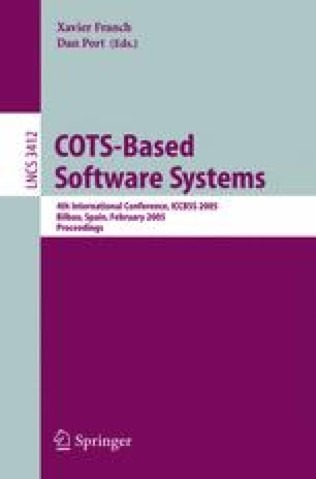
COTS-Based software systems ; 4th International Conference, ICCBSS 2005, Bilbao, Spain, February 7-11, 2005, Proceedings
The theme “Build and Conquer” : software development is an engineering discipline, and not an artistic expression. Once we are ready to “build” our software systems using pieces previously builtin (similar to any other technology manufacturer), we will be able to “conquer” the software engineering process. If we take a look at other engineering disciplines such as car manufacturing, house appliances or aeronautics, we see that the final products are built through the integration of multiprovider commercial components. These components are successfully integrated and constitute an important part of the final product. Most software-related organizations still build software from scratch, omitting thousands of ready-built commercially available software components that could be used very effectively during the development phase. This year ICCBSS moves to Europe for the first time since the first conference took place in Orlando, FL, USA in 2002. The conference scope has enlarged over the years to include the Open Source community and Web Services technologies. so many of the characteristics of COTS are also applied to Open Source and Web Services.

Cost-Based Oracle Fundamentals
In Cost-Based Oracle Fundamentals, the first book in a series of three, Jonathan Lewis—one of the foremost authorities in this field—describes the most commonly used parts of the model, what the optimizer does with your statistics, and why things go wrong. With this information, you'll be in a position to fix entire problem areas, not just single SQL statements, by adjusting the model or creating more truthful statistics.

Correct hardware design and verification methods
Constitutes the refereed proceedings of the 13th IFIP WG 10.5 Advanced Research Working Conference on Correct Hardware Design and Verification Methods, CHARME 2005, held in Saarbrucken, Germany, in October 2005.

Coordination, organizations, institutions, and norms in agent systems II ; AAMAS 2006 and ECAI 2006 International Workshops, COIN 2006 Hakodate, Japan, May 9, 2006 Riva del Garda, Italy, August 28, 2006, Revised Selected Papers
In recent years, social and organizational aspects of agency have become major research topics in MAS. Recent applications of MAS on Web services, grid c- puting and ubiquitous computing highlight the need for using these aspects in order to ensure social order within such environments. Openness, heterogeneity, and scalability of MAS, in turn, pose new demands on traditional MAS int- action models and bring forward the need to look into the environment where agents interact and at di?erent ways of constraining or regulating interactions.it provide theoretically demanding and interdisciplinary research questions at d- ferent levels of abstraction.

Coordination, organizations, institutions, and norms in agent system III ; COIN 2007 International Workshops COIN@AAMAS 2007, Honolulu, HI, USA, May 14, 2007 COIN@MALLOW 2007, Durham, UK, September 3-4, 2007 Revised Selected Papers
This book constitutes the refereed post-workshop proceedings of the International Workshop on Coordination, Organization, Institutions and Norms in Agent Systems, COIN 2007.

Coordination, organizations, institutions, and norms in agent system ; AAMAS 2005 International Workshops on Agents, Norms, and Institutions for Regulated Multiagent Systems, ANIREM 2005 and on organizations in multi-agent systems, OOOP 2005, Utrecht, The Netherlands, July 25-26, 2005, Revised Selected Papers
This book constitutes the refereed post-proceedings of the International Workshop on Agents, Norms and Institutions for Regulated Multiagent Systems, ANIREM 2005, and the International Workshop on Organizations in Multi-Agent Systems, OOOP 2005, held in Utrecht, The Netherlands, July 2005.

Coordination of Large-Scale Multiagent Systems
Challenges arise when the size of a group of cooperating agents is scaled to hundreds or thousands of members. In domains such as space exploration, military and disaster response, groups of this size (or larger) are required to achieve extremely complex, distributed goals. To effectively and efficiently achieve their goals, members of a group need to cohesively follow a joint course of action while remaining flexible to unforeseen developments in the environment. Coordination of Large-Scale Multiagent Systems provides extensive coverage of the latest research and novel solutions being developed in the field.

Coordination models and languages ; Vol.4038 ; 8th International Conference, COORDINATION 2006, Bologna, Italy, June 14-16, 2006, Proceedings
This book constitutes the refereed proceedings of the 8th International Conference on Coordination Models and Languages, COORDINATION 2006, held in Bologna, Italy, June 2006. The 17 revised full papers presented were carefully reviewed and selected from 50 submissions. Among the topics addressed are component connectors, negotiation in service-oriented computing, process algebraic specification, workflow patterns, reactive XML, ubiquitous coordination, type systems, ad-hoc network coordination, choreography, communication coordination, and distributed embedded systems.

Coordination models and languages ; 23rd IFIP WG 6.1 International Conference, COORDINATION 2021, Held as Part of the 16th International Federated Conference on Distributed Computing Techniques, DisCoTec 2021, Valletta, Malta, June 14–18, 2021, Proceedings
This book constitutes the refereed proceedings of the 23rd IFIP WG 6.1 International Conference on Coordination Models and Language, COORDINATION 2021, held in Valletta, Malta, in June 2021, as part of the 16th International Federated Conference on Distributed Computing Techniques, DisCoTec 2021. The 15 regular papers, 2 short papers, and 1 tutorial paper presented in this book were carefully reviewed and selected from 31 submissions. COORDINATION provides a well-established forum for the growing community of researchers interested in coordination models and languages, architectures, verification and implementation techniques necessary to cope with the complexity induced by the demands of today's software development.

Coordination models and languages ; 22nd IFIP WG 6.1 International Conference, COORDINATION 2020, Held as Part of the 15th International Federated Conference on Distributed Computing Techniques, DisCoTec 2020, Valletta, Malta, June 15–19, 2020, Proceedings
This book constitutes the proceedings of the 22nd International Conference on Coordination Models and Languages, COORDINATION 2020, which was due to be held in Valletta, Malta, in June 2020, as part of the 15th International Federated Conference on Distributed Computing Techniques, DisCoTec 2020. The conference was held virtually due to the COVID-19 pandemic. The 12 full papers and 6 short papers included in this volume were carefully reviewed and selected from 30 submissions. They are presented in this volume together with 2 invited tutorials and 4 tool papers. The papers are organized in the following topical sections: tutorials; coordination languages; message-based communication; communications: types & implementations; service-oriented computing; large-scale decentralized systems; smart contracts; modelling; verification & analysis.
