



الصفحة 41
الصفحة 41

Computer vision for biomedical image applications
The purpose of this book is to submit the workshop, “Computer Vision for Biomedical Image Applications: Current Techniques and Future Trends” (CVBIA), is to examine the diverse applications of computer vision to biomedical image applications, considering both current methods and promising new trends. An additional goal is to provide the opportunity for direct interactions between (1) prominent senior researchers and young scientists, including students, postdoctoral associates and junior faculty; (2) local researchers and international leaders in biomedical image analysis; and (3) computer scientists and medical practitioners. Our CVBIA workshop had two novel characteristics: each contributed paper was authored primarily by a young scientist, and the workshop attracted an unusually large number of well-respected invited speakers (and their papers).

Computer Vision and Internet of Things : Technologies and Applications
Explores the utilization of Internet of Things (IoT) with computer vision and its underlying technologies in different applications areas. Using a series of present and future applications – including business insights, indoor-outdoor securities, smart grids, human detection and tracking, intelligent traffic monitoring, e-health departments, and medical imaging – this book focuses on providing a detailed description of the utilization of IoT with computer vision and its underlying technologies in critical application areas, such as smart grids, emergency departments, intelligent traffic cams, insurance, and the automotive industry.

Computer vision and graphics ; International Conference, ICCVG 2020, Warsaw, Poland, September 14–16, 2020, Proceedings
This book constitutes the refereed proceedings of the International Conference on Computer Vision and Graphics, ICCVG 2020, held in Warsaw, Poland, in September 2020. The 20 full papers were selected from 49 submissions. The contributions cover topics such as: modelling of human visual perception; computational geometry; geometrical models of objects and scenes; illumination and reflection models and methods; image formation; image and video coding; image filtering and enhancement; biomedical image processing; biomedical graphics; colour image processing; multispectral image processing; pattern recognition in image processing

Computer Viruses and Malware
This book discusses both the technical and human factors involved in computer viruses, worms, and anti-virus software. It also looks at the application of malicious software to computer crime and information warfare. Computer Viruses and Malware is designed for a professional audience composed of researchers and practitioners in industry. This book is also suitable as a secondary text for advanced-level students in computer science.

Computer Supported Cooperative Work in Design IV ; 11th International Conference, CSCWD 2007, Melbourne, Australia, April 26-28, 2007. Revised Selected Papers
This book constitutes the thoroughly refereed post-conference proceedings of the 11th International Conference on Computer Supported Cooperative Work in Design, CSCWD 2007, held in Melbourne, Australia, in April 2007.

Computer Supported Cooperative Work in Design III ; 10th International Conference, CSCWD 2006, Nanjing, China, May 3-5, 2006, Revised Selected Papers
The design of complex artifacts and systems requires the cooperation of multidiscip- nary design teams using multiple commercial and proprietary engineering software tools (e.g., CAD, modeling, simulation, visualization, and optimization), engineering databases, and knowledge-based systems. Individuals or individual groups of mult- isciplinary design teams usually work in parallel and separately with various en- neering software tools which are located at different sites. In addition, individual members may be working on different versions of a design or viewing the design from different perspectives, at different levels of detail. In order to accomplish the work, it is necessary to have effective and efficient c- laborative design environments. Such environments should not only automate in- vidual tasks, in the manner of traditional computer-aided engineering tools, but also enable individual members to share information, collaborate, and coordinate their activities within the context of a design project. CSCW (computer-supported coope- tive work) in design is concerned with the development of such environments.

Computer Supported Cooperative Work in Design I
The design of complex artifacts and systems requires the cooperation of multidisciplinary design teams using multiple commercial and non-commercial engineering tools such as CAD tools, modeling, simulation and optimization software, engineering databases, and knowledge-based systems. Individuals or individual groups of multidisciplinary design teams usually work in parallel and separately with various engineering tools, which are located on different sites, often for quite a long time. At any moment, individual members may be working on different versions of a design or viewing the design from various perspectives, at different levels of detail. In order to meet these requirements, it is necessary to have effective and efficient collaborative design environments. These environments should not only automate individual tasks, in the manner of traditional computer-aided engineering tools, but also enable individual members to share information, collaborate and coordinate their activities within the context of a design project. CSCW (computer-supported cooperative work) in design is concerned with the development of such environments.

Computer security principles and practice
Provides an up-to-date survey of developments in computer security. Central problems that confront security designers and security administrators include defining the threats to computer and network systems, evaluating the relative risks of these threats, and developing cost-effective and user friendly countermeasures

Computer Security in the 21st Century
Computer Security in the 21st Century shares some of the emerging important research trends reflected in recent advances in computer security, including: security protocol design, secure peer-to-peer and ad hoc networks, multimedia security, and intrusion detection, defense and measurement. Highlights include presentations of : * Fundamental new security * Cryptographic protocols and design, * A new way of measuring network vulnerability: attack surfaces, * Network vulnerability and building impenetrable systems, * Multimedia content protection including a new standard for photographic images, JPEG2000. Researchers and computer security developers will find in this book interesting and useful insights into building computer systems that protect against computer worms, computer viruses, and other related concerns.

Computer Security - ESORICS 2008 ; 13th European Symposium on Research in Computer Security, Málaga, Spain, October 6-8, 2008. Proceedings
This book constitutes the refereed proceedings of the 13th European Symposium on Research in Computer Security, ESORICS 2008, held in Torremolinos, Spain, in October 2008.

Computer Security – ESORICS 2007 ; 12th European Symposium On Research In Computer Security, Dresden, Germany, September 24 - 26, 2007, Proceedings
This book address issues such as data protection; security protocols; systems; web and network security; privacy; threat modeling and detection; information flow; and security in emerging applications such as cryptocurrencies, the Internet of Things and automotive.

Computer safety, reliability, and security ; 27th International Conference, SAFECOMP 2008 Newcastle upon Tyne, UK, September 22-25, 2008 Proceedings
This book constitutes the refereed proceedings of the 27th International Conference on Computer Safety, Reliability, and Security, SAFECOMP 2008, held in Newcastle upon Tyne, UK, in September 2008.
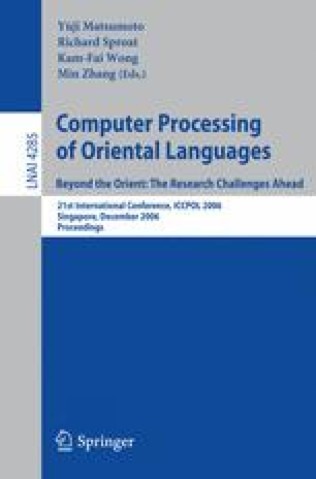
Computer Processing of Oriental Languages. Beyond the Orient : The Research Challenges Ahead ; 21st International Conference, ICCPOL 2006, Singapore, December 17-19, 2006, Proceedings
This book constitutes the thoroughly refereed proceedings of the 21st International Conference on Computer Processing of Oriental Languages, ICCPOL 2006.The papers are organized in topical sections on information retrieval, document classification, questions and answers, summarization, machine translation, word segmentation, chunking, abbreviation expansion, writing-system issues, parsing, semantics, and lexical resources.

Computer organization and design : The hardware / software interface ; 6th ed.
Designed to be used in modern computing environments such as cloud computing, mobile devices, and other embedded systems. With the post-PC era now upon us, Computer Organization and Design moves forward to explore this generational change with examples, exercises, and material highlighting the emergence of mobile computing and the Cloud. Updated content featuring tablet computers, Cloud infrastructure, and the x86 (cloud computing) and ARM (mobile computing devices) architectures is included

Computer networking : A top-down approach ; 7th ed.
The text works its way from the application layer down toward the physical layer, motivating students by exposing them to important concepts early in their study of networking. Focusing on the Internet and the fundamentally important issues of networking, this text provides an excellent foundation for students in computer science and electrical engineering, without requiring extensive knowledge of programming or mathematics. The Seventh Edition has been updated to reflect the most important and exciting recent advances in networking.

Computer Network Security ; Vol. 3685
This volume contains papers presented at the 3rd International Workshop on Mathematical Methods, Models and Architectures for Computer Network - curity (MMM-ACNS 2005) held in St. Petersburg, Russia, 2005. The 1st and the 2nd International Workshops on Mathematical Methods, Models and Architectures for Computer Network Security (MMM-ACNS 2001 and MMM-ACNS 2003), hosted by the St. Petersburg Institute for Informatics and Automation, demonstrated the keen interest of the international research community in the subject area. It was recognized that conducting a biannual series of such workshops in St. Petersburg stimulates fruitful exchanges between the di?erent schools of thought, facilitates the dissemination of new ideas and promotesthespirit of cooperationbetweenresearchersontheinternationalscale. MMM-ACNS 2005 provided an international forum for sharing original - search results and application experiences among specialists in fundamental and applied problems of computer network security. An important distinction of the workshop was its focus on mathematical aspects of information and computer network security addressing the ever-increasing demands for secure computing and highly dependable computer networks.

Computer Network Security ; 4th International Conference on Mathematical Methods, Models and Architectures for Computer Network Security, MMM-ACNS 2007, St. Petersburg, Russia, September 13-15, 2007, Proceedings
This volume focus on mathematical aspects of information and computer network security addressing the ever-increasing demands for secure computing and highly dependable computer networks.

Computer Network Security
As society becomes increasingly dependent on computers and computer networks, computer problems continue to rise in number. Yet despite the proliferation of expert remedies, a viable solution to these security issues remains elusive, and society continues to suffer at the hands of cyber vandalism and computer viruses. This comprehensive text outlines and discusses today’s most important issues and concerns in computer network and information safety and security, and promises to ignite debate and participation in the ongoing global security dialog Computer Network Security is foremost an educational tool that aims to explore computer network infrastructure and protocol design security flaws and discusses current security solutions and best practices. It explores the security threats and vulnerabilities in the current network infrastructure and protocols and outlines current efforts including: Access Control and Authorization, Cryptography, Firewalls and VPNs, Web Security and Content Filtering, among others. The text further discusses various security proposals This text is an invaluable instructional and research tool for courses in computer and information security. Students or practitioners in computer science, information science, technology studies, library sciences, and information management studies will find this text particularly useful for their purposes. In addition, it is a rich resource for those looking to gain an understanding of computer infrastructures and network security threats.

Computer Music Modeling and Retrieval. Sense of Sounds ; 4th International Symposium, CMMR 2007, Copenhagen, Denmark, August 27-31, 2007. Revised Papers
This book constitutes the thoroughly refereed post-conference proceedings of the 4th International Computer Music Modeling and Retrieval Symposium, CMMR 2007, held in Copenhagen, Denmark, in August 2007 jointly with the International Computer Music Conference 2007, ICMC 2007.

Computer Music Modeling and Retrieval Vol. 3902 ; 3rd International Symposium, CMMR 2005, Pisa, Italy, September 26-28, 2005, Revised Papers
This book constitutes the thoroughly refereed post-proceedings of the Third International Computer Music Modeling and Retrieval Symposium, CMMR 2005. the papers address a broad variety of topics. The papers are organized in topical sections on sound synthesis; music perception and cognition; interactive music: interface, interaction, gestures and sensors, music composition; music retrieval: music performance, music analysis, music representation; as well as interdisciplinarity and computer music.
