



الصفحة 41
الصفحة 41

Database and expert systems and Aapplications ; 17th International Conference, DEXA 2006, Krakow, Poland, September 4-8, 2006, Proceedings
The annual international conference on Database and Expert Systems Applications (DEXA) is now well established as a reference scientific event. The reader will find in this volume a collection of scientific papers that represent the state of the art of research in the domain of data, information and knowledge management, intelligent systems, and their applications.

Database : Enterprise, skills and innovation; 22nd British national conference on databases, BNCOD 22, Sunderland, UK, July 5-7, 2005, Proceedings
The British National Conference on Databases (BNCOD) was established in 1980 as a forum for research into the theory and practice of databases. The original conference in the series took place at the University of Aberdeen. To be precise, this conference was in fact entitled ICOD which stood for International Conference on Databases. It was the intention, when the series began, that an ICOD would take place every two years, whilst a BNCOD would run in the years in between. As the record shows ICOD was only held in 1980 and 1983. The more junior conference has managed to acquire a lifetime much longer than that of its senior relative! If truth wereknown,however,BNCOD has,overthe years,growninto ICOD and although the conference is still titled “British National,” it is, in fact, an international conference that takes place on a yearly basis. Proof of this can be obtained simply by looking at the table of contents of these proceeding which clearlyshowthatthe majorityofpaperspresentedatthis year’sconferencecame from contributors whose a?liations are outside the UK. Despitetherangeofpapersono?er,BNCODstillretainsitsuniquelyBritish ?avor. The Programme Committee is drawn from UK academics and the c- ference is always held at a British university (or in earlier years a polytechnic!).

Data Warehousing and Knowledge Discovery ; Vol.4081 ; 8th International Conference, DaWaK 2006, Krakow, Poland, September 4-8, 2006, Proceedings
DaWaK aimed at providing the right and logical balance between data warehousing and knowledge discovery. In data warehousing the papers cover different research problems, such as advanced techniques in OLAP visuali- tion and multidimensional modelling, innovation of ETL processes and integration problems, materialized view optimization, very large data warehouse processing, data warehouses and data mining applications integration, data warehousing for real-life applications, e. g. , medical applications and spatial applications. In data mining and knowledge discovery, papers are focused on a variety of topics from data streams analysis and mining, ontology-based mining techniques, mining frequent item sets, clustering, association and classification, patterns and so on.

Data warehousing and knowledge discovery ; Vol.3589 ; 7th international conference, DaWak 2005, Copenhagen, Denmark, August 22-26, 2005, Proceedings
For more than a decade, data warehousing and knowledge discovery technologies have been developing into key technologies for decision-making processes in com- nies. Since 1999, due to the relevant role of these technologies in academia and ind- try, the Data Warehousing and Knowledge Discovery (DaWaK) conference series have become an international forum where both practitioners and researchers share their findings, publish their relevant results and dispute in depth research issues and experiences on data warehousing and knowledge discovery systems and applications.

Data Warehousing and Knowledge Discovery ; 9th International Conference, DaWaK 2007, Regensburg, Germany, September 3-7, 2007, Proceedings
Data Warehousing and Knowledge Discovery have been widely accepted as key te- nologies for enterprises and organizations to improve their abilities in data analysis, decision support, and the automatic extraction of knowledge from data. With the exponentially growing amount of information to be included in the decision-making process, the data to be processed become more and more complex in both structure and semantics. Consequently, the process of retrieval and knowledge discovery from this huge amount of heterogeneous complex data constitutes the reality check for research in the area.

Data Warehousing and Knowledge Discovery ; 4th International Conference, DaWaK 2002, Aix-en-Provence, France, September 4-6, 2002. Proceedings
Within the last few years Data Warehousing and Knowledge Discovery technology has established itself as a key technology for enterprises that wish to improve the quality of the results obtained from data analysis, decision support, and the automatic extraction of knowledge from data. The Fourth International Conference on Data Warehousing and Knowledge Discovery (DaWaK 2002) continues a series of successful conferences dedicated to this topic. Its main objective is to bring together researchers and practitioners to discuss research issues and experience in developing and deploying data warehousing and knowledge discovery systems, applications, and solutions.

Data Streams : Models and Algorithms
It primarily discusses issues related to the mining aspects of data streams rather than the database management aspect of streams. This volume covers mining aspects of data streams in a comprehensive style. Each contributed chapter, from a variety of well known researchers in the data mining field, contains a survey on the topic, the key ideas in the field from that particular topic, and future research directions.

Data science, AI, and machine learning in drug development
The confluence of big data, AI, and machine learning has led to a paradigm shift in how innovative medicines are developed and healthcare delivered. To fully capitalize on these technological advances, it is essential to systematically harness data from diverse sources and leverage digital technologies and advanced analytics to enable data-driven decisions. Data science stands at a unique moment of opportunity to lead such a transformative change. Intended to be a single source of information, Data Science, AI, and Machine Learning in Drug Research and Development covers a wide range of topics on the changing landscape of drug R&D, emerging applications of big data, AI and machine learning in drug development, and the build of robust data science organizations to drive biopharmaceutical digital transformations

Data science and data analytics : Opportunities and challenges
Gives the concept of data science, tools, and algorithms that exist for many useful applications / Provides many challenges and opportunities in data science and data analytics that help researchers to identify research gaps or problems / Identifies many areas and uses of data science in the smart era / Applies data science to agriculture, healthcare, graph mining, education, security, etc.

Data Quality : Concepts, Methodologies and Techniques
Batini and Scannapieco present a comprehensive and systematic introduction to the wide set of issues related to data quality. They start with a detailed description of different data quality dimensions, like accuracy, completeness, and consistency, and their importance in different types of data, like federated data, web data, or time-dependent data, and in different data categories classified according to frequency of change, like stable, long-term, and frequently changing data. The book's extensive description of techniques and methodologies from core data quality research as well as from related fields like data mining, probability theory, statistical data analysis, and machine learning gives an excellent overview of the current state of the art.

Data mining with computational intelligence
Finding information hidden in data is as theoretically difficult as it is practically important. With the objective of discovering unknown patterns from data, the methodologies of data mining were derived Wang and Fu present in detail the state of the art on how to utilize fuzzy neural networks, multilayer perceptron neural networks, radial basis function neural networks, genetic algorithms, and support vector machines in such applications. They focus on three main data mining tasks: data dimensionality reduction, classification, and rule extraction. The book is targeted at researchers in both academia and industry, while graduate students and developers of data mining systems will also profit from the detailed algorithmic descriptions.

Data Mining in Bioinformatics
8. 1. 1 Protein Subcellular Location The life sciences have entered the post-genome era where the focus of biological research has shifted from genome sequences to protein functionality. Withwhole-genomedraftsofmouseandhumaninhand,scientistsareputting more and more e?ort into obtaining information about the entire proteome in a given cell type. The properties of a protein include its amino acid sequences, its expression levels under various developmental stages and in di?erent tissues, its3Dstructure and activesites,its functionalandstructural binding partners, and its subcellular location. Protein subcellular location is important for understanding protein function inside the cell. For example, the observation that the product of a gene is localized in mitochondria will support the hypothesis that this protein or gene is involved in energy metabolism. Proteins localized in the cytoskeleton are probably involved in intracellular tra?cking and support.

Data Mining for Biomedical Applications ; PAKDD 2006 Workshop, BioDM 2006, Singapore, April 9, 2006, Proceedings
This book constitutes the refereed proceedings of the International Workshop on Data Mining for Biomedical Applications, BioDM 2006, held in Singapore in conjunction with the 10th Pacific-Asia Conference on Knowledge Discovery and Data Mining (PAKDD 2006). The 14 revised full papers presented together with 1 keynote talks were carefully reviewed and selected from 35 submissions. The papers are organized in topical sections on protein-protein interactions, database and search, bio data clustering, and in-silico diagnosis.

Data mining and machine learning applications
Elaborates in detail on the current needs of data mining and machine learning and promotes mutual understanding among research in different disciplines, thus facilitating research development and collaboration. Data, the latest currency of today’s world, is the new gold. In this new form of gold, the most beautiful jewels are data analytics and machine learning. Data mining and machine learning are considered interdisciplinary fields. Data mining is a subset of data analytics and machine learning involves the use of algorithms that automatically improve through experience based on data.

Data mining and knowledge management ; Chinese academy of sciences symposium CASDMKD 2004, Beijing, China, July 12-14, 2004, Revised Paper
Knowledge management for enterprise: These papers address various issues related to the application of knowledge management in corporations using various techniques. A particular emphasis here is on coordination and cooperation. • Risk management: Better knowledge management also requires more advanced techniques for risk management, to identify, control, and minimize the impact of uncertain events, as shown in these papers, using fuzzy set theory and other approaches for better risk management. • Integration of data mining and knowledge management: As indicated earlier, the integration of these two research fields is still in the early stage. Nevertheless, as shown in the papers selected in this volume, researchers have endearored to integrate data mining methods such as neural networks with various aspects related to knowledge management,

Data Mining and Bioinformatics ; 1st International Workshop, VDMB 2006, Seoul, Korea, September 11, 2006, Revised Selected Papers
This volume contains the papers presented at the inaugural workshop on Data Mining and Bioinformatics at the 32nd International Conference on Very Large Data Bases (VLDB). The purpose of this workshop was to begin bringing - gether researchersfrom database, data mining, and bioinformatics areas to help leverage respective successes in each to the others.
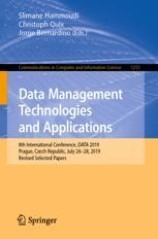
Data Management Technologies and Applications ; 8th International Conference, DATA 2019, Prague, Czech Republic, July 26–28, 2019, Revised Selected Papers
This book constitutes the thoroughly refereed proceedings of the 8th International Conference on Data Management Technologies and Applications, DATA 2019, held in Prague, Czech Republic, in July 2019. The 8 revised full papers were carefully reviewed and selected from 90 submissions. The papers deal with the following topics: decision support systems, data analytics, data and information quality, digital rights management, big data, knowledge management, ontology engineering, digital libraries, mobile databases, object-oriented database systems, and data integrity.

Data Management in Grids ; 1st VLDB Workshop, DMG 2005, Trondheim, Norway, September 2-3, 2005, Revised Selected Papers
This book constitutes the thoroughly refereed post-proceedings of the First International Workshop on Data Management in Grids, DMG 2005, held in Trondheim, Norway in September 2005 in conjunction with VLDB 2005. papers address all current research activities in relation to data management in dynamic, heterogeneous and cross-organizational environments, i.e. grids. They show unique expertise in the management of very large, widely distributed databases.

Data management in a connected world : Essays dedicated to Hartmut Wedekind on the occasion of his 70th birthday
Data management systems play the most crucial role in building large application s- tems. Since modern applications are no longer single monolithic software blocks but highly flexible and configurable collections of cooperative services, the data mana- ment layer also has to adapt to these new requirements. Therefore, within recent years, data management systems have faced a tremendous shift from the central management of individual records in a transactional way to a platform for data integration, fede- tion, search services, and data analysis. This book addresses these new issues in the area of data management from multiple perspectives, in the form of individual contributions, and it outlines future challenges in the context of data management.

Data Integration in the Life Sciences ; Vol. 4075 ; 3rd International Workshop, DILS 2006, Hinxton, UK, July 20-22, 2006, Proceedings
Data management and data integration are fundamental problems in the life sciences. Advances in molecular biology and molecular medicine are almost u- versallyunderpinned by enormouse?orts in data management,data integration, automatic data quality assurance, and computational data analysis. Many hot topics in the life sciences, such as systems biology, personalized medicine, and pharmacogenomics, critically depend on integrating data sets and applications producedby di?erent experimentalmethods, in di?erent researchgroups,andat di?erent levels of granularity.
