



الصفحة 4
الصفحة 4

Modern IoT onboarding platforms for advanced applications: a practitioner’s guide to KIS.ME
There is no doubt that digitalization solutions from Industry 4.0 and the Internet of Things (IoT) can be perceived as excellent candidate strategies capable of handling the above-stated issues concerning measurements and transparency. However, IoT tools themselves can provide appropriate data only, while their efficient integration and application are possible using a dedicated onboarding platform only. To settle this issue, the book undertakes the problem of modern IoT onboarding platforms for the advanced applications pertaining to manufacturing and logistics. In particular, instead of deliberating about a possible hypothetic platforms, an existing and efficient one is employed, which is called KIS.ME. KIS.ME (Keep It Simple. Manage Everything) is a complete IoT solution for a simple integration in manufacturing and logistics.

Models in Software Engineering ; Workshops and Symposia at MoDELS 2006, Genoa, Italy, October 1-6, 2006, Reports and Revised Selected Papers
This book constitutes the thoroughly refereed post-proceedings of 11 international workshops held as satellite events of the 9th International Conference on Model Driven Engineering Languages and Systems, MoDELS 2006, in Genoa, Italy, in October 2006 (see LNCS 4199). The 32 revised full papers were carefully selected for inclusion in the book.

Modelling and Simulation : Exploring Dynamic System Behaviour
Modelling and Simulation: Exploring Dynamic System Behaviour provides the reader with a balanced and integrated presentation of the modelling and simulation activity for both Discrete Event Dynamic Systems (DEDS) and Continuous Time Dynamic Systems (CTDS). This book presents the fundamentals necessary to understand the many important facets of the modeling and simulation methodology.

Modeling, Simulation and Optimization of Complex Processes HPSC 2018 ; Proceedings of the 7th International Conference on High Performance Scientific Computing, Hanoi, Vietnam, March 19-23, 2018
The contributions cover a broad, interdisciplinary spectrum of scientific computing and showcase recent advances in theory, methods, and practical applications. Subjects covered include numerical simulation, methods for optimization and control, machine learning, parallel computing and software development, as well as the applications of scientific computing in mechanical engineering, airspace engineering, environmental physics, decision making, hydrogeology, material science and electric circuits.

Modeling and Using Context ; 5th International and Interdisciplinary Conference, CONTEXT 2005, Paris, France, July 5-8, 2005, Proceedings
Context is of crucial importance for research and applications in many disciplines, as evidenced by many workshops, symposia, seminars, and conferences on specific aspects of context. The International and Interdisciplinary Conference on Modeling and Using Context (CONTEXT), the oldest conference series focusing on context, provides a unique interdisciplinary emphasis, bringing together participants from a wide range of disciplines, including artificial intelligence, cognitive science, computer science, linguistics, organizational science, philosophy, psychology, ubiquitous computing, and application areas such as medicine and law, to discuss and report on context-related research and projects. Previous CONTEXT conferences were held in Rio de Janeiro, Brazil (1997), Trento, Italy (1999, LNCS 1688), Dundee, UK (2001, LNCS 2116), and Palo Alto, USA (2003, LNCS 2680). CONTEXT 2005 was held in Paris, France during July 5–8, 2005. There was a strong response to the CONTEXT 2005 Call for Papers, with 120 submissions received. A careful review process assessed all submissions, with each paper first reviewed by the international Program Committee, and then reviewer discussions were initiated as needed to assure that the final decisions carefully considered all aspects of each paper. Reviews of submissions by the Program Chairs were supervised independently and anonymously, to assure fair consideration of all work. Out of the 120 submissions, 23 were selected as full papers for oral presentation, and 20 were selected as full papers for poster presentation. These outstanding papers are presented in this proceedings.

Modeling and simulation of complex communication networks
Covers important topics and approaches related to the modeling and simulation of complex communication networks from a complex adaptive systems perspective. The authors present different modeling paradigms and approaches as well as surveys and case studies. Modern network systems such as Internet of Things, Smart Grid, VoIP traffic, Peer-to-Peer protocol, and social networks, are inherently complex. They require powerful and realistic models and tools not only for analysis and simulation but also for prediction. With contributions from an international panel of experts, this book is essential reading for networking, computing, and communications professionals, researchers and engineers in the field of next generation networks and complex information and communication systems, and academics and advanced students working in these fields.

Modeling and Retrieval of Context ; 2nd International Workshop, MRC 2005, Edinburgh, UK, July 31-August 1, 2005, Revised Selected Papers
Computing in context has become a necessity in modern and intelligent IT - plications. With the use of mobile devices and current research on ubiquitous computing, context-awareness has become a major issue. However, context and context-awareness are crucial not only for mobile and ubiquitous computing. They are also vital for spanning various application areas, such as collaborative softwareand Web engineering,personaldigital assistantsand peer-to-peer inf- mation sharing, health care work?ow and patient control, and adaptive games and e-learning solutions. In these areas, context serves as a major source for reasoning, decision making, and adaptation, as it covers not only application knowledge but also environmental knowledge.Likewise, modeling and retrieving context is an important part of modern knowledge management processes.

Model-Driven Architecture - Foundations and Applications ; 2nd European Conference, ECMDA-FA 2006, Bilbao, Spain, July 10-13, 2006, Proceedings
The goal of the European Conference on Model-Driven Architecture — Foundations and Applications (ECMDA-FA) is to bring together industry and academia to tackle the problems in model-driven development. This volume includes 18 foundation papers and 12 application papers, which is a fine balance between both worlds. ECMDA-FA 2006 also hosted six workshops on both theoretical and practical aspects of MDA. Furthermore, the keynote speakers, David Frankel and Bran Selic, from some of the world’s largest IT companies proved that industry is very much involved in MDA. This second ECMDA-FA conference is the result of the work of the authors who submitted a total of 78 papers, the Program Committee members who took the effort to review the papers, the people organizing the workshops, and of course the Steering Committee. All in all, several hundreds of people have worked hard to make this conference a success.

Model Driven Engineering Languages and Systems ; Vol. 4199 ; 9th International Conference, MoDELS 2006, Genova, Italy, October 1-6, 2006, Proceedings
This book constitutes the refereed proceedings of the 9th International Conference on Model Driven Engineering Languages and Systems (formerly the UML series of conferences), MoDELS 2006, held in Genova, Italy, in October 2006. The 51 revised full papers and 2 invited papers presented were carefully reviewed and selected from 178 initial submissions. The papers are organized in topical sections on evaluating UML, MDA in software development, concrete syntax, applying UML to interaction and coordination, aspects, model integration, formal semantics of UML, security, model transformation tools and implementation, analyzing dynamic models, specifying transformations, MOF, bridging models, risk, trust and dependability, tool environments, OCL, roundtrip engineering, real time and embedded systems, as well as workshops, tutorials and panels.
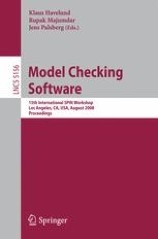
Model Checking Software ; 15th International SPIN Workshop, Los Angeles, CA, USA, August 10-12, 2008 Proceedings
This book constitutes the refereed proceedings of the 15th International SPIN workshop on Model Checking Software, SPIN 2008, held in Los Angeles, CA, USA, in August 2008.The 17 revised full papers presented together with 1 tool paper and 4 invited talks were carefully reviewed and selected from 41 submissions. The main focus of the workshop series is software systems, including models and programs. The papers cover theoretical and algorithmic foundations as well as tools for software model checking and foster interactions and exchanges of ideas with related areas in software engineering, such as static analysis, dynamic analysis, and testing.

Model checking and artificial intelligence ; 4th Workshop, MoChArt IV, Riva del Garda, Italy, August 29, 2006, Revised Selected and Invited Papers
This book constitutes the thoroughly refereed post-proceedings of the 4th Workshop on Model Checking and Artificial Intelligence, MoChArt IV, held in Riva Del Garda, Italy in August 2006, as a satellite event of ECAI0 2006, the 17th biannual European conference on Artificial Intelligence.

Model and Mathematics : From the 19th to the 21st Century
This book collects the historical and medial perspectives of a systematic and epistemological analysis of the complicated, multifaceted relationship between model and mathematics, ranging from, for example, the physical mathematical models of the 19th century to the simulation and digital modelling of the 21st century. The aim of this anthology is to showcase the status of the mathematical model between abstraction and realization, presentation and representation, what is modeled and what models.

Model and Design of Improved Current Mode Logic Gates : Differential and Single-ended
This book presents MOSFET-based current mode logic (CML) topologies, which increase the speed, and lower the transistor count, supply voltage and power consumption. The improved topologies modify the conventional PDN, load, and the current source sections of the basic CML gates.

Model and Design of Bipolar and MOS Current-Mode Logic : CML, ECL and SCL Digital Circuits
many works and results have been published which reinforce the importance of Current-Mode digital circuits. In the topic of Current-Mode digital circuits, the authors properly exploited classical paradigms developed and used in the analog circuit domain (a topic in which one of the authors maturated a great experience).

Mobile forensics : The file format handbook : Common file formats and file systems used in mobile devices
This book summarizes knowledge about several file systems and file formats commonly used in mobile devices. In addition to the fundamental description of the formats, there are hints about the forensic value of possible artefacts, along with an outline of tools that can decode the relevant data.

Mobile and Wireless Communications with Practical Use-Case Scenarios
While wireless technologies had a spectacular evolution over the past years, the present trend is to adopt a global heterogeneous network of shared standards that enables the provisioning of Quality of Service and Quality of Experience to the end-user. To this end, enabling technologies like Machine Learning, Internet of Things, Digital Twins, are seen as promising solutions for next generation networks that will enable an intelligent adaptive interconnected environment with support for prediction and decision making so that the heterogeneous applications and users requirements can be highly satisfied. The aim of this textbook is to provide the readers with a comprehensive technical foundation of the mobile communication systems and wireless network design, operations and applications of various radio access technologies. Additionally, it also introduces the reader to the latest advancements in technologies in terms of Internet of Things ecosystem, Machine Learning and Digital Twins for IoT-enabled intelligent environments. Furthermore, this textbook also includes practical use-case scenarios using Altair WinProp Software as well as Phyton, TensorFlow and Jupiter as support for practice-based laboratory sessions"

Mobile 3D Graphics
Historically, not enough was understood about how to deliver a high quality playing experience on handheld, small screen, small memory devices, plus there has been considerable confusion about the hardware’s abilities and restrictions. By addressing these issues this book provides: • A comprehensive explanation of 3D mobile graphics programming • Includes an extensive range of code samples in both C and Java • Combines 3D and 2D mobile graphics methods • Covers recent advances in mobile computer graphics techniques and applications. The book teaches fundamental 3D mobile graphics programming with standard APIs, and covers the basic and advanced application programme interfaces behind the major wireless and mobile devices supporting 3D graphics applications. Advanced undergraduates and postgraduates, as well as mobile application and games developers, will find this an excellent reference source.

Mixed-Signal Layout Generation Concepts
Mixed-Signal Layout Generation Concepts covers important physical-design issues that exist in contemporary analog and mixed-signal design flows. The fundamental issues in creating a layout are placement and routing.

Mission AI: the new system technology
Offers a strategic perspective on AI and the process of embedding it in society. After decades of research, Artificial Intelligence (AI) is now entering society at large. Due to its general purpose character, AI will change society in multiple, fundamental and unpredictable ways. Therefore, the Netherlands Scientific Council for Government Policy (WRR) characterizes AI as a system technology: a rare type of technologies that have a systemic impact on society. Earlier system technologies include electricity, the combustion engine and the computer. The history of these technologies provides us with useful insights about what it takes to direct the introduction of AI in society.

Mind conversation = التنبؤ بالحروف العربية من خلال الإشارات الدماغية
Throughout history, humans have long dreamed of understanding what goes on inside the human mind—what people are thinking or feeling. It seemed like something from a far-off future or a magical realm. But now, thanks to amazing technology called EEG and BCI, this dream is turning into reality. EEG stands for electroencephalography. It's a way of listening to what the brain is up to by placing small sensors on or near the head. These sensors pick up tiny electrical signals produced by the brain's activity. It's like eavesdropping on the brain's conversations with itself. BCI, or Brain-Computer Interface, is like a bridge between the brain and machines. It lets the brain talk to devices or computers. This means people can control things without using their hands or voices. Our system takes advantage of EEG and BCI to create something helpful, a special mobile app. This app is designed for people who can't move their bodies, like those who are paralyzed. It helps them use their phones to express what they are thinking about.
