



الصفحة 4
الصفحة 4

Autonomous intelligent systems : Multi-agents and data mining ; 2nd International workshop, AIS-ADM 2007, St. Petersburg, Russia, June 3-5, 2007, Proceedings
MAS offiers powerful metaphors for information system conceptualization, a range of new techniques, and technologies specifically focused on the design and implementation of lar- scale open distributed intelligent systems. KDD also provides intelligent inf- mation technology with powerful ideas, algorithms, and software means to help cope with the main problem of artificial intelligence, formulated in the we- known question “Where does the knowledge come from?”, thus actually making modern applications intelligent and adaptive. The evident recent trend in both science and industry is to integrate and take advantage of both technologies. The existing experience with combined application of multi-agent technology to design architectures of distributed (- erarchical and peer-to-peer) data mining and KDD systems, as well as the u- lization of data mining and KDD achievements to provide enhanced intelligence of MAS, confirms the fact that both technologies are capable of mutual enri- ment and their integrateduse may result in intelligent information systems with new emergent properties.
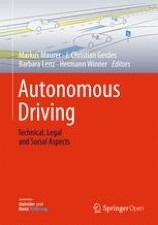
Autonomous driving : Technical, legal and social aspects
This book takes a look at fully automated, autonomous vehicles and discusses many open questions: How can autonomous vehicles be integrated into the current transportation system with diverse users and human drivers? Where do automated vehicles fall under current legal frameworks? What risks are associated with automation and how will society respond to these risks? How will the marketplace react to automated vehicles and what changes may be necessary for companies?
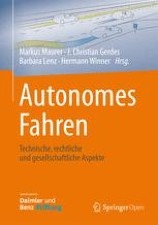
Autonomes fahren : Technische, rechtliche und gesellschaftliche aspekte = Autonomous driving : Technical, legal and social aspects
This book provides answers to a wide range of these and other questions. Experts from Germany and the USA describe central topics related to the automation of vehicles on public roads from an engineering and social science perspective. They show which "decisions" are required of an autonomous vehicle or which "ethics" must be programmed. The authors discuss expectations and concerns that characterize the individual and societal acceptance of autonomous driving. An increased safety potential through autonomous vehicles is compared to the challenges and solution approaches that play a role in securing the safety concept. In addition, they explain what possibilities for change and opportunities arise for our mobility and the reorganization of traffic, not least for freight traffic. The book thus offers an up-to-date, comprehensive and scientifically sound examination of the topic of "autonomous driving".

Automotive Lighting and Human Vision
Visual perception is the most important of the human senses. Lack of visual perception is one of the main causes of accidents. The safety of vehicle traffic depends on how well automotive lighting supports the visual perception of the driver. This book explains the fundamentals of visual perception, like e.g. physiology of eye and brain, as well as those of automotive lighting technology, like e.g. design of headlamps and signal lights. It is an interdiciplinary approach to a fastly evolving field of science and technology, answering questions like "How does information enter our brain when driving a car?" and "What are the benefits and dangers of LED signal lighting?"

Automatic Quantum Computer Programming : A Genetic Programming Approach
Computer science will be radically transformed if ongoing efforts to build large-scale quantum computers eventually succeed and if the properties of these computers meet optimistic expectations. Nevertheless, computer scientists still lack a thorough understanding of the power of quantum computing, and it is not always clear how best to utilize the power that it is understood. This dilemma exists because quantum algorithms are difficult to grasp and even more difficult to write. Despite large-scale international efforts, only a few important quantum algorithms are documented, leaving many essential questions about the potential of quantum algorithms unanswered.
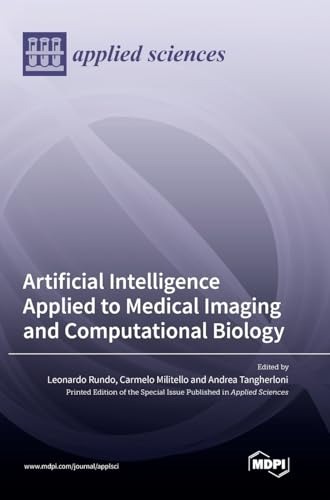
Artificial intelligence applied to medical imaging and computational biology
Medical imaging and computational biology continuously pose new fundamental medical and biological questions that often give rise to novel challenges in Artificial Intelligence. These research fields present an increasing need for the application of cutting-edge computational approaches that generally involve machine learning or computational intelligence techniques, which can effectively perform bioimage and biosignal processing in different clinical areas.

Artificial intelligence and knowledge engineering applications : A bioinspired approach ; 1st international work-Conference on the interplay between natural and artificial computation, IWINAC 2005, Las Palmas, Canary Islands, Spain, June 15-18, 2005, Proceedings, Part II
The computational paradigm considered here is a conceptual, theoretical andformal framework situated above machines and living creatures (two instantia-tions), sufficiently solid, and still non-exclusive, that allows us:1. to help neuroscientists to formulate intentions, questions, experiments, meth-ods and explanation mechanisms assuming that neural circuits are the psy-chological support of calculus;2. to help scientists and engineers from the fields of artificial intelligence (AI)and knowledge engineering (KE) to model, formalize and program the com-putable part of human knowledge;3. to establish an interaction framework between natural system computation(NSC) and artificial system computation (ASC) in both directions, fromASC to NSC (in computational neuroscience), and from NSC to ASC (inbioinspired computation).
Artificial general intelligence
This book focused on engineering general intelligence – autonomous, self-reflective, self-improving, commonsensical intelligence.Each author explains a specific aspect of AGI in detail in each chapter, while also investigating the common themes in the work of diverse groups, and posing the big, open questions in this vital area.

Annotating, Extracting and Reasoning about Time and Events ; International Seminar, Dagstuhl Castle, Germany, April 20-15, 2005, Revised Papers
The book presented centers around an emergingde factost and ardfortime and event annotation: TimeML. TimeML has recently been adopted as a candidate for an ISO standard, and is currently being reviewed in this capacity.It discussions focussed on the following three Time- related issues: using the TimeML language efiectively for consistent annotation, determining how useful such annotation is for further processing,and describing modifications that should be applied to the standard for applications such as question-answering and information retrieval. Discussions at the Dagstuhl Seminar led to new researchideas, and a variety

An Invitation to Abstract Mathematics
this book begins with a playful exploration of the building blocks of mathematics, such as definitions, axioms, and proofs. A study of the fundamental concepts of logic, sets, and functions follows, before focus turns to methods of proof. Having covered the core of a transition course, the author goes on to present a selection of advanced topics that offer opportunities for extension or further study. Throughout, appendices touch on historical perspectives, current trends, and open questions, showing mathematics as a vibrant and dynamic human enterprise.This second edition has been reorganized to better reflect the layout and curriculum of standard transition courses. It also features recent developments and improved appendices. An Invitation to Abstract Mathematics is ideal for those seeking a challenging and engaging transition to advanced mathematics, and will appeal to both undergraduates majoring in mathematics, as well as non-math majors interested in exploring higher-level concepts.
Ambient intelligence for scientific discovery : Foundations, theories, and systems
Many difficult scientific discovery tasks can only be solved in interactive ways, by combining intelligent computing techniques with intuitive and adaptive user interfaces. It is inevitable to use human intelligence in scientific discovery systems: human eyes can capture complex patterns and relationships, along with detecting the exceptional cases in a data set; the human brain can easily manipulate perceptions to make decisions. Ambient intelligence is about this kind of ubiquitous and autonomous human interaction with information. Scientific discovery is a process of creative perception and communication, dealing with questions like: how do we significantly reduce information while maintaining meaning, or how do we extract patterns from massive data and growing data resources. Originating from the SIGCHI Workshop on Ambient Intelligence for Scientific Discovery, this state-of-the-art survey is organized in three parts: new paradigms in scientific discovery, ambient cognition, and ambient intelligence systems. Many chapters share common features such as interaction, vision, language, and biomedicine.
Advances in Artificial Economics : The Economy as a Complex Dynamic System
Perceiving the economy as a complex dynamic system, generates a need for new tools for its study. As a constructive simulation method, Agent-Based Computational Economics (ACE) has in recent years proven its strength and extensive applicability. Fields of study are widely spread within economics, with a cluster around financial markets. This book is based on communications given at AE’2006 (Aalborg, Denmark) – the second symposium on Artificial Economics, and covers both wellknown questions of economics, like the existence of market efficiency, as well as new questions raised by the new tools, for example questions related to networks of social interaction.
Adaptive Business Intelligence
In the modern information era, managers must recognize the competitive opportunities represented by decision-support tools. Adaptive business intelligence systems combine prediction and optimization techniques to assist decision makers in complex, rapidly changing environments. These systems address the fundamental questions: What is likely to happen in the future? And what is the best decision right now? Adaptive Business Intelligence includes elements of data mining, predictive modeling, forecasting, optimization, and adaptability.

Accessing Multilingual Information Repositories ; 6th Workshop of the Cross-Language Evaluation Forum, CLEF 2005, Vienna, Austria, 21-23 September, 2005, Revised Selected Papers
The sixth campaign of the Cross Language Evaluation Forum (CLEF) for European languages was held from January to September 2005. CLEF is by now an established international evaluation initiative and 74 groups from all over the world submitted results for one or more of the different evaluation tracks in 2005, compared with 54 groups in 2004. There were eight distinct evaluation tracks, designed to test the performance of a wide range of systems for multilingual information access. Full details regarding the design of the tracks, the methodologies used for evaluation, and the results obtained by the participants can be found in the different sections of these proceedings.

501 Math Word Problems
Contains only word problems - the kinds you encounter at school and on high stakes tests. Gaining familiarity with this specific question type is a proven technique for increasing test scores. The Skill Builder in Focus method provides the targeted practice on these questions necessary to attain higher scores. Questions are divided into six chapters: algebra, geometry, fractions, percents, decimals, and miscellaneous math. Within each chapter, questions move from easy to advanced, giving test-takers the opportunity to gain confidence in each math area. Each chapter contains questions, answers, and detailed explanations to reinforce learning and understanding. Diagrams and useful terminology help clarify math rules for effective studying and retention.
