



الصفحة 4
الصفحة 4
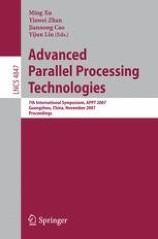
Advanced parallel processing technologies ; 7th International Symposium, APPT 2007 Guangzhou, China, November 22-23, 2007 Proceedings
APPT was upgraded to the International Symposium on Advanced Parallel Processing Technologies. However, it kept its traditional flavor by sharing of the underlying theories and applications, and the establishment of new and long-term collaborative channels. And it will continue to provide a forum for researchers, professionals, and industrial practitioners from around the world to report on new advances in high-performance architecture and software, as well as to identify issues and directions for research and development in the new era of evolving technologies.
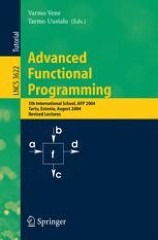
Advanced functional programming ; 5th International School, AFP 2004, Tartu, Estonia, August 14-21, 2004, Revised Lectures
Contains the revised lecture notes corresponding to nine of thelecture courses presented at the 5th International School on Advanced Functional Programming, AFP 2004, held in Tartu, Estonia, August 14–21, 2004. The goal of the AFP schools is to inform the wide international communitiesof computer science students and software production professionals about thenew and important developments in the area of functional programming. The schools put a special emphasis on practical applications of advanced techniques.
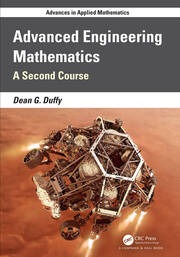
Advanced engineering mathematics : A second course with MatLab
Presents a wide variety of topics needed by today's engineers. The fifth edition of that book, available now, has been broken into two parts: topics currently needed in mathematics courses and a new stand-alone volume presenting topics not often included in these courses and consequently unknown to engineering students and many professionals.

Adaptive and Natural Computing Algorithms ; 8th International Conference, ICANNGA 2007, Warsaw, Poland, April 11-14, 2007, Proceedings, Part II
The ICANNGA series of conferences has been organized since 1993 and has a long history of promoting the principles and understanding of computational intelligence paradigms within the scientifc community. the ICANNGA series has established itself as a reference for scientists and practitioners in this area. The series has also been of value to young researchers wishing both to extend their knowledge and experience and to meet experienced professionals in their ?elds. In a rapidly advancing world, where technology and engineering change d- matically, new challenges in computer science compel us to broaden the c- ference scope in order to take into account new developments.
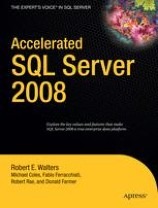
Accelerated SQL Server 2008
The expert tuition and approach to rapid learning in Accelerated SQL Server 2008, one of the first SQL Server 2008 books available, will enable SQL Server and other database professionals to make the leap to the 2008 release of Microsoft's flagship database management system quickly. Take full advantage of the features of SQL Server 2008, know what tools are available, and quickly realize the power and ease of use that SQL Server 2008 has to offer.

A healthcare professionals training system
The Objective Structured Clinical Examination (OSCE) is a type of examination often used in health sciences. It is designed to test clinical skill performance and competence in a range of skills. It is a practical, real-world approach to learning and assessment. Comprises a circuit of short (5-10 minutes) stations, in which each candidate is examined on a one-to-one basis with one or two impartial examiner(s) and patients who are either real or simulated (actors or electronic patient simulators). Each station has a different examiner; in comparison, the traditional method of clinical examination is when a candidate is assigned to an examiner for the entire examination.
3-D Computer vision : Principles, algorithms and applications
Offers advanced content on computer vision (basic content can be found in its prerequisite textbook, “2D Computer Vision: Principles, Algorithms and Applications”), including the basic principles, typical methods and practical techniques. It is intended for graduate courses on related topics, e.g. Computer Vision, 3-D Computer Vision, Graphics, Artificial Intelligence, etc. The book is mainly based on my lecture notes for several undergraduate and graduate classes I have offered over the past several years, while a number of topics stem from my research publications co-authored with my students. This book takes into account the needs of learners with various professional backgrounds, as well as those of self-learners. Furthermore, it can be used as a reference guide for practitioners and professionals in related fields.
