



الصفحة 4
الصفحة 4
Fundamental approaches to software engineering ; Vol. 3442 ; 8th International Conference, FASE 2005, Held as Part of the Joint European conferences on theory and practice of software, ETAPS 2005, Edinburgh, UK, April 4-8, 2005, Proceedings
ETAPS 2005 was the eighth instance of the European Joint Conferences on Theory and Practice of Software. ETAPS is an annual federated conference that was established in 1998 by combining a number of existing and new conf- ences. This year it comprised ?ve conferences (CC, ESOP, FASE, FOSSACS, TACAS), 17 satellite workshops (AVIS, BYTECODE, CEES, CLASE, CMSB, COCV, FAC, FESCA, FINCO, GCW-DSE, GLPL, LDTA, QAPL, SC, SLAP, TGC, UITP), seven invited lectures (not including those that were speci?c to the satellite events), and several tutorials. We received over 550 submissions to the ?ve conferences this year, giving acceptance rates below 30% for each one. The events that comprise ETAPS address various aspects of the system - velopment process, including speci?cation, design, implementation, analysis and improvement. The languages, methodologies and tools which support these - tivities are all well within its scope. Di?erent blends of theory and practice are represented, with an inclination towards theory with a practical motivation on the one hand and soundly based practice on the other. Many of the issues involved in software design apply to systems in general, including hardware s- tems,andtheemphasisonsoftwareisnotintendedtobeexclusive.

From Specification to Embedded Systems Application
Application documents recent approaches and results presented at the International Embedded Systems Symposium (IESS 2005), which was held in August 2005 in Manaus (Brazil) and sponsored by International Federation for Information Processing (IFIP). The topics which have been chosen for this working conference are very timely: design methodology, modeling, specification, software synthesis, power management, formal verification, testing, network, communication systems, distributed control systems, resource management and special aspects in system design.

From Program to Product : Turning Your Code into A Saleable Product
Many would–be software entrepreneurs with expertise in many fields attempt to turn a homegrown application—one developed for use in their own business or profession—into a commercial product. Lack of knowledge, experience, or skills often prevents the idea from ever taking shape, let alone achieving its potential. Entering a new field to start a business leaves many developers unprepared and not even fully aware that it's something they know so little about. They will also often have a job that conflicts with the time commitment required to market the program well enough for it to become a complete success.

Foundations of software science and computational structures ; Vol.3441 : 8th International Conference, FOSSACS 2005, Held as part of the joint European conferences on theory and practice of software, ETAPS 2005
ETAPS 2005 was the eighth instance of the European Joint Conferences on Theory and Practice of Software. ETAPS is an annual federated conference that was est- lished in 1998 by combining a number of existing and new conferences. This year it comprised ?ve conferences (CC, ESOP, FASE, FOSSACS, TACAS), 17 satellite wo- shops (AVIS, BYTECODE, CEES, CLASE, CMSB, COCV, FAC, FESCA, FINCO, GCW-DSE, GLPL, LDTA, QAPL, SC, SLAP, TGC, UITP), seven invited lectures (not including those that were speci?c to the satellite events), and several tutorials. We - ceived over 550 submissions to the ?ve conferences this year, giving acceptance rates below 30% for each one. Congratulations to all the authors who made it to the ?nal program! I hope that most of the other authors still found a way of participating in this exciting event and I hope you will continue submitting. The events that comprise ETAPS address various aspects of the system devel- ment process, including speci?cation, design, implementation, analysis and impro- ment. The languages, methodologies and tools which support these activities are all well within its scope.

Foundations of Qt Development
Foundations of Qt Development is based on Qt 4.2, and is aimed at C++ programmers who want to become proficient using this excellent toolkit to create graphical applications that can be ported to all major platforms. The book is focused on teaching you to write your own code in addition to using existing code. Common areas of confusion are identified, addressed, and answered.

Foundations of Object-Oriented Programming Using .NET 2.0 Patterns
Foundations of Object-Oriented Programming Using .NET 2.0 Patterns solves the object-oriented and pattern-programming problem by mixing the two—the book teaches object-oriented concepts using patterns, or a solutions-based approach. The book's material is organized around tasks and patterns, and illustrated through development problems and solutions that include persistence, code efficiency, and good design. This book is of special interest to those who want to learn how to use .NET 2.0 Generics in conjunction with patterns. This unique book is based on the author's lectures, and the information unfolds in a practical manner.

Foundations of Atlas : Rapid Ajax Development with ASP.NET 2.0
This book introduces a fast-track path to understanding Atlas, and how this technology can increase the power and functionality of your code while conserving time and effort. The book begins with a bare-bones introduction that explains how Atlas relates to Ajax. Microsoft Atlas is a web-client framework that makes building Ajax-style applications easier. It provides a prewritten framework that gives you a structured environment in which to work. Atlas also provides you with an object model and standardized debugging to make development faster and simpler. Ajax is a way of combining a number of Web technologies including JavaScript, dynamic HTML, and a feature known as XMLHttp (which reduces the need for client browsers to constantly reconnect to the server every time new information is downloaded). But at the moment, people developing with Ajax have to write their code from the ground up, which is complex and time consuming.
Foundations of Agile Python Development
You've long been enamored with the Python language, and have mastered its many nuances. Yet something seems to be missing—a productivity boost that you know is possible but you're not sure how to go about it. This was the sentiment of so many developers before discovering Agile programming paradigm, which embraces concepts such as automation, effective code management, and test–driven development. Foundations of Agile Python Development is the first book to apply these sought–after principles to Python developers, introducing both the tools and techniques built and supported by the Python community. Authored by Jeff Younker, a well–known member of Python's agile community who is perhaps best known for his creation of a popular Python testing framework
Foundation Web Design with Dreamweaver 8
Dreamweaver is Macromedia's bestselling web design/development environment. Dreamweaver has the capability to generate dynamic website code using server-side languages like ASP, PHP, and ASP.NET. We know that you don't always require a full database-driven site though, so this book focuses on using version 8 of Dreamweaver to design and create usable, standards-compliant websites using XHTML and CSS. One of the highlights of this version is much closer, tighter CSS/XHTML. This book will show you how to make the most of that feature. After a brief introduction to the latest version of Dreamweaver, and how CSS and XHTML fit into it, Craig Grannell looks at using the software for your web design projects in a hands-on, task based manner.

Foundation models for natural language processing : pre-trained language models integrating media
Covers basic natural language processing models, pre-trained language models BERT, GPT, and sequence-to-sequence converters, as well as the concepts of self-attention and context-sensitive embedding. Various approaches to improving these models are then discussed, such as expanding the pre-training parameters, increasing the length of input texts, or incorporating additional knowledge. An overview of the best performing models is then provided for about twenty application areas, e.g., question answering, translation, story generation, dialogue systems, image generation from text, etc. For each application area, the strengths and weaknesses of existing models are discussed, and an overview of further developments is provided. In addition, links to freely available code are provided. The concluding chapter summarizes the economic opportunities, risk mitigation, and potential developments of AI.

Foundation ASP for Dreamweaver 8
Dreamweaver 8 takes a lot of the hard work out of performing tasks such as integrating a database into your website, but it can't do everything. That's why this book not only shows you how to use all of Dreamweaver's functions, but also shows you how the underlying code functions, so you can then work around Dreamweaver's shortcomings. There's no attempt to turn you into a code guru, but you'll come away with sufficient knowledge of basic ASP to have the confidence to dive into the Dreamweaver code and tweak it to your own requirements. The emphasis is exclusively on ASP, so you don't waste any time on information that's not relevant to what you want to do.

Foundation ActionScript for Flash 8
This book contains all you need to understand and make use of ActionScript, and to have some fun while learning. The Foundation series teaching style is ideal if you're a non-programmer who wants to learn Flash programming quickly and thoroughly. The authors teach the basics, and provide an all-around proficiency in ActionScript, as well as Flash components within Flash 8. You'll gain the practical skills to build ActionScript based Flash projects, including making initial design decisions, structuring code, and testing. An ongoing case study means that by the end of the book, you'll have constructed a cutting-edge Flash site to showcase your newly learned skills.

Foundation ActionScript animation : Making things move!
In this book Keith Peters guides you through some basic animation theory and then demystifies the math and physics behind creating realistic animation, looking at trigonometry, velocity and acceleration, and bouncing & friction. This book will teach you how to use Flash ActionScript to move the objects in your movies, rather than letting Flash's tween engine do it for you. The benefit of this is smaller, more realistic, more dynamic interactive movies that seem to come alive on your screen. Almost all of the code featured in this book will work fine in either Flash MX 2004 or Flash 8, and with a few minor adjustments, most of it can even be applied to Flash MX.

Formal Refinement for Operating System Kernels
The purpose of this book is to show that the formal specification of kernels can be followed by a completely formal refinement process that leads to the extraction of executable code. The formal refinement process ensures that the code meets the specification in a precise sense.
Formal Methods and Software Engineering ; Vol. 3785 ; 7th International Conference on Formal Engineering Methods, ICFEM 2005, Manchester, UK, November 1-4, 2005, Proceedings
This volume contains papers presented at the 7th International Conference on Formal Engineering Methods (ICFEM 2005), 1-4 November 2005, Manchester, UK. Formal engineering methods are changing the way that systems are dev- oped. With language and tool support, these methods are being used for se- automatic code generation, and for the automatic abstraction and checking of implementations. In the future, they will be used at every stage of development: requirements, speci?cation, design, implementation, testing, anddocumentation. The aim of ICFEM 2005 was to bring together those interested in the - plication of formal engineering methods to computer systems. Researchers and practitioners, from industry, academia, and government, were encouraged to - tend, and to help advance the state of the art. The conference was supported by sponsorships from Microsoft Research, USA, the Software Engineers Association of Japan, the University of Man- ester, Manchester City Council, FormalMethods Europe (FME) and the British Computer Society FormalAspects ofComputing Specialist Group(BCS-FACS). We wish to thank these sponsors for their generosity. The ?nal programme consisted of 3 invited talks and 30 technical papers selected from a total of 74 submissions. The invited speakers were: Anthony Hall, independent consultant, UK; Egon B] orger, University of Pisa, Italy; John Rushby, SRI, USA. Their talks were sponsored by BCS-FACS, Microsoft - search and FME respectively. We wish to thank the invited speakers for their inspiring talks.

Formal Approaches to Agent-Based Systems ; 3rd International Workshop, FAABS 2004, Greenbelt, MD, April 26-27, 2004, Revised Selected Papers
The 3rd Workshop on Formal Approaches to Agent-Based Systems (FAABS-III) was held at the Greenbelt Marriott Hotel (near NASA Goddard Space Flight Center) in April 2004 in conjunction with the IEEE Computer Society. The first FAABS workshop was help in April 2000 and the second in October 2002. Interest in agent-based systems continues to grow and this is seen in the wide range of conferences and journals that are addressing the research in this area as well as the prototype and developmental systems that are coming into use. Our third workshop, FAABS-III, was held in April, 2004. This volume contains the revised papers and posters presented at that workshop. The Organizing Committee was fortunate in having significant support in the planning and organization of these events, and were privileged to have wor- renowned keynote speakers Prof. J Moore (FAABS-I), Prof. Sir Roger Penrose (FAABS-II), and Prof. John McCarthy (FAABS-III), who spoke on the topic of se- aware computing systems, auguring perhaps a greater interest in autonomic computing as part of future FAABS events. We are grateful to all who attended the workshop, presented papers or posters, and participated in panel sessions and both formal and informal discussions to make the workshop a great success. Our thanks go to the NASA Goddard Space Flight Center, Codes 588 and 581 (Software Engineering Laboratory) for their financial support and to the IEEE Computer Society (Technical Committee on Complexity in Computing) for their sponsorship and organizational assistance.

Forensic Computing
In the second edition of this very successful book, Tony Sammes and Brian Jenkinson show how information held in computer systems can be recovered when it has been hidden or subverted by criminals, and give the reader the means to insure that it is accepted as admissible evidence in court.
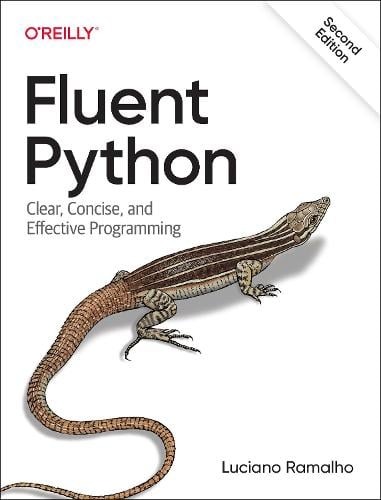
Fluent Python : Clear, Concise, and Effective Programming
You’ll learn how to write effective, modern Python 3 code by leveraging its best ideas. Don’t waste time bending Python to fit patterns you learned in other languages. Discover and apply idiomatic Python 3 features beyond your past experience. Author Luciano Ramalho guides you through Python’s core language features and libraries and teaches you how to make your code shorter, faster, and more readable.

FitBuddy : An artificial intelligence powered personal trainer
FitBuddy App is a sports application that employs artificial intelligence in its job as a personal trainer that enables users to exercise anywhere with convenience, tremendous benefit, and high accuracy. The user can exercise with or without weights, in addition to cycling and running. The user must first provide the application with the personal data it has asked for in order to create an appropriate sports program for the user. After that, the user may explore the sports program's weeks and day's sections.
Financial cryptography and data security ; FC 2020 International Workshops, AsiaUSEC, CoDeFi, VOTING, and WTSC, Kota Kinabalu, Malaysia, February 14, 2020, Revised Selected Papers
This book constitutes the refereed proceedings of two workshops held at the 24th International Conference on Financial Cryptography and Data Security, FC 2020, in Kota Kinabalu, Malaysia, in February 2020. The 39 full papers and 3 short papers presented in this book were carefully reviewed and selected from 73 submissions. The papers feature four Workshops: The 1st Asian Workshop on Usable Security, AsiaUSEC 2020, the 1st Workshop on Coordination of Decentralized Finance, CoDeFi 2020, the 5th Workshop on Advances in Secure Electronic Voting, VOTING 2020, and the 4th Workshop on Trusted Smart Contracts, WTSC 2020.
