



الصفحة 4
الصفحة 4

Natural Language Processing and Information Systems ; Vol. 3513 ; 10th International Conference on Applications of Natural Language to Information Systems, NLDB 2005, Alicante, Spain, June 15-17, Proceedings
The development and convergence of computing, telecommunications and information systems has already led to a revolution in the way that we work, communicate with each other, buy goods and use services, and even in the way that we entertain and educate ourselves.The revolution continues, and one of its results is that large volumes of information will increasingly be held in a form which is more natural for users than the data presentation formats typical of computer systems of the past. Natural language processing (NLP) is crucial in solving these problems, and language technologies will make an indispensable contribution to the success of information systems. We hope that NLDB 2005 was a modest contribution to this goal. NLDB 2005 contributed to advancing the goals and the high international standing of these conferences, largely due to its Program Committee, composed of renowned researchers in the field of natural language processing and inf- mation system engineering. Papers were reviewed by three reviewers from the Program Committee. This clearly contributed to the significant number of - pers submitted (95). Twenty-nine were accepted as regular papers, while 18 were accepted as short papers.
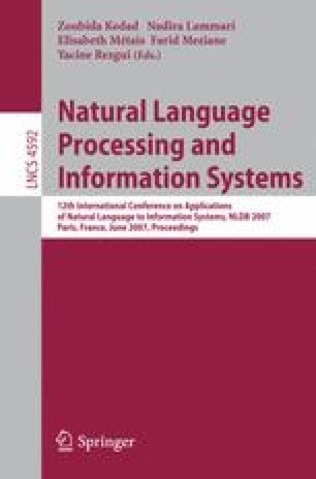
Natural language processing and information systems ; 12th International Conference on Applications of Natural Language to Information Systems, NLDB 2007, Paris, France, June 27-29, 2007, Proceedings
NLP techniques may substantially enhance most phases of the information system lifecycle, starting with requirement analysis, specification and validation, and going up to conflict resolution, result processing and presentation.
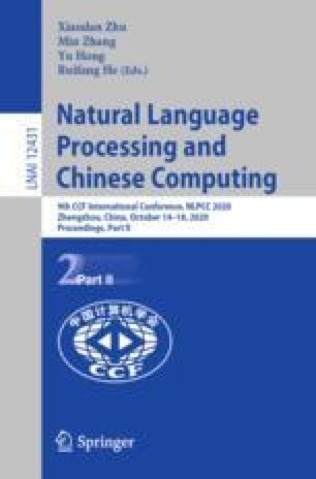
Natural Language Processing and Chinese Computing ; 9th CCF International Conference, NLPCC 2020, Zhengzhou, China, October 14–18, 2020, Proceedings, Part II
This two-volume set of LNAI 12340 and LNAI 12341 constitutes the refereed proceedings of the 9th CCF Conference on Natural Language Processing and Chinese Computing, NLPCC 2020, held in Zhengzhou, China, in October 2020. The 70 full papers, 30 poster papers and 14 workshop papers presented were carefully reviewed and selected from 320 submissions. They are organized in the following areas: Conversational Bot/QA; Fundamentals of NLP; Knowledge Base, Graphs and Semantic Web; Machine Learning for NLP; Machine Translation and Multilinguality; NLP Applications; Social Media and Network; Text Mining; and Trending Topics.
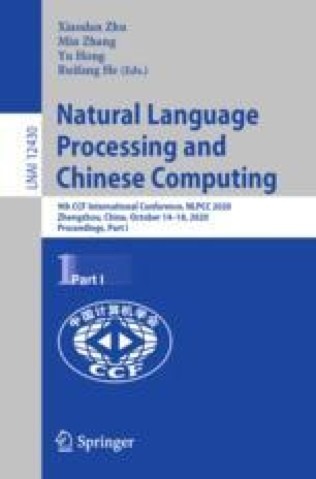
Natural language processing and chinese computing ; 9th CCF International conference, NLPCC 2020, Zhengzhou, China, October 14–18, 2020, Proceedings, Part I
This two-volume set of LNAI 12340 and LNAI 12341 constitutes the refereed proceedings of the 9th CCF Conference on Natural Language Processing and Chinese Computing, NLPCC 2020, held in Zhengzhou, China, in October 2020. The 70 full papers, 30 poster papers and 14 workshop papers presented were carefully reviewed and selected from 320 submissions. They are organized in the following areas: Conversational Bot/QA; Fundamentals of NLP; Knowledge Base, Graphs and Semantic Web; Machine Learning for NLP; Machine Translation and Multilinguality; NLP Applications; Social Media and Network; Text Mining; and Trending Topics.

Natural Language Processing – IJCNLP 2004 ; 1st International Joint Conference, Hainan Island, China, March 22-24, 2004, Revised Selected Papers
This book constitutes the thoroughly refereed post-proceedings of the First International Joint Conference on Natural Language Processing, IJCNLP 2004, held in Hainan Island, China in March 2004. The 84 revised full papers presented in this volume were carefully selected during two rounds of reviewing and improvement from 211 papers submitted. The papers are organized in topical sections on dialogue and discourse; FSA and parsing algorithms; information extractions and question answering; information retrieval; lexical semantics, ontologies, and linguistic resources; machine translation and multilinguality; NLP software and applications, semantic disambiguities; statistical models and machine learning; taggers, chunkers, and shallow parsers; text and sentence generation; text mining; theories and formalisms for morphology, syntax, and semantics; word segmentation; NLP in mobile information retrieval and user interfaces; and text mining in bioinformatics.
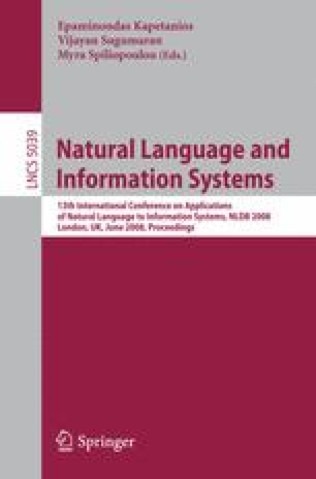
Natural language and information systems ; 13th International Conference on Applications of Natural Language to Information Systems, NLDB 2008 London, UK, June 24-27, 2008 Proceedings
This volume contains the papers presented at NLDB 2008, the 13th Inter- tional Conference on Natural Language and Information Systems, held June 25-27,2008.It also containssome of the best researchproposalsas submitted to the NLDB2008 doctoral symposium heldonJune24,2008.Theprogrammealso includes three invited talks covering the main perspectives of the application of naturallanguageto informationsystems: the wayhumansprocess, communicate and understand natural language, what are the implications and challenges - wardssemanticsearchfor the new Webgeneration, how naturallanguageapplies to the well-established database way of querying as a means to unlock data and information for end users.

Multivariate Public Key Cryptosystems
Multivariate public key cryptosystems (MPKC) is a fast-developing new area in cryptography. In the past 10 years, MPKC schemes have increasingly been seen as a possible alternative to number theoretic-based cryptosystems such as RSA, as they are generally more efficient in terms of computational effort. As quantum computers are developed, MPKC will become a necessary alternative. Multivariate Public Key Cryptosystems systematically presents the subject matter for a broad audience. Information security experts in industry can use the book as a guide for understanding what is needed to implement these cryptosystems for practical applications, and researchers in both computer science and mathematics will find this book a good starting point for exploring this new field. It is also suitable as a textbook for advanced-level students.

Multi-processor system-on-chip 1 : Architectures
covers the key components of MPSoC: processors, memory, interconnect and interfaces. It describes advance features of these components and technologies to build efficient MPSoC architectures. All the main components are detailed: use of memory and their technology, communication support and consistency, and specific processor architectures for general purposes or for dedicated applications.

Multiple-Aspect Analysis of Semantic Trajectories ; First International Workshop, MASTER 2019, Held in Conjunction with ECML-PKDD 2019, Würzburg, Germany, September 16, 2019, Proceedings
This book constitutes the refereed post-conference proceedings of the First International Workshop on Multiple-Aspect Analysis of Semantic Trajectories, MASTER 2019, held in conjunction with the 19th European Conference on Machine Learning and Knowledge Discovery in Databases, ECML PKDD 2019, in Würzburg, Germany, in September 2019.
Multiple Classifier Systems ; 6th International Workshop, MCS 2005, Seaside, CA, USA, June 13-15, 2005, Proceedings
Constitutes the refereed proceedings of the 6th International Workshop on Multiple Classifier Systems, MCS 2005. This book contains papers that are organized in topical sections on boosting, combination methods, performance analysis, and applications. They exemplify the advances in the theory and applications of multiple classifier systems

Multiple Classifier Systems ; 2nd International Workshop, MCS 2001 Cambridge, UK, July 2-4, 2001 Proceedings
Driven by the requirements of a large number of practical and commercially - portant applications, the last decade has witnessed considerable advances in p- tern recognition. Better understanding of the design issues and new paradigms, such as the Support Vector Machine, have contributed to the development of - proved methods of pattern classi cation. However, while any performance gains are welcome, and often extremely signi cant from the practical point of view, it is increasingly more challenging to reach the point of perfection as de ned by the theoretical optimality of decision making in a given decision framework. The asymptoticity of gains that can be made for a single classi er is a re?- tion of the fact that any particular design, regardless of how good it is, simply provides just one estimate of the optimal decision rule.

Multiobjective Problem Solving from Nature : From Concepts to Applications
he book focuses on how MOEAs and related techniques can be used to solve problems, particularly in the disciplines of science and engineering. Contributions by leading researchers show how the concepts of multiobjective optimization can be used to reformulate and resolve problems in broad areas such as constrained optimization, coevolution, classification, inverse modelling and design. The book is distinguished from other texts on MOEAs in that it is not primarily about the algorithms, nor specific applications, but about the concepts and processes involved in solving problems using a multiobjective approach. Each chapter contributes to the central, deep concepts and themes of the book: evaluating the utility of the multiobjective approach; discussing alternative problem formulations; showing how problem formulation affects the search process; and examining solution selection and decision making.

Multiobjective Evolutionary Algorithms and Applications
Multiobjective Evolutionary Algorithms and Applications provides comprehensive treatment on the design of multiobjective evolutionary algorithms and their applications in domains covering areas such as control and scheduling. Emphasizing both the theoretical developments and the practical implementation of multiobjective evolutionary algorithms, a profound mathematical knowledge is not required. Written for a wide readership, engineers, researchers, senior undergraduates and graduate students interested in the field of evolutionary algorithms and multiobjective optimization with some basic knowledge of evolutionary computation will find this book a useful addition to their book case.

Multimodal Video Characterization and Summarization
Multimodal Video Characterization and Summarization is a valuable research tool for both professionals and academicians working in the video field. This book describes the methodology for using multimodal audio, image, and text technology to characterize video content. This new and groundbreaking science has led to many advances in video understanding, such as the development of a video summary. Applications and methodology for creating video summaries are described, as well as user-studies for evaluation and testing.

Multimodal Technologies for Perception of Humans ; International Evaluation Workshops CLEAR 2007 and RT 2007, Baltimore, MD, USA, May 8-11, 2007, Revised Selected Papers
This book constitutes the thoroughly refereed joint post-workshop proceedings of two co-located events: the Second International Workshop on Classification of Events, Activities and Relationships, CLEAR 2007, and the 5th Rich Transcription 2007 Meeting Recognition evaluation, RT 2007, held in succession in Baltimore, MD, USA, in May 2007.The workshops had complementary evaluation efforts; CLEAR for the evaluation of human activities, events, and relationships in multiple multimodal data domains; and RT for the evaluation of speech transcription-related technologies from meeting room audio collections.

Multimedia security : Algorithm development, analysis and applications (algorithms for intelligent systems)
Provides an insight about various techniques used in multimedia security and identifies its progress in both technological and algorithmic perspectives. In the contemporary world, digitization offers an effective mechanism to process, preserve and transfer all types of information. The incredible progresses in computing and communication technologies augmented by economic feasibility have revolutionized the world. The availability of efficient algorithms together with inexpensive digital recording and storage peripherals have created a multimedia era bringing conveniences to people in sharing the digital data that includes images, audio and video. The ever-increasing pace, at which the multimedia and communication technology is growing, has also made it possible to combine, replicate and distribute the content faster and easier, thereby empowering mankind by having a wealth of information at their disposal.

Multimedia Forensics
Media forensics has never been more relevant to societal life. Not only media content represents an ever-increasing share of the data traveling on the net and the preferred communications means for most users, it has also become integral part of most innovative applications in the digital information ecosystem that serves various sectors of society, from the entertainment, to journalism, to politics. Undoubtedly, the advances in deep learning and computational imaging contributed significantly to this outcome. The underlying technologies that drive this trend, however, also pose a profound challenge in establishing trust in what we see, hear, and read, and make media content the preferred target of malicious attacks.

Multimedia Encryption and Watermarking
Multimedia Encryption and Watermarking presents a comprehensive survey of contemporary multimedia encryption and watermarking techniques, which enable a secure exchange of multimedia intellectual property. Part I, Digital Rights Management (DRM) for Multimedia, introduces DRM concepts and models for multimedia content protection, and presents the key players. Part II, Multimedia Cryptography, provides an overview of modern cryptography, with the focus on modern image, video, speech, and audio encryption techniques. This book also provides an advanced concept of visual and audio sharing techniques. Part III, Digital Watermarking, introduces the concept of watermarking for multimedia, classifies watermarking applications, and evaluates various multimedia watermarking concepts and techniques, including digital watermarking techniques for binary images. Multimedia Encryption and Watermarking is designed for researchers and practitioners, as well as scientists and engineers who design and develop systems for the protection of digital multimedia content. This volume is also suitable as a textbook for graduate courses on multimedia security.

Multimedia Database Retrieval : A Human-Centered Approach
Multimedia Database Retrieval: A Human-Centered Approach presents the latest development in user-centered methods and the state-of-the-art in visual media retrieval. It includes discussion on perceptually inspired non-linear paradigm in user-controlled interactive retrieval (UCIR) systems. It also features a coherent approach which focuses on specific topics within content/concept-based retrievals via audio-visual information modeling of multimedia. Highlights include: * Exploring an adaptive machine that can learn from its environment * Optimizing the learning system by incorporating self-organizing adaptation into the retrieval process * Demonstrating state-of-the-art applications within small, medium, and large databases
Multimedia Data Mining and Knowledge Discovery
Multimedia Data Mining and Knowledge Discovery provides an overview of the current state-of-the-art in the field of multimedia data mining and knowledge discovery, and discusses the variety of hot topics in multimedia data mining research. Consisting of an introductory section and four topical parts, the book describes the objectives and current tendencies in multimedia data mining research and their applications.
