



الصفحة 39
الصفحة 39

Advances in Artificial Life ; 9th European Conference, ECAL 2007, Lisbon, Portugal, September 10-14, 2007, Proceedings
This book is organized in topical sections on conceptual articles, morphogenesis and development, robotics and autonomous agents, evolutionary computation and theory, cellular automata, models of biological systems and their applications, ant colony and swarm systems, evolution of communication, simulation of social interactions, self-replication, artificial chemistry, and posters.

Advances in artificial life ; 8th European Conference, ECAL 2005 , Canterbury, UK, September 5-9, 2005, Proceedings
The Artificial Life term appeared more than 20 years ago . Since then the area has developed dramatically, many researchersjoining enthusiastically and research groups sprouting everywhere.a conceptual track, where papers were judged on criteria like importance and/or novelty of the concepts proposed rather than the experimental / theoretical results, has been introduced this year. A conference on a theme as broad as Artificial Life is bound to be very di-verse, but a few tendencies emerged. First, fields like ‘Robotics and Autonomous Agents’ or ‘Evolutionary Computation’are still extremely active and keep onbringing a wealth of results to the A-Life community. Even there, however, new tendencies appear, like collective robotics, and more specifically self-assembling robotics, which represent now a large subsection. Second, new areas appear.‘Morphogenesis and Development’ which used to be the subject of only a fewpapers, is now one of the largest subsections, and seems to be on the brinkof becoming a field of its own. Finally, most classical themes of A-Life re-search like ‘Artificial Chemistry’, ‘Ant-Inspired Systems’, ‘Cellular Automata’,‘Self-Replication’, ‘Social Simulations’ or ‘Bio-realist Simulations’ are still goingstrong and are well represented within this volume.

Advances in artificial intelligence: models, optimization, and machine learning
Contains all the articles accepted and published in the Special Issue “Advances in Artificial Intelligence: Models, Optimization, and Machine Learning” of the MDPI Mathematics journal, which covers a wide range of topics connected to the theory and applications of artificial intelligence and its subfields. These topics include, among others, deep learning and classic machine learning algorithms, neural modelling, architectures and learning algorithms, biologically inspired optimization algorithms, algorithms for autonomous driving, probabilistic models and Bayesian reasoning, intelligent agents and multiagent systems.
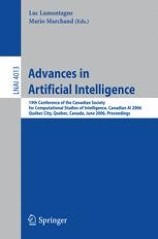
Advances in Artificial Intelligence ; Vol. 4013 : 19th Conference of the Canadian Society for Computational Studies of Intelligence, Canadian AI 2006, Quebec City, Quebec, Canada, June 7-9, Proceedings
Constitutes the refereed proceedings of the 4th Hellenic Conference on Artificial Intelligence, SETN 2006, held at Heraklion, Crete, Greece in May 2006. The 43 revised full papers and extended abstracts of 34 revised short papers presented together with 2 invited contributions were carefully reviewed and selected from 125 submissions. The papers address any area of artificial intelligence; particular fields of interest include; logic programming, knowledge-based systems, intelligent information retrieval, machine learning, neural nets, genetic algorithms, data mining and knowledge discovery, hybrid intelligent systems and methods, intelligent agents, multi-agent systems, intelligent distributed systems, intelligent/natural interactivity, intelligent virtual environments, planning, scheduling, and robotics.

Advances in Artificial Intelligence ; Vol. 3955 : 4th Helenic Conference on AI, SETN 2006, Heraklion, Crete, Greece, May 18-20, 2006, Proceedings
Constitutes the refereed proceedings of the 4th Hellenic Conference on Artificial Intelligence, SETN 2006, held at Heraklion, Crete, Greece in May 2006. The 43 revised full papers and extended abstracts of 34 revised short papers presented together with 2 invited contributions were carefully reviewed and selected from 125 submissions. The papers address any area of artificial intelligence; particular fields of interest include; logic programming, knowledge-based systems, intelligent information retrieval, machine learning, neural nets, genetic algorithms, data mining and knowledge discovery, hybrid intelligent systems and methods, intelligent agents, multi-agent systems, intelligent distributed systems, intelligent/natural interactivity, intelligent virtual environments, planning, scheduling, and robotics.

Advances in Artificial Intelligence ; 20th Conference of the Canadian Society for Computational Studies of Intelligence, Canadian AI 2007, Montreal, Canada, May 28-30, 2007, Proceedings
This book cover agents, bioinformatics, classification, constraint satisfaction, data mining, knowledge representation and reasoning, learning, natural language, and planning.
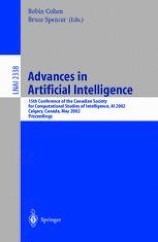
Advances in Artificial Intelligence ; 15th Conference of the Canadian Society for Computational Studies of Intelligence, AI 2002 Calgary, Canada, May 27-29, 2002 Proceedings
The AI conference series is the premier event sponsored by the Canadian - ciety for the Computational Studies of Intelligence / Soci´et´e canadienne pour l’´etude d’intelligence par ordinateur. Attendees enjoy our typically Canadian - mosphere –hospitable and stimulating. The Canadian AI conference showcases the excellent research work done by Canadians, their international colleagues, and others choosing to join us each spring. International participation is always high; this year almost 40% of the submitted papers were from non-Canadian - searchers. We accepted 24 papers and 8 poster papers from 52 full-length papers submitted. We also accepted eight of ten abstracts submitted to the Graduate Student Symposium. All of these accepted papers appear in this volume.
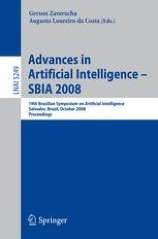
Advances in Artificial Intelligence - SBIA 2008 ; 19th Brazilian Symposium on Artificial Intelligence Savador, Brazil, October 26-30, 2008. Proceedings
Constitutes the refereed proceedings of the 19th Brazilian Symposium on Artificial Intelligence, SBIA 2008, held in Salvador, Brazil, in October 2008.

Advances in Artificial Intelligence - IBERAMIA-SBIA 2006 ; 2nd International Joint Conference, 10th Ibero-American Conference on AI, 18th Brazilian AI Symposium, Ribeirao Preto, Brazil, October 23-27, 2006
This decision was a consequence of the successful event organized in 2000, when the First International Joint Conference IBERAMIA/ SBIA 2000 (7th Ibero- American Artifcial Intelligence Conference and 15th Brazilian Artifcial Intel- gence Symposium) occurred in Brazil. Moreover, in 2006 the artifcial intelligence community celebrated the golden anniversary of the 1956 Dartmouth Conference that marked the beginning of artifcial intelligence as a research feld. th SBIA 2006 was the 18 conference of the SBIA conference series, which is the leading Brazilian conference for the presentation of AI research and applications.

Advances in Artificial Intelligence - IBERAMIA 2008 ; 11th Ibero-American Conference on AI, Lisbon, Portugal, October 14-17, 2008. Proceedings
Constitutes the refereed proceedings of the 11th Ibero-American Conference on Artificial Intelligence, IBERAMIA 2008, held in Lisbon, Portugal, in October 2008.

Advances in Artificial Economics : The Economy as a Complex Dynamic System
Perceiving the economy as a complex dynamic system, generates a need for new tools for its study. As a constructive simulation method, Agent-Based Computational Economics (ACE) has in recent years proven its strength and extensive applicability. Fields of study are widely spread within economics, with a cluster around financial markets. This book is based on communications given at AE’2006 (Aalborg, Denmark) – the second symposium on Artificial Economics, and covers both wellknown questions of economics, like the existence of market efficiency, as well as new questions raised by the new tools, for example questions related to networks of social interaction.
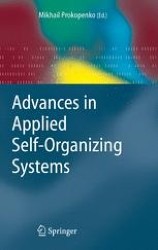
Advances in Applied Self-organizing Systems
This book presents the state-of-the-practice in successfully engineered self-organizing systems, and examines ways to balance design and self organization in the context of applications.
Advances in Applied Artificial Intelligence ; 19th International Conference on Industrial, Engineering and Other Applications of Applied Intelligent Systems, IEA/AIE 2006, Annecy, France, June 27-30, 2006, Proceedings
Intelligent Design and complex problem solving are twined like wife and husband.” In the current competitive global industrial environment there are many pr- lems which need intelligent systems technology for optimal solutions. The central theme of the 19th International Conference on Industrial, Engineering & Other Applications of Applied Intelligent Systems (IEA/AIE 2006) is to focus on the research methodologies and practical implementations of these methodologies for intelligent solutions of problems in real-world applications. We are pleased to present the papers in these proceedings which cover va- ous aspects of applications of applied intelligent systems. We received more than 330 papers from many countries and each paper was reviewed by at least two reviewers. Only 134 papers were selected for presentation in the normal and special sessions.

Advances in Ad Hoc Networking ; Proceedings of the Seventh Annual Mediterranean Ad Hoc Networking Workshop, Palma de Mallorca, Spain, June 25–27, 2008
The IFIP series publishes state-of-the-art results in the sciences and technologies of information and communication. The principal aim of the IFIP series is to encourage education and the dissemination and exchange of information about all aspects of computing.

Advancement of Deep Learning and its Applications in Object Detection and Recognition
In just the past five years, deep learning has taken the world by surprise, driving rapid progress in fields as diverse as computer vision, natural language processing, automatic speech recognition, etc. This book presents an introduction to deep learning and various applications of deep learning such as recommendation systems, text recognition, diabetic retinopathy prediction of breast cancer, prediction of epilepsy, sentiment, fake news detection, software defect prediction and protein function prediction.

Advanced Web and Network Technologies, and Applications ; APWeb 2008 International Workshops : BIDM, IWHDM, and DeWeb Shenyang, China, April 26-28, 2008. Revised Selected Papers
Constitutes the thoroughly refereed joint post-workshop proceedings of three international workshops held in conjunction with the 10th Asia-Pacific Web Conference, APWeb 2008, in Shenyang, China, in April 2008.

Advanced Web and Network Technologies, and Applications ; APWeb 2006 International Workshops : XRA, IWSN, MEGA, and ICSE, Harbin, China, January 16-18, 2006, Proceedings
The QOS evaluating model for computational grid nodes put forward can help greatly improving the self-adaptability of resource management and accelerating the appli- tion and development of Computational Grid. Now this model has been applied in NPU Campus Computational Grid. And the good effect brought by it has effectively proved its function. References 1. Foster, I. and C. Kesselman, eds. The Grid: Blueprint for a New Computing Infrastructure. Morgan Kaufmann, 1999. 2. Liu Liang, Zhou Xing-she, and Gu Jian-hua: A Multi-Agent System for Grid Computing. The Second International Conference on Active Media Technology, 2003 3. Yao Wang, Julita Vassileva: Trust and Reputation Model in Peer-to-Peer Networks. Farag Azzedin and Muthucumaru Maheswaran: Integrating Trust into Grid Resource M- agement Systems.

Advanced Topics in Exception Handling Techniques
Modern software systems are becoming more complex in many ways and are having to cope with a growing number of abnormal situations which, in turn, are increasingly complex to handle.This book is composed of five parts; the first four deal with topics related to exception handling in the context of programming languages, concurrency and operating systems, pervasive computing systems, and requirements and specifications. The last part focuses on case studies, experimentation and qualitative comparisons. The 16 coherently written chapters by leading researchers competently address a wide range of issues in exception handling.
Advanced Software Engineering : Expanding the Frontiers of Software Technology ; IFIP 19th World Computer Congress, First International Workshop on Advanced Software Engineering, August 25, 2006, Santiago, Chile
The scope of the series includes: foundations of computer science; software theory and practice; education; computer applications in technology; communication systems; systems modeling and optimization; information systems; computers and society; computer systems technology; security and protection in information processing systems; artificial intelligence; and human-computer interaction. Proceedings and post-proceedings of referred international conferences in computer science and interdisciplinary fields are featured. These results often precede journal publication and represent the most current research. The principal aim of the IFIP series is to encourage education and the dissemination and exchange of information about all aspects of computing.

Advanced SharePoint Services Solutions
Whether or not youve already benefited from Scot P. Hillier's first renowned Apress book, Microsoft SharePoint: Building Office 2003 Solutions, this fantastic follow-up is sure to please! This book will cover advanced techniques for programming web parts and SharePoint Services. Hillier also covers advanced integration techniques with related products like BizTalk Server 2004 and Content Server. Intended for advanced developers who already know all of the basic SharePoint Services, this book will steer you in solving ultra-specific, advanced problems.
