



الصفحة 35
الصفحة 35

Formal Methods for Computational Systems Biology ; 8th International School on Formal Methods for the Design of Computer, Communication, and Software Systems, SFM 2008 Bertinoro, Italy, June 2-7, 2008 Advanced Lectures
This volume presents the set of papers accompanying the lectures of the eighth International School on Formal Methods for the Design of Computer, Com- nication, and Software Systems (SFM). This series of schools addresses the use of formal methods in computer science asaprominent approach to theri gorousdesign of computer, communication, and software systems. The main aim of the SFM series is to ofer a good spectrum of current research in foundations as well as applications of formal methods, which can be of help for graduate students and young researchers who intend to approach the feld.
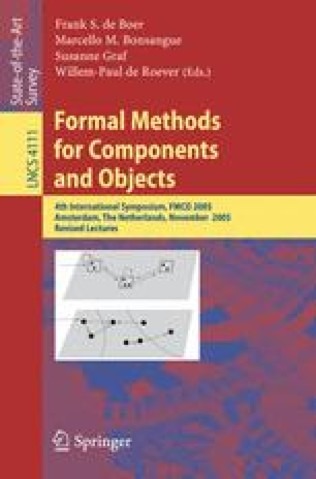
Formal Methods for Components and Objects ; Vol. 4111 ; 4th International Symposium, FMCO 2005, Amsterdam, The Netherlands, November 1-4, 2005, Revised Lectures
This book presents 19 revised invited keynote lectures and revised tutorial lectures given by top-researchers at the 4th International Symposium on Formal Methods for Components and Objects, FMCO 2005, held in Amsterdam, Netherlands, in November 2005. The book provides a unique combination of ideas on software engineering and formal methods that reflect the current interest in the application or development of formal methods for large scale software systems such as component-based systems and object systems.
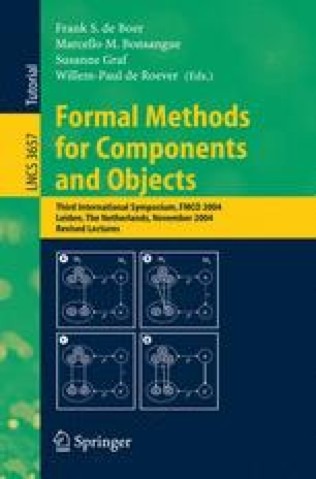
Formal Methods for Components and Objects ; Vol. 3657 ; 3rd International Symposium, FMCO 2004, Leiden, The Netherlands, November 2-5, 2004, Revised Lectures
This book presents revised tutorial lectures given by invited speakers at the Third International Symposium on Formal Methods for Components and Objects, FMCO 2004, held in Leiden, The Netherlands, in November 2004. The 14 revised lectures by leading researchers present a comprehensive account of the potential of formal methods applied to large and complex software systems such as component-based systems and object systems. The book provides an unique combination of ideas on software engineering and formal methods that reflect the expanding body of knowledge on modern software systems.

Formal Methods for Components and Objects ; 6th International Symposium, FMCO 2007, Amsterdam, The Netherlands, October 24-26, 2007, Revised Lectures
Formal methods have been applied successfully to the verification of medium-sized programs in protocol and hardware design.This book presents 12 revised papers submitted after the symposium by the speakers of each of the following European IST projects: the IST-FP6 project Mobius, developing the technology for establishing trust and security for the next generation of global computers; the IST-FP6 project SelfMan on self management for large-scale distributed systems based on structured overlay networks and components

Formal Methods for Components and Objects ; 5th International Symposium, FMCO 2006, Amsterdam, Netherlands, November 7-10,2006, Revised Lectures
The book provides a unique combination of ideas on software engineering and formal methods that reflect the current interest in the application or development of formal methods for large scale software systems.

Formal methods applications and technology ; 11th International workshop on formal methods for industrial critical systems, FMICS 2006, and 5th International Workshop on parallel and distributed methods in verification, PDMC 2006, Bonn, Germany, August 26-27, and August 31, 2006, Revised Selected
The workshop program included two invited talks, by Anna Slobodova from Intel on “Challenges for Formal Veri?cation in an Industrial Setting” and by Edward A. Lee from the University of California at Berkeley on “Making C- currency Mainstream.” The former full paper can be found in this volume.

Formal Methods and Software Engineering; 9th International Conference on Formal Engineering Methods, ICFEM 2007, Boca Raton, Florida, USA, November 14-15, 2007, Proceedings
This book constitutes the refereed proceedings of the 9th International Conference on Formal Engineering Methods, ICFEM 2007, held in Boca Raton, Florida, USA, November 14-15, 2007. The papers address all current issues in formal methods and their applications in software engineering.

Formal Methods and Software Engineering ; Vol. 4260 ; 8th International Conference on Formal Engineering Methods, ICFEM 2006, Macao, China, November 1-3, 2006, Proceedings
This book constitutes the refereed proceedings of the 8th International Conference on Formal Engineering Methods, ICFEM 2006, held in Macao, China, in November 2006. The papers address all current issues in formal methods and their applications in software engineering.

Formal Methods and Software Engineering ; 10th International Conference on Formal Engineering Methods, ICFEM 2008, Kitakyushu-City, Japan, October 27-31, 2008. Proceedings
This book constitutes the refereed proceedings of the 10th International Conference on Formal Engineering Methods, ICFEM 2008, held in Kitakyushu-City, Japan, October 2008.The 20 revised full papers together with 3 invited talks presented were carefully reviewed and selected from 62 submissions. The papers address all current issues in formal methods and their applications in software engineering. They are organized in topical sections on specification and verification; testing; verification; model checking and analysis; tools; application of formal methods; semantics.

Formal concept analysis ; Vol. 3874 ; 4th International Conference, ICFCA 2006, Dresden, Germany, Feburary 13-17, 2006, Proceedings
This book constitutes the refereed proceedings of the 4th International Conference on Formal Concept Analysis, held in February 2006. The 17 revised full papers presented together with four invited papers were carefully reviewed and selected for inclusion in the book. The papers show advances in applied lattice and order theory and in particular scientific advances related to formal concept analysis and its practical applications: data and knowledge processing including data visualization, information retrieval, machine learning, data analysis and knowledge management.

Formal concept analysis ; Vol. 3403 ; 3rd International Conference, ICFCA 2005, Lens, France, February 14-18, 2005, Proceedings
This book constitutes a comprehensive and systematic presentation of the state of the art of formal concept analysis and its applications. The first part of the book is devoted to foundational and methodological topics. The contributions in the second part demonstrate how formal concept analysis is successfully used outside of mathematics, in linguistics, text retrieval, association rule mining, data analysis, and economics. The third part presents applications in software engineering.

Formal Concept Analysis ; 6th International Conference, ICFCA 2008, Montreal, Canada, February 25-28, 2008. Proceedings
Formal Concept Analysis (FCA) is a mathematical theory of concepts and c- ceptual hierarchyleadingto methods for conceptually analyzing data and kno- edge. The theory itselfstronglyreliesonorder and lattice theory,whichhasbeen studied by mathematicians over decades. FCA proved itself highly relevant in several applications from the beginning , and, over the last years, the range of application shaskept growing. The mainreasonfor this comesfromthe fact that our modern society has turned into an “information” society. After years and years of using computers, companies realized they had stored gigantic amounts of data.

Formal Concept Analysis ; 5th International Conference, ICFCA 2007, Clermont-Ferrand, France, February 12-16, 2007, Proceedings
This book constitutes the refereed proceedings of the 5th International Conference on Formal Concept Analysis, ICFCA 2007. The papers comprise state of the art research from foundational to applied lattice theory and related fields, all of which involve methods and techniques of formal concept analysis such as data visualization, information retrieval, machine learning, data analysis and knowledge management.

Formal aspects in security and trust ; Vol. 173 ; IFIP TC1 WG1.7 Workshop on Formal Aspects in Security and Trust (FAST), World Computer Congress, August 22-27, 2004, Toulouse, France
The IFIP series publishes state-of-the-art results in the sciences and technologies of information and communication. The scope of the series includes: foundations of computer science; software theory and practice; education; computer applications in technology; communication systems; systems modeling and optimization; information systems; computers and society; computer systems technology; security and protection in information processing systems; artificial intelligence; and human-computer interaction. Proceedings and post-proceedings of referred international conferences in computer science and interdisciplinary fields are featured. These results often precede journal publication and represent the most current research. The principal aim of the IFIP series is to encourage education and the dissemination and exchange of information about all aspects of computing.

Formal approaches to software testing and runtime verification ; 1st Combined International Workshops FATES 2006 and RV 2006, Seattle, WA, USA, August 15-16, 2006, Revised Selected Papers
Software validation is one of the most cost-intensive tasks in modern software production processes. The objective of FATES/RV 2006 was to bring sci- tists from both academia and industry together to discuss formal approaches to test and analyze programs and monitor and guide their executions. Formal approaches to test may cover techniques from areas like theorem proving, model checking, constraint resolution, static program analysis, abstract interpretation, Markov chains, and various others. Formal approaches to runtime veri?cation use formal techniques to improve traditional ad-hoc monitoring techniques used in testing, debugging, performance monitoring, fault protection, etc.

Formal approaches to software testing ; Vol. 3997 ; 5th International Workshop, FATES 2005, Edinburgh, UK, July 11, 2005, Revised Selected Papers
This book constitutes the thoroughly refereed post-proceedings of the 5th International Workshop on Formal Approaches to Software Testing, FATES 2005, held in Edinburgh, UK, in July 2005 in conjunction with CAV 2005.

Formal approaches to software testing ; Vol. 3395 ; 4th International workshop, FATES 2004, Linz, Austria, September 21, 2004, Revised Selected Papers
Testing often accounts for more than 50% of the required e?ort during system development.Thechallengeforresearchistoreducethesecostsbyprovidingnew methods for the speci?cation and generation of high-quality tests. Experience has shown that the use of formal methods in testing represents a very important means for improving the testing process. Formal methods allow for the analysis andinterpretationofmodelsinarigorousandprecisemathematicalmanner.The use of formal methods is not restricted to system models only. Test models may alsobeexamined.Analyzingsystemmodelsprovidesthepossibilityofgenerating complete test suites in a systematic and possibly automated manner whereas examining test models allows for the detection of design errors in test suites and their optimization with respect to readability or compilation and execution time. Due to the numerous possibilities for their application, formal methods have become more and more popular in recent years. The Formal Approaches in Software Testing (FATES) workshop series also bene?ts from the growing popularity of formal methods. After the workshops in Aalborg (Denmark, 2001), Brno (Czech Republic, 2002) and Montr´ eal (Canada, 2003), FATES 2004 in Linz (Austria) was the fourth workshop of this series. Similar to the workshop in 2003, FATES 2004 was organized in a?liation with the IEEE/ACM Conference on Automated Software Engineering (ASE 2004). FATES 2004 received 41 submissions. Each submission was reviewed by at least three independent reviewers from the Program Committee with the help of some additional reviewers. Based on their evaluations, 14 full papers and one wo- in-progress paper from 11 di?erent countries were selected for presentation.

Formal Approaches to Agent-Based Systems ; 3rd International Workshop, FAABS 2004, Greenbelt, MD, April 26-27, 2004, Revised Selected Papers
The 3rd Workshop on Formal Approaches to Agent-Based Systems (FAABS-III) was held at the Greenbelt Marriott Hotel (near NASA Goddard Space Flight Center) in April 2004 in conjunction with the IEEE Computer Society. The first FAABS workshop was help in April 2000 and the second in October 2002. Interest in agent-based systems continues to grow and this is seen in the wide range of conferences and journals that are addressing the research in this area as well as the prototype and developmental systems that are coming into use. Our third workshop, FAABS-III, was held in April, 2004. This volume contains the revised papers and posters presented at that workshop. The Organizing Committee was fortunate in having significant support in the planning and organization of these events, and were privileged to have wor- renowned keynote speakers Prof. J Moore (FAABS-I), Prof. Sir Roger Penrose (FAABS-II), and Prof. John McCarthy (FAABS-III), who spoke on the topic of se- aware computing systems, auguring perhaps a greater interest in autonomic computing as part of future FAABS events. We are grateful to all who attended the workshop, presented papers or posters, and participated in panel sessions and both formal and informal discussions to make the workshop a great success. Our thanks go to the NASA Goddard Space Flight Center, Codes 588 and 581 (Software Engineering Laboratory) for their financial support and to the IEEE Computer Society (Technical Committee on Complexity in Computing) for their sponsorship and organizational assistance.

Forecasting Oracle Performance
Forecasting Oracle Performance is the first book to focus squarely on the problem of forecasting the future performance of an Oracle database. Other Oracle performance books are good for putting out fires; Craig's book helps you avoid all the heat in the first place.

Food lens = فود لينس
Food lens is an innovative application designed to revolutionize dietary management by leveraging advanced image recognition and nutritional analysis. The primary objective of this senior project is to develop a user-friendly tool that identifies various foods through a camera interface and provides detailed nutritional information. This application not only enhances the user's understanding of their dietary intake but also assists in achieving personalized health and fitness goals. The core functionality of Food Lens involves the integration of a robust image recognition system capable of accurately identifying a wide range of foods. Upon identification, the application retrieves comprehensive nutritional data, including calorie content, macronutrient distribution (proteins, fats, carbohydrates), and essential micronutrients (vitamins and minerals). This data is then seamlessly integrated into the user's dietary profile. Food Lens is designed to track the user's daily caloric intake and compare it against personalized recommendations based on age, gender, weight, height, and activity level. By maintaining a dynamic record of consumed foods, the application provides real-time feedback on the user’s nutritional progress. This feature is particularly beneficial for individuals aiming to manage weight, address dietary restrictions, or improve overall health.
