



الصفحة 33
الصفحة 33

Crowd investment platform
Investment platforms are challenging the grip of massive business on the venture sector and are providing new means of power to the crowds. It is of no surprise that new and interesting equity sharing platforms are now disrupting the convention practices of the market. There are a number of concerns that the user faces, including legal, commercial and security concerns, as well as concerns about trusting these platforms in investment operations, especially in the financial transfer process between the user and companies. We built a site that reduces the presence of these concerns and protects the user from fraud, as we store money transfers and investment operations between users and companies or users and other users within a smart contract that brings them together and the amount that will be invested in the blockchain that encodes this contract and makes it public only to its owners.

Creating Web-based Laboratories
Remote web-based experimentation, enabling students and researchers to access the laboratory anytime via the Internet, is becoming an increasingly attractive way to complement or even replace traditional laboratory sessions. Placing a video camera & microphone before the equipment and apparatus to capture what is actually happening in the laboratory allows the images and audio data to be streamed to the client side. Researchers in different countries can share equipment and conduct research cooperatively and remotely. The authors summarise their research and discuss the development of the 5 web-based laboratories launched from the National University of Singapore. The principles, structure, and technologies required for the creation of Internet remote experimentation systems are discussed with particular emphasis on the integration of hardware and software systems. Also highlighted is the design and development of interfaces and components for use in typical web-based laboratories or similar web-control applications.

Creating New Learning Experiences on a Global Scale ; 2nd European Conference on Technology Enhanced Learning, EC-TEL 2007, Crete, Greece, September 17-20, 2007, Proceedings
It is holding more than 500 pages of combined wisdom on Technology Enhanced Learning (TEL) in your hands! With the advance of metadata, standards, learning objects, Web 2. 0 approaches to rip, mix and burn learning, wikis, blogs, syndication, user-generated content, W- based video, games and the ubiquitous availability of computing devices we can and have to offer more flexible learning services on a global scale.It provided a unique forum for all research related to technology enhanced learning, including its interactions with knowledge management, business processes and work environments.

Creating Mobile Games : Using Java™ ME Platform to Put the Fun into Your Mobile Device and Cell Phone
Creating Mobile Games: shows you how to create a basic game and make it a professional one (by adding a pro look-and-feel by writing your own menus or using the open source J2ME Polish, and enabling marketing/billing from your own web site). Demonstrates Wireless Messaging and other optional APIs (using SMS, PIM, File Connection, Bluetooth, and so forth in a multiplayer game).

Creating Flash Widgets with Flash CS4 and ActionScript 3.0
Creating Flash Widgets with Flash CS4 and ActionScript 3.0 is an introduction to developing widgets for the Internet using the features of Flash CS4 and ActionScript 3.0. Many social-networking sites, blogs, and personal home pages have adopted the use of widgets and Flash developers can create and distribute their own widgets for others to use. A step-by-step example demonstrates how to design and develop your own Flash widgets and integrate them with XML. In addition, publishing, promoting, and capitalizing on your Flash widgets is discussed.

Creating Client Extranets with SharePoint 2003
Creating Client Extranets with SharePoint 2003 is a guide for creating client-facing extranets using SharePoint 2003. This book serves as a how-to for building full-featured extranets using SharePoint 2003 and .NET technologies. If you already have experience developing and deploying business applications in .NET, then this book will help you master the intricacies of SharePoint 2003 development and customization. This is the only book of its kind—one designed to help you build a functioning client extranet from start to finish, avoiding many inherent traps in SharePoint development. It contains numerous valuable tips, tricks, and traps. And it offers various working code samples to help you get up to speed quickly using the SharePoint object model and Web Services. It uniquely focuses on SharePoint as a corporate development platform, while other books tend to focus only on end-user features.
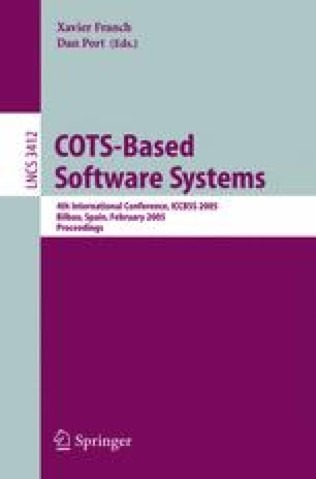
COTS-Based software systems ; 4th International Conference, ICCBSS 2005, Bilbao, Spain, February 7-11, 2005, Proceedings
The theme “Build and Conquer” : software development is an engineering discipline, and not an artistic expression. Once we are ready to “build” our software systems using pieces previously builtin (similar to any other technology manufacturer), we will be able to “conquer” the software engineering process. If we take a look at other engineering disciplines such as car manufacturing, house appliances or aeronautics, we see that the final products are built through the integration of multiprovider commercial components. These components are successfully integrated and constitute an important part of the final product. Most software-related organizations still build software from scratch, omitting thousands of ready-built commercially available software components that could be used very effectively during the development phase. This year ICCBSS moves to Europe for the first time since the first conference took place in Orlando, FL, USA in 2002. The conference scope has enlarged over the years to include the Open Source community and Web Services technologies. so many of the characteristics of COTS are also applied to Open Source and Web Services.

Correct hardware design and verification methods
Constitutes the refereed proceedings of the 13th IFIP WG 10.5 Advanced Research Working Conference on Correct Hardware Design and Verification Methods, CHARME 2005, held in Saarbrucken, Germany, in October 2005.

Core Java ; Vol. I : Fundamentals ; 12th ed.
The definitive guide to writing robust, maintainable code. Whatever version of Java you are using—up to and including Java 17—this book will help you achieve a deep and practical understanding of the language and APIs. With hundreds of realistic examples, Cay S. Horstmann reveals the most powerful and effective ways to get the job done.

Coordination, organizations, institutions, and norms in agent systems II ; AAMAS 2006 and ECAI 2006 International Workshops, COIN 2006 Hakodate, Japan, May 9, 2006 Riva del Garda, Italy, August 28, 2006, Revised Selected Papers
In recent years, social and organizational aspects of agency have become major research topics in MAS. Recent applications of MAS on Web services, grid c- puting and ubiquitous computing highlight the need for using these aspects in order to ensure social order within such environments. Openness, heterogeneity, and scalability of MAS, in turn, pose new demands on traditional MAS int- action models and bring forward the need to look into the environment where agents interact and at di?erent ways of constraining or regulating interactions.it provide theoretically demanding and interdisciplinary research questions at d- ferent levels of abstraction.

Coordination models and languages ; 23rd IFIP WG 6.1 International Conference, COORDINATION 2021, Held as Part of the 16th International Federated Conference on Distributed Computing Techniques, DisCoTec 2021, Valletta, Malta, June 14–18, 2021, Proceedings
This book constitutes the refereed proceedings of the 23rd IFIP WG 6.1 International Conference on Coordination Models and Language, COORDINATION 2021, held in Valletta, Malta, in June 2021, as part of the 16th International Federated Conference on Distributed Computing Techniques, DisCoTec 2021. The 15 regular papers, 2 short papers, and 1 tutorial paper presented in this book were carefully reviewed and selected from 31 submissions. COORDINATION provides a well-established forum for the growing community of researchers interested in coordination models and languages, architectures, verification and implementation techniques necessary to cope with the complexity induced by the demands of today's software development.

Coordination models and languages ; 22nd IFIP WG 6.1 International Conference, COORDINATION 2020, Held as Part of the 15th International Federated Conference on Distributed Computing Techniques, DisCoTec 2020, Valletta, Malta, June 15–19, 2020, Proceedings
This book constitutes the proceedings of the 22nd International Conference on Coordination Models and Languages, COORDINATION 2020, which was due to be held in Valletta, Malta, in June 2020, as part of the 15th International Federated Conference on Distributed Computing Techniques, DisCoTec 2020. The conference was held virtually due to the COVID-19 pandemic. The 12 full papers and 6 short papers included in this volume were carefully reviewed and selected from 30 submissions. They are presented in this volume together with 2 invited tutorials and 4 tool papers. The papers are organized in the following topical sections: tutorials; coordination languages; message-based communication; communications: types & implementations; service-oriented computing; large-scale decentralized systems; smart contracts; modelling; verification & analysis.

Cooperative Information Agents XI ; Matthias Klusch, Koen V. Hindriks, Mike P. Papazoglou, Leon Sterling
In today’s world of ubiquitously connected heterogeneous information systems and computing devices, the intelligent coordination and provision of relevant added-value information at any time, anywhere is of key importance to a va- ety of applications. This challenge is envisioned to be coped with by means of appropriate intelligent and cooperative information agents. An information agent is a computational software entity that has access to one or multiple heterogeneous and geographically dispersed data and infor- tion sources. It pro-actively searches for and maintains information on behalf of its human users, or other agents preferably just in time. In other words, it is managing and overcoming the di?culties associated with information overload in open, pervasive information and service landscapes. Each component of a modern cooperative information system is represented by an appropriate intelligent information agent capable of resolving system and semantic heterogeneities in a given context on demand. Cooperative infor- tion agents are supposed to accomplish both individual and shared joint goals depending on the actual user preferences in line with given or deduced limits of time, budget and resources available.

Cooperative Control : A Post-Workshop Vol., 2003 Block Island Workshop on Cooperative Control
This carefully edited book presents how natural groupings such as fish schools, bird flocks, deer herds etc. coordinate themselves and move so flawlessly, often without an apparent leader or any form of centralized control. It shows how the underlying principles of cooperative control may be used for groups of mobile autonomous agents to help enable a large group of autonomous robotic vehicles in the air, on land or sea or underwater, to collectively accomplish useful tasks such as distributed, adaptive scientific data gathering, search and rescue, or reconnaissance.

Converged communications : Evolution from telephony to 5G mobile internet
The central theme of the book is to build deeper understanding about incremental technological progress by introducing both state of the art and their predecessor technologies. The book explores four main areas, including fixed telephone systems, data communication systems, mobile cellular systems, and IP multimedia systems. It clearly explains architectures, protocols, and functional procedures, and discusses a variety of topics ranging from physical layer processes to system level interactions. Converged Communications offers: In-depth treatments of fixed telephone and transmission systems, including operation of telephone exchanges and signaling systems Comprehensive explorations of data communication systems, including transmission of data over telephone lines and data network technologies, such as Ethernet and TCP/IP Incisive discussions of mobile cellular systems, including GSM, 3G, LTE, VoLTE and 5G Insightful analysis of incremental system evolution to justify various design choices made The book is supported with extensive online appendices, which covers communication system concepts, an overview of standardization, various technologies used in the past, state-of-the art technologies such as WLAN, cable modems, and FTTx, complementing the other systems described in the book which have evolved from the fixed telephone network.

Control Theory Tutorial : Basic Concepts Illustrated by Software Examples
Introduces the basic principles of control theory in a concise self-study guide. It complements the classic texts by emphasizing the simple conceptual unity of the subject. A novice can quickly see how and why the different parts fit together. The concepts build slowly and naturally one after another, until the reader soon has a view of the whole. Each concept is illustrated by detailed examples and graphics. The full software code for each example is available, providing the basis for experimenting with various assumptions, learning how to write programs for control analysis, and setting the stage for future research projects. The topics focus on robustness, design trade-offs, and optimality. Most of the book develops classical linear theory. The last part of the book considers robustness with respect to nonlinearity and explicitly nonlinear extensions, as well as advanced topics such as adaptive control and model predictive control.

Control of Single Wheel Robots
This monograph presents a novel concept of a mobile robot, which is a single-wheel, gyroscopically stabilized robot. The robot is balanced by a spinning wheel attached through a two-link manipulator at the wheel bearing, and actuated by a drive motor.

Control of Robot Manipulators in Joint Space
Robot control is the backbone of robotics, an essential discipline in the maintenance of high quality and productivity in modern industry. The most common method of control for industrial robotic manipulators relies on the measurement and amendment of joint displacement: so-called "joint-space control

Control of Redundant Robot Manipulators : Theory and Experiments
This monograph provides a comprehensive and thorough treatment of the problem of controlling a redundant robot manipulator. It presents the latest research from the field with a good balance between theory and practice. All theoretical developments are verified both via simulation and experimental work on an actual prototype redundant robot manipulator

Contributions to Simulation Speed-Up : Rare Event Simulation and Short-Term Dynamic Simulation for Mobile Network Planning
Eugen Lamers explains the principle of simulation speed-up in general, demonstrates the technique RESTART for the simulation of rare events, and addresses its efficiency on distributed systems.
