



الصفحة 30
الصفحة 30

Deontic Logic and Artificial Normative Systems ; 8th International Workshop on Deontic Logic in Computer Science, DEON 2006, Utrecht, The Netherlands, July 12-14, 2006, Proceedings
This volume presents the papers contributed to DEON 2006, the 8th Inter- tional Workshop on Deontic Logic in Computer Science, held in Utrecht, The Netherlands, July 12–14, 2006. These biennial DEON (more properly, ?EON) workshops are designed to promote international cooperation among scholars across disciplines who are interested in deontic logic and its use in computer science.

Deepfake detection = اكتشاف التزييف العميق
In the rapidly evolving era of artificial intelligence, addressing the escalating threats of deepfake technology becomes a necessity because of the increasing sophistication of AI algorithms in generating deceptive content, and since it threatens the integrity of information across diverse data. The main objective is to build a sophisticated AI-driven system to detect different types of deepfake in text, audio, and images. In English text deepfake detection, multiple pre-trained tokenizers have been used, but XLNET and BERT stand out with identifying objects outside the dataset with an accuracy of 0.9809 and both have been generalized & trained using LSTM. In Arabic text deepfake detection, Arabert has been trained using LSTM which led with an accuracy of 99.53% by generalizing the model. Both English and Arabic datasets have been generated to enhance the accuracy and effectiveness of the models. Audio deepfake detection has been generalized too, using Random Forest with an accuracy of 98.259%.

Deepfake detection
Recently, various techniques of manipulating the video content have become available to everyone – online, one can find free applications e.g., for face swapping in videos. Such universal accessibility carries a notable risk of flooding online content with false information, affecting not only the greats of this world, but also the whole societies, also the rapid progress in synthetic image generation and manipulation has now come to a point where it raises significant concerns for the implications towards society. It is therefore necessary to develop a verification tool that will help assess the authenticity of the videos posted on the internet. This project describes the approach of using artificial intelligence solutions to detect doctored videos.

Deepfake detection
The rise of large language models (LLMs) and the increasing sophistication of deepfake images have made detecting synthetic content a pressing challenge. Several approaches have been proposed to tackle this problem, including statistical analysis, and machine learning algorithms. In this project, A novel zero-shot approach is proposed that utilizes the power of LLMs to detect fake text. The pre-trained LLM is fine-tuned to enhance its ability to differentiate real and fake text. The approach uses the LLM to detect text by analyzing the log probabilities of the text. For detecting fake images, computer vision algorithms and neural networks are used to analyze facial features. The facial region is cropped and preprocessed and the neural network identifies patterns indicative of synthetic content.

Deepfake
The technology used to create such digital content has quickly become accessible to the masses, such as “DEEPFAKE.” Deep fakes refer to manipulated videos, or other digital representations produced by sophisticated artificial intelligence, that yields to synthesize a sequence of face images and voices of characters corresponding to their identities, such as voice tone, facial expression, with a good lip synchronization. Therefore, this study is about developing real-time video generation software, which generates a target video from a single input image. Several methods and algorithms have been applied to detect, analyze personalize facial expression, voice and natural head poses to present a life-like image instead of a low quality one.

Deep structure, singularities, and computer vision ; 1st international workshop, DSSCV 2005, Maastricht, The Netherlands, June 9-10, 2005, revised selected papers
Constitutes the refereed post-proceedings of the First International Workshop on Deep Structure, Singularities, and Computer Vision, DSSCV 2005, held in Maastricht. This book represents in understanding the relation between structural, topological information represented by singularities and metric information of signals, shapes, and colors.

Deep Statistical Comparison for Meta-heuristic Stochastic Optimization Algorithms
Presents a comprehensive comparison of the performance of stochastic optimization algorithms / Includes an introduction to benchmarking and statistical analysis / Provides a web-based tool for making statistical comparisons of optimization algorithms / Overviews of the current approaches used to analyze algorithm performance in a range of common scenarios, while also addressing issues that are often overlooked. In turn, it shows how these issues can be easily avoided by applying the principles that have produced Deep Statistical Comparison and its variants. The focus is on statistical analyses performed using single-objective and multi-objective optimization data. At the end of the book, examples from a recently developed web-service-based e-learning tool (DSCTool) are presented. The tool provides users with all the functionalities needed to make robust statistical comparison analyses in various statistical scenarios. The book is intended for newcomers to the field and experienced researchers alike. For newcomers, it covers the basics of optimization and statistical analysis, familiarizing them with the subject matter before introducing the Deep Statistical Comparison approach. Experienced researchers can quickly move on to the content on new statistical approaches.

Deep Learning, Machine Learning and IoT in Biomedical and Health Informatics : Techniques and Applications
Examines and demonstrates state-of-the-art approaches for IoT and Machine Learning based biomedical and health related applications. This book aims to provide computational methods for accumulating, updating and changing knowledge in intelligent systems and particularly learning mechanisms that help us to induce knowledge from the data. It is helpful in cases where direct algorithmic solutions are unavailable, there is lack of formal models, or the knowledge about the application domain is inadequately defined. In the future IoT has the impending capability to change the way we work and live. These computing methods also play a significant role in design and optimization in diverse engineering disciplines. With the influence and the development of the IoT concept, the need for AI (artificial intelligence) techniques has become more significant than ever.

Deep Learning to See : Towards New Foundations of Computer Vision
Topics and features: Presents a curiosity-driven approach, posing questions to stimulate readers to design novel computational models of vision Offers a rethinking of computer vision, arguing for an approach based on vision in nature, versus regarding visual signals as collections of images Provides an interdisciplinary commentary, aiming to unify computer vision, machine learning, human vision, and computational neuroscience Serving to inspire and stimulate critical reflection and discussion, yet requiring no prior advanced technical knowledge, the text can naturally be paired with classic textbooks on computer vision to better frame the current state of the art, open problems, and novel potential solutions.

Deep learning pipeline : Building a deep learning model with TensorFlow
Build your own pipeline based on modern TensorFlow approaches rather than outdated engineering concepts. This book shows you how to build a deep learning pipeline for real-life TensorFlow projects. You'll learn what a pipeline is and how it works so you can build a full application easily and rapidly. Then troubleshoot and overcome basic Tensorflow obstacles to easily create functional apps and deploy well-trained models. Step-by-step and example-oriented instructions help you understand each step of the deep learning pipeline while you apply the most straightforward and effective tools to demonstrative problems and datasets.

Declarative programming for knowledge management ; 16th International conference on applications of declarative programming and knowledge management, INAP 2005, Fukuoka, Japan, October 22-24, 2005. Revised Selected Papers
Presents a selection of papers presented at the 16th Inter- tional Conference on Applications of Declarative Programming and Knowledge Management, INAP 2005,held in October 2005 at Waseda University, Fukuoka, Japan. These papers re?ect a snapshot of ongoing research and current app- cations in knowledge management and declarative programming.

Declarative agent languages and technologies IV ; 4th International Workshop, DALT 2006, Hakodate, Japan, May 8, 2006, Selected, Revised and Invited Papers
Constitutes the thoroughly refereed post-proceedings of the 4th International Workshop on Declarative Agent Languages and Technologies, DALT 2006, held in Japan in May 2006. This was an associated event of AAMAS 2006, the main international conference on autonomous agents and multi-agent systems. The 12 revised full papers presented together with one invited talk and three invited papers were carefully selected for inclusion in the book.
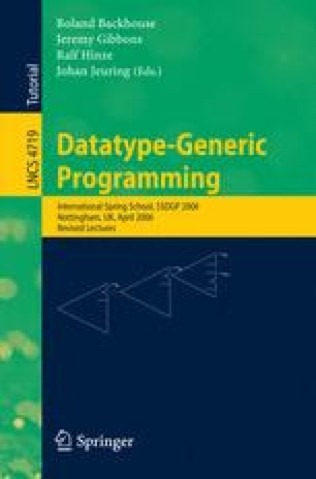
Datatype-Generic Programming ; International Spring School, SSDGP 2006, Nottingham, UK, April 24-27, 2006, Revised Lectures
A leitmotif in the evolution of programming paradigms has been the level and extent of parametrisation that is facilitated — the so-called genericity of the paradigm. The sorts of parameters that can be envisaged in a programming language range from simple values, like integers and fioating-point numbers, through structured values, types and classes, to kinds (the type of types and/or classes).Datatype-generic programming is about parametrising programsby the structure of the data that they manipulate. To appreciate the importance of data type genericity,one need look no further than the internet. The internet is a massive repository of structured data, but the structure is rarely exploited. For example, compression of data can be much more efiective if its structure is known, but most compression algorithms regard the input data as simply a string of bits, and take no account of its internal organisation. Datatype-generic programming is about exploiting the structure of data when it is relevant and ignoring it when it is not. Programming languages most c- monly used at the present time do not provide efiective mechanisms for do- menting and implementing datatype genericity.

Data-Driven 3D Facial Animation
Data-Driven 3D Facial Animation: systematically describes the emerging data-driven techniques developed over the last ten years or so. Although data-driven 3D facial animation is used more and more in animation practice, to date there have been very few books that specifically address the techniques involved. Comprehensive in scope, the book covers not only traditional lip-sync (speech animation), but also expressive facial motion, facial gestures, facial modeling, editing and sketching, and facial animation transferring. It provides an up-to-date reference source for academic research and for professionals working in the facial animation field.

Database theory - ICDT 2005 ; 10th international conference, Edinburgh, UK, January 5-7, 2005, Proceedings
This volume collects the papers presented at the 10th International Conference on Database Theory, ICDT 2005, held during January 5–7, 2005, in Edinburgh, UK. ICDT (http://alpha.luc.ac.be/~lucp1080/icdt/) has now a long tra- tion of international conferences, providing a biennial scienti?c forum for the communication of high-quality and innovative research results on theoretical - pects of all forms of database systems and database technology. The conference usually takes place in Europe, and has been held in Rome (1986), Bruges (1988), Paris (1990), Berlin (1992), Prague (1995), Delphi (1997), Jerusalem (1999), London (2001), and Siena (2003) so far. ICDT has merged with the Sym- sium on Mathematical Fundamentals of Database Systems (MFDBS), initiated in Dresden in 1987, and continued in Visegrad in 1989 and Rostock in 1991. ICDT had a two-stage submission process. First, 103 abstracts were subm- ted, which were followed a week later by 84 paper submissions. From these 84 submissions, the ICDT Program Committee selected 24 papers for presentation at the conference. Most of these papers were “extended abstracts” and preli- nary reports on work in progress. It is anticipated that most of these papers will appear in a more polished form in scienti?c journals.
Database performance at scale: a practical guide
Optimizing database performance at the scale required for today’s data-intensive applications often requires more than performance tuning and scaling out. This book shares commonly overlooked considerations, pitfalls, and opportunities that have helped many teams break through database performance plateaus. It’s neither a definitive guide to distributed databases nor a beginner’s resource. Rather, it’s a look at the many different factors that impact performance, and our top field-tested recommendations for navigating them. Chapter 1 provides two (fun and fanciful) tales that surface some of the many roadblocks you might face and highlight the range of strategies for navigating around them.

Data Warehousing and Data Mining Techniques for Cyber Security
It provide techniques for collecting information from distributed databases and for performing data analysis. The ever expanding, tremendous amount of data collected and stored in large databases has far exceeded our human ability to comprehend--without the proper tools. There is a critical need for data analysis that can automatically analyze data, summarize it and predict future trends. In the modern age of Internet connectivity, concerns about denial of service attacks, computer viruses and worms are extremely important. Data Warehousing and Data Mining Techniques for Cyber Security contributes to the discipline of security informatics. The author discusses topics that intersect cyber security and data mining, while providing techniques for improving cyber security. Since the cost of information processing and internet accessibility is dropping, an increasing number of organizations are becoming vulnerable to cyber attacks. This volume introduces techniques for applications in the area of retail, finance, and bioinformatics, to name a few.

Data structure and algorithms using C++ : A practical implementation
Intended to flow from the basic concepts of C++ to technicalities of the programming language, its approach and debugging. The chapters of the book flow with the formulation of the problem, it's designing, finding the step-by-step solution procedure along with its compilation, debugging and execution with the output. Keeping in mind the learner’s sentiments and requirements, the exemplary programs are narrated with a simple approach so that it can lead to creation of good programs that not only executes properly to give the output, but also enables the learners to incorporate programming skills in them. The style of writing a program using a programming language is also emphasized by introducing the inclusion of comments wherever necessary to encourage writing more readable and well commented programs. As practice makes perfect, each chapter is also enriched with practice exercise questions so as to build the confidence of writing the programs for learners.

Data security : Technical and organizational protection measures against data loss and computer Crime
Offers an easy-to understand introduction to technical and organizational data security. It provides an insight into the technical knowledge that is mandatory for data protection officers. Data security is an inseparable part of data protection, which is becoming more and more important in our society. It can only be implemented effectively if there is an understanding of technical interrelationships and threats.

Data science on the Google cloud platform : Implementing end-to-end real-time data pipelines : From ingest to machine learning
Learn how easy it is to apply sophisticated statistical and machine learning methods to real-world problems when you build using Google Cloud Platform (GCP). This hands-on guide shows data engineers and data scientists how to implement an end-to-end data pipeline with cloud native tools on GCP. You'll work through a sample business decision by employing a variety of data science approaches. Follow along by building a data pipeline in your own project on GCP, and discover how to solve data science problems in a transformative and more collaborative way. Employ best practices in building highly scalable data and ML pipelines on Google Cloud Automate and schedule data ingest using Cloud Run Create and populate a dashboard in Data Studio Build a real-time analytics pipeline using Pub/Sub, Dataflow, and BigQuery Conduct interactive data exploration with BigQuery Create a Bayesian model with Spark on Cloud Dataproc Forecast time series and do anomaly detection with BigQuery ML Aggregate within time windows with Dataflow Train explainable machine learning models with Vertex AI Operationalize ML with Vertex AI Pipelines
