



الصفحة 3
الصفحة 3
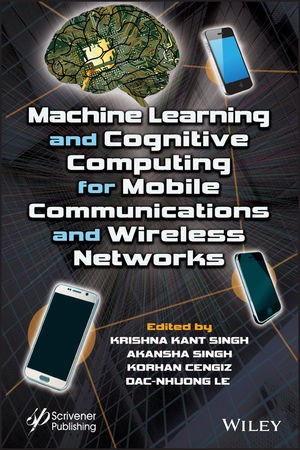
Machine Learning and Cognitive Computing for Mobile Communications and Wireless Networks
Communication and network technology has witnessed recent rapid development and numerous information services and applications have been developed globally. These technologies have high impact on society and the way people are leading their lives. The advancement in technology has undoubtedly improved the quality of service and user experience yet a lot needs to be still done. Some areas that still need improvement include seamless wide-area coverage, high-capacity hot-spots, low-power massive-connections, low-latency and high-reliability and so on. Thus, it is highly desirable to develop smart technologies for communication to improve the overall services and management of wireless communication. Machine learning and cognitive computing have converged to give some groundbreaking solutions for smart machines. With these two technologies coming together, the machines can acquire the ability to reason similar to the human brain. The research area of machine learning and cognitive computing cover many fields like psychology, biology, signal processing, physics, information theory, mathematics, and statistics that can be used effectively for topology management. Therefore, the utilization of machine learning techniques like data analytics and cognitive power will lead to better performance of communication and wireless systems.

Learn BlackBerry 10 App Development : A Cascades-Driven Approach
Learn how to leverage the BlackBerry 10 Cascades framework to create rich native applications. Learn BlackBerry 10 App Development gives you a solid foundation for creating BlackBerry 10 apps efficiently. Along the way, you will learn how to use QML and JavaScript for designing your app’s UI, and C++/Qt for the application logic. No prior knowledge of C++ is assumed and the book covers the fundamental aspects of the language for writing BlackBerry 10 apps. Also a particular emphasis is put on how to create a visually enticing user experience with the Cascades framework, which is based on Qt and QML.

Cellular Automata and Discrete Complex Systems ; 26th IFIP WG 1.5 International Workshop, AUTOMATA 2020, Stockholm, Sweden, August 10–12, 2020, Proceedings
This volume constitutes the refereed post-conference proceedings of the 26th IFIP WG 1.5 International Workshop on Cellular Automata and Discrete Complex Systems, AUTOMATA 2020, held in Stockholm, Sweden, in August 2020. The workshop was held virtually. The 11 full papers presented in this book were carefully reviewed and selected from a total of 21 submissions. The topics of the conference include dynamical, topological, ergodic and algebraic aspects of CA and DCS, algorithmic and complexity issues, emergent properties, formal languages, symbolic dynamics, tilings, models of parallelism and distributed systems, timing schemes, synchronous versus asynchronous models, phenomenological descriptions, scientific modeling, and practical applications.

CASCOM : Intelligent service coordination in the semantic web
A general architecture for service delivery and coordination in intelligent agent-based peer-to-peer (IP2P) environments, that has been developed within the CASCOM research project, is presented in this book.

Architecture of computing systems - ARCS 2006 ; 19th International Conference, Frankfurt / Main, Germany, March 13-16, 2006, Proceedings
Technological progress is one of the driving forces behind the dramatic devel- mentofcomputersystemarchitecturesoverthe pastthreedecades.Eventhough it is quite clear that this development cannot only be measured by the ma- mum number of components on a chip, Moore’s Law may be and is often taken as a simple measure for the non-braked growth of computational power over the years. The more components are realizable on a chip, the more innovative and unconventional ideas can be realized by system architects. As a result, research in computer system architectures is more exciting than ever before. This book coversthe trends that shape the ?eld of computer system archit- tures.

Applied Informatics; Third International Conference, ICAI 2020, Ota, Nigeria, October 29–31, 2020, Proceedings
This book constitutes the thoroughly refereed papers of the Second International Conference on Applied Informatics, ICAI 2020, held in Ota, Nigeria, in October 2020. The 35 full papers were carefully reviewed and selected from 101 submissions. The papers are organized in topical sections on artificial intelligence; business process management; cloud computing; data analysis; decision systems; health care information systems; human-computer interaction; image processing; learning management systems; software design engineering.

Android Essentials
Android Essentials is a no–frills, no–nonsense, code–centric run through the guts of application development on Google's Mobile OS. This book uses the development of a sample application to work through topics, focusing on giving developers the essential tools and examples required to make viable commercial applications work. Covering the entirety of the Android catalog in less than 150 pages is simply impossible. Instead, this book focuses on just four main topics: the application life cycle and OS integration, user interface, location–based services, and networking.
Android Application Development for the Intel® Platform
The number of Android devices running on Intel processors has increased since Intel and Google announced, in late 2011, that they would be working together to optimize future versions of Android for Intel Atom processors. Today, Intel processors can be found in Android smartphones and tablets made by some of the top manufacturers of Android devices, such as Samsung, Lenovo, and Asus.

Algorithms and architectures for parallel processing ; 7th International Conference, ICA3PP 2007, Hangzhou, China, June 11-14, 2007, Proceedings
The improvements in computation and communication capabilities have enabled the creation of demanding applications in critical domains such as the environment, health, aerospace, and other areas of science and technology. Similarly, new classes of applications are enabled by the availability of heterogeneous large-scale distributed systems which are becoming available nowadays (based on technologies such as grid and peer-to-peer systems).Parallel computing systems exploit a large diversity of computer architectures, from supercomputers, shared-memory or distributed-memory multi processors, to local networks and clusters of p- sonal computers. With the recent emergence of multi core architectures, parallel computing is now set to achieve “mainstream” status. Approaches that have been advocated by parallel computing researchers in the past are now being utilized in a number of software libraries and hardware systems that are available for everyday use. Parallel computing ideas have also come to dominate areas such as multi user gaming (especially in the development of gaming engines based on “cell” arc- tectures).

Algorithms – ESA 2005 ; 13th Annual European Symposium, Palma de Mallorca, Spain, October 3-6, 2005, Proceedings
This volume contains the 75 contributed papers and the abstracts of the threeinvited lectures presented at the 13th Annual European Symposium on Algo-rithms (ESA 2005), held in Spain, 2005. respectively.Papers were solicited in all areas of algorithmic research, including but notlimited to algorithmic aspects of networks, approximation and on-line algo-rithms, computational biology, computational geometry, computational financeand algorithmic game theory, data structures, database and information re-trieval, external memory algorithms, graph algorithms, graph drawing, machinelearning, mobile computing, pattern matching and data compression, quantumcomputing, and randomized algorithms. The algorithms could be sequential,distributed, or parallel. Submissions were especially encouraged in the area ofmathematical programming and operations research, including combinatorialoptimization, integer programming, polyhedral combinatorics, and semidefiniteprogramming.Each extended abstract was submitted to one of the two tracks.
Algorithmic Aspects of Wireless Sensor Networks ; 4th International Workshop, ALGOSENSORS 2008, Reykjavik, Iceland, July 2008. Revised Selected Papers
This book constitutes the reviewed proceedings of the Fourth International Workshop on Algorithmic Aspects of Wireless Sensor Networks, ALGOSENSORS 2008, held in Reykjavik, Iceland, Wroclaw, Poland, July 12, 2008.
Algorithmic Aspects of Wireless Sensor Networks ; 3rd International Workshop, ALGOSENSORS 2007, Wroclaw, Poland, July 14, 2007, Revised Selected Papers
This book contains the proceedings of the Third International Workshop on Algorithmic Aspects of Wireless Sensor Networks. Coverage includes abstract models, complexity-theoretic results, and the design and analysis of algorithms for wireless sensor networks.

Agent-oriented software engineering V ; 5th International workshop, AOSE 2004, New York, NY, USA, July 2004, revised selected papers
The explosive growth of application areas such as electronic commerce, ent- prise resource planning and mobile computing has profoundly and irreversibly changed our views on software systems. Nowadays, software is to be based on open architectures that continuously change and evolve to accommodate new components and meet new requirements. Software must also operate on di?- ent platforms, without recompilation, and with minimal assumptions about its operating environment and its users. Furthermore, software must be robust and ¨ autonomous, capable of serving a naive user with a minimum of overhead and interference. Agent concepts hold great promise for responding to the new realities of software systems. They o?er higher-level abstractions and mechanisms which address issues such as knowledge representation and reasoning, communication, coordination, cooperation among heterogeneous and autonomous parties, p- ception, commitments, goals, beliefs, and intentions, all of which need conceptual modelling. On the one hand, the concrete implementation of these concepts can lead to advanced functionalities.
Agent-oriented information systems IV ; 8th International bi-conference workshop, AOIS 2006, Hakodate, Japan, May 9, 2006 and Luxembourg, Luxembourg, June 6, 2006, Revised Selected Papers
In AOIS, we focus on the application of agent technology in information systems development and explore the potential for facilitating the increased usage of agent technology in the creation of information systems in the widest sense.
Agent-oriented information systems III ; 7th International bi-conference workshop, AOIS 2005, Utrecht, The Netherlands, July 26, 2005, and Klagenfurt, Austria, October 27, 2005, Revised Selected Papers
In 2005, two AOIS workshops were held internationally. The first was affiliated with the AAMAS 2005 meeting in July in Utrecht in The Netherlands and chaired by Henderson-Sellers and Winikoff and the second with ER 2005 in November in Klagenfurt in Austria and chaired by Kolp and Bresciani. The best papers from these meetings were identified and authors invited to revise and possibly extend their papers in the light of reviewers’ comments and feedback at the workshop. We have grouped these papers loosely under four headings: Agent behavior, communications and reasoning; Methodologies and ontologies; Agent-oriented software engineering; and Applications.

Agent-oriented information systems II ; 6th International bi-conference workshop, AOIS 2004, Riga, Latvia, June 8, 2004 and New York, NY, USA, July 20, 2004, revised selected papers
Information systems have become the backbone of all kinds of organizations - day. In almost every sector – manufacturing, education, health care, government and businesses large and small – information systems are relied upon for - eryday work, communication, information gathering and decision-making. Yet, the in?exibilities in current technologies and methods have also resulted in poor performance, incompatibilities and obstacles to change. As many organizations are reinventing themselves to meet the challenges of global competition and e-commerce, there is increasing pressure to develop and deploy new technologies that are ?exible, robust and responsive to rapid and unexpected change. Agent concepts hold great promise for responding to the new realities of - formation systems. They o?er higher-level abstractions and mechanisms which address issues such as knowledge representation and reasoning, communication, coordination, cooperation among heterogeneous and autonomous parties, p- ception, commitments, goals, beliefs, intentions, etc., all of which need conc- tual modelling. On the one hand, the concrete implementation of these concepts can lead to advanced functionalities.

Advances in web and network technologies, and information management ; APWeb/WAIM 2007 International Workshops : DBMAN 2007, WebETrends 2007, PAIS 2007 and ASWAN 2007, Huang Shan, China, June 16-18, 2007, Proceedings
With the increasing ubiquity of personal computing devices, such as mobile phones and PDAs, and the increasing deployment of sensor networks, new distributed applications are developed over networked databases posing interesting challenges. It aimed to bring together researchers in different fields related to database management and application over networks and to provide a forum where researchers and practitioners could share and exchange their knowledge and experience.

Advances in multimedia modeling ; 13th International multimedia modeling conference, MMM 2007, Singapore, January 9-12, 2007, Proceedings, Part II
The two volume set LNCS 4351 and LNCS 4352 constitutes the refereed proceedings of the 13th International Multimedia Modeling Conference, MMM 2007, held in Singapore in January 2007. Based on rigorous reviewing, the program committee selected 123 carefully revised full papers of the main technical sessions and 33 revised full papers of four special sessions from a total of 392 submissions for presentation in two volumes.
Advances in informatics ; 10th Panhellenic Conference on informatics, PCI 2005, Volas, Greece, November 11-13, 2005, Proceedings
This volume contains a subset of the papers presented at the 10th Panhellenic Conference in Informatics (PCI 2005), which took place at the , Greece, Of the submitted papers, 81 were accepted for inclusion in this volume, papers are classi?ed into 17 thematic sections as follows: – data bases and data mining – algorithms and theoretical foundations – cultural and museum information systems – Internet-scale software/information systems – wearable and mobile computing – computer graphics, virtual reality and visualization – AI, machine learning and knowledge bases – languages, text and speech processing – bioinformatics – software engineering – educational technologies – e-business – computer and sensor hardware and architecture – computer security – image and video processing – signal processing and telecommunications – computer and sensor networks
Advances in grid and pervasive computing ; 2nd International Conference, GPC 2007, Paris, France, May 2-4, 2007, Proceedings
This book address all aspects of grid and pervasive computing and focus on topics such as cluster computing, high performance computing, grid computing, semantic Web and semantic grid, service-oriented computing, peer-to-peer computing, pervasive computing, mobile computing, network storage, as well as grid and pervasive related applications.
