



الصفحة 27
الصفحة 27

Foundations of augmented cognition ; 3rd International Conference, FAC 2007, Held as Part of HCI International 2007, Beijing, China, July 22-27, 2007, Proceedings
These papers address the latest research and development efforts and highlight the human aspects of design and use of computing systems. This volume contains papers in the thematic area of Augmented Cognition.

Foundations and advances in data mining
In this carefully edited volume a theoretical foundation as well as important new directions for data-mining research are presented. It brings together a set of well respected data mining theoreticians and researchers with practical data mining experiences. The presented theories will give data mining practitioners a scientific perspective in data mining and thus provide more insight into their problems, and the provided new data mining topics can be expected to stimulate further research in these important directions.
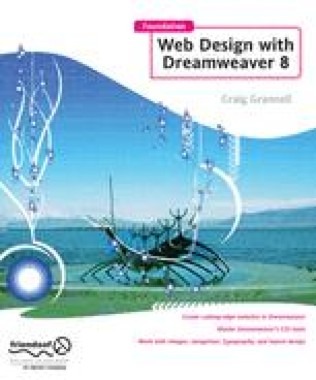
Foundation Web Design with Dreamweaver 8
Dreamweaver is Macromedia's bestselling web design/development environment. Dreamweaver has the capability to generate dynamic website code using server-side languages like ASP, PHP, and ASP.NET. We know that you don't always require a full database-driven site though, so this book focuses on using version 8 of Dreamweaver to design and create usable, standards-compliant websites using XHTML and CSS. One of the highlights of this version is much closer, tighter CSS/XHTML. This book will show you how to make the most of that feature. After a brief introduction to the latest version of Dreamweaver, and how CSS and XHTML fit into it, Craig Grannell looks at using the software for your web design projects in a hands-on, task based manner.

Foundation 3ds Max 8 Architectural Visualization
Welcome to the world of 3D architectural visualizations using the most powerful and versatile 3D software package on the planet: 3ds Max. In just the last few years, the visualization industry has arguably become the fastest-growing 3D industry, and may soon overtake all others in total number of users. Just as the use of computer-aided design became the norm for nearly all architectural, engineering, and construction firms in the 1990s, 3D visualizations have become standard practice today. This book takes you through the challenge of learning one of the most complex computer programs ever created, by way of easy-to-follow tutorials and instruction. It specifically focuses on those parts of the program you need to know to produce stunning architectural visualizations.

Form-oriented analysis : A new methodology to model form-based applications
Form-based applications range from simple web shops to complex enterprise resource planning systems. Draheim and Weber adapt well-established basic modeling techniques in a novel way to achieve a modeling framework optimized for this broad application domain. They introduce new modeling artifacts, such as page diagrams and form storyboards, and separate dialogue patterns to allow for reuse. In their implementation they have developed new constructs such as typed server pages, and tools for forward and reverse engineering of presentation layers. The methodology is explained using an online bookshop as a running example in which the user can experience the modeling concepts in action. The combination of theoretical achievements and hands-on practical advice and tools makes this book a reference work for both researchers in the areas of software architectures and submit-response style user interfaces, and professionals designing and developing such applications. More information and additional material is also available online.

Formal techniques for distributed objects, components, and systems ; 40th IFIP WG 6.1 International conference, FORTE 2020, Held as Part of the 15th International Federated Conference on distributed computing techniques, DisCoTec 2020, Valletta, Malta, June 15–19, 2020, Proceedings
This book constitutes the proceedings of the 40th IFIP WG 6.1 International Conference on Formal Techniques for Distributed Objects, Components, and Systems, FORTE 2020, held in Valletta, Malta, in June 2020, as part of the 15th International Federated Conference on Distributed Computing Techniques, DisCoTec 2020.*

Formal techniques for computer systems and business processes ; European performance engineering workshop, EPEW 2005 and International workshop on web services and formal methods, WS-FM 2005, Versailles, France, September 1-3, 2005, Proceedings
This book constitutes the refereed proceedings of two colocated international workshops EPEW 2005 (European Performance Engineering Workshop) and WS-FM 2005 (Web Services and Formal Methods) held in Versailles, France in September 2005. The 20 revised full papers presented were carefully reviewed and selected from 59 submissions. For EPEW 2005 only 10 papers - of the 32 submitted - were accepted for presentation; they deal with queueing theory, bounding techniques, stochastic model checking, communication schemes analysis for high-speed LAN, QOS analysis in wireless ad-hoc networks and optical networks analysis. The main topics of the 10 papers accepted for WS-FM 2005 - from 27 submissions - include: protocols and standards for WS (SOAP, WSDL, UDDI, etc.); languages and description methodologies for Choreography/Orchestration/Workflow (BPML, XLANG and BizTalk, WSFL, WS-BPEL, etc.); coordination techniques for WS (transactions, agreement, coordination services, etc.); semantics-based dynamic WS discovery services (based on Semantic Web/Ontology Techniques or other semantic theories); security, performance evaluation and quality of service of WS; semi-structured data and XML related technologies; comparisons with different related technologies/approaches.

Formal Modeling and Analysis of Timed Systems ; Vol.4202 ; 4th International Conference, FORMATS 2006, Paris, France, September 25-27, 2006, Proceedings
The aim of FORMATS is to promote the study of fundamental and practical aspects of timed systems, and to bring together researchers from di?erent d- ciplines that share interests in modelling and analysis of timed systems. In this volume, there are articles on: – Foundations and Semantics: contributions to the theoretical foundations of timed systems and timed formal languages as well as comparison between di?erentmodelsusedbydi?erentcommunities(timedautomata,timedPetri nets, timed MSCs, hybrid automata, timed process algebra, timed temporal logics, timed abstract state machines, as well as probabilistic models). – Methods and Tools: techniques, algorithms, data structures, and software toolsforanalyzingtimedsystemsandresolvingtemporalconstraints(mod- checking, simulation, robustness analysis, scheduling, etc).
Formal Modeling and Analysis of Timed Systems ; 5th International Conference, FORMATS 2007, Salzburg, Austria, October 3-5, 2007, Proceedings
This volume consists of the proceedings of the Fifth International Conference on Formal Modelling and Analysis of Timed Systems (FORMATS 2007). The main goal of this series of conferences is to bring together diverse communities of researchers that deal with the timing aspects of computing systems.

Formal Methods in Systems Biology ; 1st International Workshop, FMSB 2008, Cambridge, UK, June 4-5, 2008. Proceedings
This book constitutes the refereed proceedings of the First International Workshop on Formal Methods in Systems Biology, FMSB 2008, held in Cambridge, UK, in June, 2008.The 9 revised full papers presented were carefully reviewed and selected from the workshop lectures that all were invited contributions. The purpose of this meeting was to identify techniques for the specification, development and verification of biological models. It also focused on the design of tools to execute and analyze biological models that can significantly advance our understanding of biological systems.
Formal Methods in Software and Systems Modeling : Essays Dedicated to Hartmut Ehrig on the Occasion of His 60th Birthday
By presenting state-of-the-art research results on various aspects of formal and visual modeling of software and systems, this book commemorates the 60th birthday of Hartmut Ehrig. The 24 invited reviewed papers are written by students and collaborators of Hartmut Ehrig who are established researchers in their fields. Reflecting the scientific interest and work of Hartmut Ehrig, the papers fall into three main parts on graph transformation, algebraic specification and logic, and formal and visual modeling.
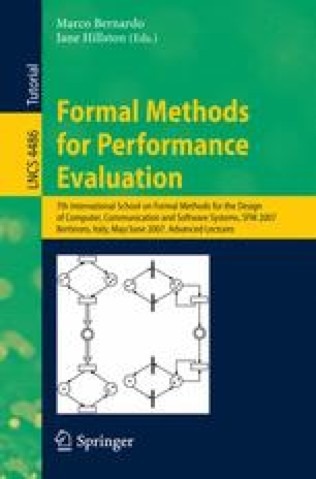
Formal Methods for Performance Evaluation ; 7th International School on Formal Methods for the Design of Computer, Communication, and Software Systems, SFM 2007, Bertinoro, Italy, May 8-June 2, 2007, Advanced Lectures
This book presents a set of 11 papers accompanying the lectures of leading researchers given at the 7th edition of the International School on Formal Methods for the Design of Computer, Communication and Software Systems, SFM 2007.

Formal Methods for Open Object-Based Distributed Systems ; Vol. 4037 ; 8th IFIP WG 6.1 International Conference, FMOODS 2006, Bologna, Italy, June 14-16, 2006, Proceedings
This book constitutes the refereed proceedings of the 8th IFIP WG 6.1 International Conference on Formal Methods for Open Object-Based Distributed Systems, FMOODS 2006, held in Bologna, Italy, June 2006. The book presents 16 revised full papers together with an invited paper and abstracts of 2 invited talks. Coverage includes component- and model-based design, service-oriented computing, software quality, modeling languages implementation, formal specification, verification, validation, testing, and service-oriented systems.

Formal Methods for Open Object-Based Distributed Systems ; Vol. 3535 ; 7th IFIP WG 6.1 International Conference, FMOODS 2005, Athens, Greece, June 15-17, 2005, Proceedings
This volume contains the proceedings of FMOODS2005, the 7th IFIPWG6. 1 International Conference on Formal Methods for Open Object-Based Distributed Systems. The conference was held in Athens, Greece on June 15-17, 2005. The eventwasthe seventh meeting ofthis conference series, whichis held roughly every year and a half, with the earlier events held respectively in Paris, Canterbury, Florence, Stanford, Twente, and Paris. The goal of the FMOOD Sseries of conferences is to bring together researchers whose work encompasses three important and related fields: - formal methods; - distributed systems; - object-based technology. Sucha convergenceis representative of recent advances in the field of distributed systems, and provides links between several scientific and technological communities, as represented by the conferences FORTE, CONCUR, and ECOOP. The objective of FMOODS is to provide an integrated forum for the pres- tation of research in the above-mentioned fields, and the exchange of ideas and experiences in the topics concerned with the formal methods support for open object-based distributed systems.

Formal Methods for Open Object-Based Distributed Systems ; 9th IFIP WG 6.1 International Conference, FMOODS 2007, Paphos, Cyprus, June 6-8, 2007, Proceedings
This book constitutes the refereed proceedings of the 9th IFIP WG 6.1 International Conference on Formal Methods for Open Object-Based Distributed Systems, FMOODS 2007, held in Paphos, Cyprus in June 2007. The papers are organized in topcical sections on model checking rewriting logic components and services algebraic calculi specification, verification and refinenment, and quality of service.

Formal Methods for Mobile Computing ; 5th International School on Formal Methods for the Design of Computer, Communication, and Software Systems, SFM-Moby 2005, Bertinoro, Italy, April 26-30, 2005, Advanced Lectures
This book presents 8 tutorial survey papers by leading researchers who lectured at the 5th International School on Formal Methods for the Design of Computer, Communication, and Software Systems, SFM 2005, held in Bertinoro, Italy in April 2005. SFM 2005 was devoted to formal methods and tools for the design of mobile systems and mobile communication infrastructures. The 8 lectures are organized into topical sections on models and languages, scalability and performance, dynamic power management, and middleware support.

Formal Methods for Hardware Verification ; 6th International School on Formal Methods for the Design of Computer, Communication, and Software Systems, SFM 2006, Bertinoro, Italy, May 22-27, 2006, Advances Lectures
This book presents 8 papers accompanying the lectures of leading researchers given at the 6th edition of the International School on Formal Methods for the Design of Computer, Communication and Software Systems (SFM 2006). SFM 2006 was devoted to formal techniques for hardware verification and covers several aspects of the hardware design process, including hardware design languages and simulation, property specification formalisms, automatic test pattern generation, symbolic trajectory evaluation, and more.

Formal Methods for Computational Systems Biology ; 8th International School on Formal Methods for the Design of Computer, Communication, and Software Systems, SFM 2008 Bertinoro, Italy, June 2-7, 2008 Advanced Lectures
This volume presents the set of papers accompanying the lectures of the eighth International School on Formal Methods for the Design of Computer, Com- nication, and Software Systems (SFM). This series of schools addresses the use of formal methods in computer science asaprominent approach to theri gorousdesign of computer, communication, and software systems. The main aim of the SFM series is to ofer a good spectrum of current research in foundations as well as applications of formal methods, which can be of help for graduate students and young researchers who intend to approach the feld.
Formal Methods for Components and Objects ; Vol. 4111 ; 4th International Symposium, FMCO 2005, Amsterdam, The Netherlands, November 1-4, 2005, Revised Lectures
This book presents 19 revised invited keynote lectures and revised tutorial lectures given by top-researchers at the 4th International Symposium on Formal Methods for Components and Objects, FMCO 2005, held in Amsterdam, Netherlands, in November 2005. The book provides a unique combination of ideas on software engineering and formal methods that reflect the current interest in the application or development of formal methods for large scale software systems such as component-based systems and object systems.
Formal Methods for Components and Objects ; Vol. 3657 ; 3rd International Symposium, FMCO 2004, Leiden, The Netherlands, November 2-5, 2004, Revised Lectures
This book presents revised tutorial lectures given by invited speakers at the Third International Symposium on Formal Methods for Components and Objects, FMCO 2004, held in Leiden, The Netherlands, in November 2004. The 14 revised lectures by leading researchers present a comprehensive account of the potential of formal methods applied to large and complex software systems such as component-based systems and object systems. The book provides an unique combination of ideas on software engineering and formal methods that reflect the expanding body of knowledge on modern software systems.
