



الصفحة 26
الصفحة 26

Hearing faces
Our project aims to aid deaf-mute people by tracking hand movements of the deaf-mute person for word level American Sign Language using WLASL model that include 2D CNN -3D CNN and RNN networks training on WLASL large video dataset, then generating the corresponding text and analyzing the person's facial gestures to generate information related to the tone of voice that is most appropriate to the person's age, gender, and race through MTCNN network algorithm that training on generated dataset by us depending on blending VOXCELEB dataset and VGGFACE dataset .

Healthcare solutions using machine learning and informatics
Covers novel and innovative solutions for the healthcare that apply machine learning and biomedical informatics technology. The healthcare sector is one of the most critical in society. This book presents a series of artificial intelligence, machine learning, intelligent IoT-based solutions for medical image analysis, medical big data processing, disease predictions. Machine learning and artificial intelligence use cases in healthcare presented in the book give researchers, practitioners, and students a wide range of practical examples of cross-domain convergence. The wide variety of topics covered include: Artificial Intelligence in healthcare Machine learning solutions for such disease as diabetes, arthritis, cardiovascular disease, and COVID-19 Big data analytics solutions for healthcare data processing Reliable biomedical applications using AI models Intelligent IoT in healthcare. The book explains fundamental concepts as well as the advanced use cases illustrating how to apply emerging technologies such as machine learning, AI models, data informatics into practice to tackle challenges in the field of healthcare with real-world scenarios. Chapters contributed by noted academicians and professionals examine various solutions, frameworks, applications, case studies, and best practices in the healthcare domain

Health information systems : Technological and management perspectives
Details a variety of scenarios in the context of both health and heath care, including where prevention and wellness are related, such as the treatment of both acute and chronic diseases. Stakeholder requirements are also described to provide perspectives for describing the architectures and management techniques associated with health information systems, enabling the reader to develop a detailed holistic overview of the subject. Health Information Systems: Technological and Management Perspectives features a detailed overview of how information systems in health care can be managed and is a vital resource for medical informatics students seeking an up-to-date text on the topic.

Health Information Science ; 9th International Conference, HIS 2020, Amsterdam, The Netherlands, October 20–23, 2020, Proceedings
This book constitutes the proceedings of the 9th International Conference on Health Information Science, HIS 2020, which took place in Amsterdam, The Netherlands, during October 20-23, 2020. The 11 full papers and 6 short papers presented in this volume were carefully reviewed and selected from 62 submissions. They were organized in topical sections named: mental health; medical record processing; medical information systems; medical diagnosis with machine learning; and health behavior and medication.

HCI related papers of Interacción 2004 ; Conference proceedings
The present book contains a collection of the best papers presented at the 5th International Conference on Interacción Persona Ordenador (IPO) (which is Human Computer Interaction in Spanish), which took place in th th Lleida on May 5 -7 , 2004. . The main goals of Interacción 2004 were: To expand the conference scope with internationally recognised invited speakers. The plenary talks were presented by Alan Dix, Yvonne Rogers, Geritt van der Veer, and Angel Puerta. To open the participation to Spanish speaker worldwide in order to be a point of reference of this discipline not only in Spain but also in the wider Spanish speaking community. This goal was reached through a very diverse program which included panels and posters sessions, where many different aspect of the Human Computer Interaction (HCI) were presented. All through the program, research from outside Spain was reflected through the contributions from people of other countries.

HCI in games : Experience design and game mechanics ; Third International Conference, HCI-Games 2021, Held as Part of the 23rd HCI International Conference, HCII 2021, Virtual Event, July 24–29, 2021, Proceedings, Part I
This two-volume set LNCS 12789 and 12790 constitutes the refereed proceedings of the Third International Conference on HCI in Games, HCI-Games 2021, held as part of the 23rd International Conference, HCI International 2021, which took place in July 2021. Due to COVID-19 pandemic the conference was held virtually.The total of 1276 papers and 241 poster papers included in the 39 HCII 2021 proceedings volumes was carefully reviewed and selected from 5222 submissions. The regular papers of DAPI 2021, Distributed, Ambient and Pervasive Interactions, are organized in topical sections named: Experience Design in Games; User Engagement and Game Impact; Game Mechanics.

Hardware and software, verification and testing ; 2nd International Haifa Verification Conference, HVC 2006, Haifa, Israel, October 23-26, 2006, Revised Selected Papers
The Haifa Verification Conference 2006 took place for the second year in a row at the IBM Haifa Research Lab and at the Haifa University in Israel during October 23–26, 2006. The verification conference was a three-day, single-track conference followed by a one-day tutorial on PSL.

Hardware and software : Verification and testing ; 3rd International Haifa Verification Conference, HVC 2007, Haifa, Israel, October 23-25, 2007. Proceedings
These are the conference proceedings of the 4th Haifa Verifcation Conference, held October 27–30, 2008 in Haifa, Israel. This international conference is a unique venue that brings together leading researchers and practitioners of both formal and dynamic verifcation, for both hardware and software systems. This year’s conference extended the successes of the previous years, with a largejumpinthenumberofsubmitted papers. with many more high-quality papers than we had room to accept. Submissions came from 19 di?erent countries, re?ecting the growing international visibility of the conference. Of the 49 submissions, 43 were regular papers, 2 of which were later withdrawn, and 6 were tool papers. After a rigorous review process.

Haptics: Science, Technology, Applications ; 12th International Conference, EuroHaptics 2020, Leiden, The Netherlands, September 6–9, 2020, Proceedings
This book constitutes the proceedings of the 12th International Conference on Human Haptic Sensing and Touch Enabled Computer Applications, EuroHaptics 2020, held in Leiden, The Netherlands, in September 2020.

Haptics : Perception, Devices and Scenarios ; 6th International Conference, EuroHaptics 2008 Madrid, Spain, June 10-13, 2008 Proceedings
This book constitutes the refereed proceedings of the 6th International Conference on Human Haptic Sensing and Touch Enabled Computer Applications, EuroHaptics 2008, held in Madrid, Spain, in June 2008.The 119 revised full papers presented were carefully reviewed and selected from 150 submissions. The papers are organized in topical sections on control and technology, haptic perception and psychophysics, haptic devices, haptics rendering and display, multimodal interaction and telepresence, as well as haptic applications.

Haptic and Audio Interaction Design ; 3rd International Workshop, HAID 2008 Jyväskylä, Finland, September 15-16, 2008 Proceedings
This book constitutes the refereed proceedings of the Third International Workshop on Haptic and Audio Interaction Design, HAID 2008 held in Jyväskylä, Finland, in September 2008.The 13 revised full papers presented were carefully reviewed and selected for inclusion in the book. The papers are organized in topical sections on visual impairment, applications of multimodality, evaluation, conceptual integration of audio and haptics, interaction techniques, and perception.

Haptic and Audio Interaction Design ; 1st International Workshop, HAID 2006, Glasgow, UK, August 31 - September 1, 2006, Proceedings
Overview The International Workshop on Haptic and Audio Interaction Design was - ganized as part of the EPSRC-funded MultiVis project. The main focus of the workshop was to investigate how the modalities of sound and haptics (touch) could be used together in interaction, and what novel interfaces could be p- vided when they are used in conjunction. What are the relative advantages of each of the modalities when used alone and together? Are there reasons why haptic-based information is moreuseful in certain situations than equivalent - dio information? How can di?erent modalities be used together to create c- pelling and useful interaction with computer-based systems?

Hands-On Software Architecture with Java - Learn key architectural techniques and strategies to design efficient and elegant Java applications
Starts with the fundamentals of architecture and takes you through the basic components of application architecture. You'll cover the different types of software architectural patterns and application integration patterns and learn about their most widespread implementation in Java. You'll then explore cloud-native architectures and best practices for enhancing existing applications to better suit a cloud-enabled world. Later, the book highlights some cross-cutting concerns and the importance of monitoring and tracing for planning the evolution of the software, foreseeing predictable maintenance, and troubleshooting. The book concludes with an analysis of the current status of software architectures in Java programming and offers insights into transforming your architecture to reduce technical debt.

Hands-on question answering systems with BERT : Applications in neural networks and natural language processing
Begins with an overview of the technology landscape behind BERT. It takes you through the basics of NLP, including natural language understanding with tokenization, stemming, and lemmatization, and bag of words. Next, you’ll look at neural networks for NLP starting with its variants such as recurrent neural networks, encoders and decoders, bi-directional encoders and decoders, and transformer models. Along the way, you’ll cover word embedding and their types along with the basics of BERT. After this solid foundation, you’ll be ready to take a deep dive into BERT algorithms such as masked language models and next sentence prediction. You’ll see different BERT variations followed by a hands-on example of a question answering system. You will: Examine the fundamentals of word embeddings / Apply neural networks and BERT for various NLP tasks / Develop a question-answering system from scratch / Train question-answering systems for your own data
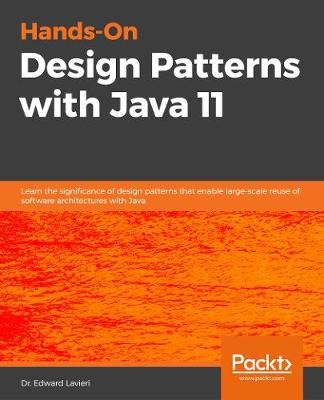
Hands-On Design Patterns with Java : Learn Design Patterns That Enable the Building of Large-Scale Software Architectures
Java design patterns are reusable and proven solutions to software design problems. This book covers over 60 battle-tested design patterns used by developers to create functional, reusable, and flexible software. Hands-On Design Patterns with Java starts with an introduction to the Unified Modeling Language (UML), and delves into class and object diagrams with the help of detailed examples. You'll study concepts and approaches to object-oriented programming (OOP) and OOP design patterns to build robust applications. As you advance, you'll explore the categories of GOF design patterns, such as behavioral, creational, and structural, that help you improve code readability and enable large-scale reuse of software. You’ll also discover how to work effectively with microservices and serverless architectures by using cloud design patterns, each of which is thoroughly explained and accompanied by real-world programming solutions. By the end of the book, you’ll be able to speed up your software development process using the right design patterns, and you’ll be comfortable working on scalable and maintainable projects of any size.

Hands-On Data Structures and Algorithms with Python : Store, manipulate, and access data effectively ; 3rd ed.
Expands your understanding of key structures, including stacks, queues, and lists, and also show you how to apply priority queues and heaps in applications. You'll learn how to analyze and compare Python algorithms, and understand which algorithms should be used for a problem based on running time and computational complexity. You will also become confident organizing your code in a manageable, consistent, and scalable way, which will boost your productivity as a Python developer. By the end of this Python book, you'll be able to manipulate the most important data structures and algorithms to more efficiently store, organize, and access data in your applications
Handbook of multibiometrics
Handbook of Multibiometrics, a professional book, introduces multibiometric systems, and demonstrates the noteworthy advantages of these systems over their unimodal counterparts. In addition, this book describes in detail the various scenarios that are possible when fusing biometric evidence from multiple information sources. This comprehensive volume on multibiometric systems concisely and clearly outlines the different fusion methodologies that have been proposed by researchers to integrate multiple biometric traits.

Handbook of Mathematical Models in Computer Vision
In this edited volume we present the most prominent mathematical models that are considered in computational vision. To this end, tasks of increasing complexity are considered and we present the state-of-the-art methods to cope with such tasks. The volume consists of six thematic areas that provide answers to the most dominant questions of computational vision: Image reconstruction, Segmentation and object extraction, Shape modeling and registration, Motion analysis and tracking, 3D from images, geometry and reconstruction Applications in medical image analysis

Handbook Of Mathematical Models For Languages And Computation
Introduces a variety of concepts in discrete mathematics and mathematical modeling for languages and computation. The authors pay special attention to the implementation of mathematical concepts to explain clearly how to encode them in computational practice. All computer programs are written in C#. The theory of computation is used to address challenges arising in many computer science areas such as artificial intelligence, language processors, compiler writing, information and coding systems, programming language design, computer architecture and more. To grasp topics concerning this theory readers need to familiarize themselves with its computational and language models, based on concepts of discrete mathematics including sets, relations, functions, graphs and logic.

Handbook of Geometric Computing : Applications in Pattern Recognition, Computer Vision, Neuralcomputing, and Robotics
Many computer scientists, engineers, applied mathematicians, and physicists use geometry theory and geometric computing methods in the design of perception-action systems, intelligent autonomous systems, and man-machine interfaces. This handbook brings together the most recent advances in the application of geometric computing for building such systems, with contributions from leading experts in the important fields of neuroscience, neural networks, image processing, pattern recognition, computer vision, uncertainty in geometric computations, conformal computational geometry, computer graphics and visualization, medical imagery, geometry and robotics, and reaching and motion planning. For the first time, the various methods are presented in a comprehensive, unified manner.
