



الصفحة 24
الصفحة 24

Database and XML Technologies ; Vol. 3671 ; 3rd international XML database symposium, XSym 2005, Trondheim, Norway, August 28-29, 2005, Proceedings
Constitutes the proceedings of the Third International XML Database Symposium, XSym 2005, held in Trondheim, Norway in August 2005. The 15 papers are organized in sections on indexing support for the evaluation of XPath and XQuery; benchmarks and algorithms for XQuery and XPath evaluation; algorithms for constraint satisfaction checking, and more.

Database and expert systems applications ; DEXA 2020 International workshops BIOKDD, IWCFS and MLKgraphs, Bratislava, Slovakia, September 14–17, 2020, Proceedings
This volume constitutes the refereed proceedings of the three workshops held at the 31st International Conference on Database and Expert Systems Applications, DEXA 2020, held in September 2020: The 11th International Workshop on Biological Knowledge Discovery from Data, BIOKDD 2020, the 4th International Workshop on Cyber-Security and Functional Safety in Cyber-Physical Systems, IWCFS 2020, the 2nd International Workshop on Machine Learning and Knowledge Graphs, MLKgraphs2019. Due to the COVID-19 pandemic the conference and workshop were held virtually. The 10 papers were thoroughly reviewed and selected from 15 submissions, and discuss a range of topics including: knowledge discovery, biological data, cyber security, cyber-physical system, machine learning, knowledge graphs, information retriever, data base, and artificial intelligent.

Database and expert systems applications ; 31st International Conference, DEXA 2020, Bratislava, Slovakia, September 14–17, 2020, Proceedings, Part II
The double volumes LNCS 12391-12392 constitutes the papers of the 31st International Conference on Database and Expert Systems Applications, DEXA 2020, which will be held online in September 2020. The 38 full papers presented together with 20 short papers plus 1 keynote papers in these volumes were carefully reviewed and selected from a total of 190 submissions.

Database and expert systems applications ; 31st International conference, DEXA 2020, Bratislava, Slovakia, September 14–17, 2020, Proceedings, Part I
The double volumes LNCS 12391-12392 constitutes the papers of the 31st International Conference on Database and Expert Systems Applications, DEXA 2020, which will be held online in September 2020. The 38 full papers presented together with 20 short papers plus 1 keynote papers in these volumes were carefully reviewed and selected from a total of 190 submissions.

Database and Expert Systems Applications ; 19th International Conference, DEXA 2008, Turin, Italy, September 1-5, 2008. Proceedings
This book constitutes the refereed proceedings of the 19th International Conference on Database and Expert Systems Applications, DEXA 2008, held in Turin, Italy, in September 2008.

Database and Expert Systems Applications ; 18th International Conference, DEXA 2007, Regensburg, Germany, September 3-7, 2007, Proceedings
This volume represent the state of the art of - search in the domain of data, information and knowledge management, intelligent systems, and their applications.

Database and expert systems applications ; 16th international conference, DEXA 2005, Copenhagen, Denmark, August 22-26, 2005, Proceedings
DEXA 2005, the 16th International Conference on Database and Expert Systems Applications, was held at the Copenhagen Business School, Copenhagen, Denmark, from August 22 to 26, 2005. The success of the DEXA series has partly been due to the way in which it has kept abreast of recent developments by spawning specialized workshops and conferences each with its own proceedings. In 2005 the DEXA programme was co-located with the 7th International Conference on Data Warehousing and Knowledge Discovery [DaWaK 2005], the 6th International Conference on Electronic Commerce and Web Technologies [EC-Web 2005], the 4th International Conference on Electronic Government [EGOV 2005], the 2nd International Conference on Trust, Privacy, and Security in Digital Business [TrustBus 2005], the 2nd International Conference on Industrial Applications of Holonic and Multi-agent Systems [HoloMAS 2005], as well as 19 specialized workshops. These proceedings are the result of a considerable amount of hard work.
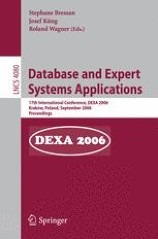
Database and expert systems and Aapplications ; 17th International Conference, DEXA 2006, Krakow, Poland, September 4-8, 2006, Proceedings
The annual international conference on Database and Expert Systems Applications (DEXA) is now well established as a reference scientific event. The reader will find in this volume a collection of scientific papers that represent the state of the art of research in the domain of data, information and knowledge management, intelligent systems, and their applications.

Data warehousing and knowledge discovery ; Vol.3589 ; 7th international conference, DaWak 2005, Copenhagen, Denmark, August 22-26, 2005, Proceedings
For more than a decade, data warehousing and knowledge discovery technologies have been developing into key technologies for decision-making processes in com- nies. Since 1999, due to the relevant role of these technologies in academia and ind- try, the Data Warehousing and Knowledge Discovery (DaWaK) conference series have become an international forum where both practitioners and researchers share their findings, publish their relevant results and dispute in depth research issues and experiences on data warehousing and knowledge discovery systems and applications.

Data Warehousing and Knowledge Discovery ; 9th International Conference, DaWaK 2007, Regensburg, Germany, September 3-7, 2007, Proceedings
Data Warehousing and Knowledge Discovery have been widely accepted as key te- nologies for enterprises and organizations to improve their abilities in data analysis, decision support, and the automatic extraction of knowledge from data. With the exponentially growing amount of information to be included in the decision-making process, the data to be processed become more and more complex in both structure and semantics. Consequently, the process of retrieval and knowledge discovery from this huge amount of heterogeneous complex data constitutes the reality check for research in the area.

Data Warehousing and Knowledge Discovery ; 4th International Conference, DaWaK 2002, Aix-en-Provence, France, September 4-6, 2002. Proceedings
Within the last few years Data Warehousing and Knowledge Discovery technology has established itself as a key technology for enterprises that wish to improve the quality of the results obtained from data analysis, decision support, and the automatic extraction of knowledge from data. The Fourth International Conference on Data Warehousing and Knowledge Discovery (DaWaK 2002) continues a series of successful conferences dedicated to this topic. Its main objective is to bring together researchers and practitioners to discuss research issues and experience in developing and deploying data warehousing and knowledge discovery systems, applications, and solutions.

Data Warehousing and Data Mining Techniques for Cyber Security
It provide techniques for collecting information from distributed databases and for performing data analysis. The ever expanding, tremendous amount of data collected and stored in large databases has far exceeded our human ability to comprehend--without the proper tools. There is a critical need for data analysis that can automatically analyze data, summarize it and predict future trends. In the modern age of Internet connectivity, concerns about denial of service attacks, computer viruses and worms are extremely important. Data Warehousing and Data Mining Techniques for Cyber Security contributes to the discipline of security informatics. The author discusses topics that intersect cyber security and data mining, while providing techniques for improving cyber security. Since the cost of information processing and internet accessibility is dropping, an increasing number of organizations are becoming vulnerable to cyber attacks. This volume introduces techniques for applications in the area of retail, finance, and bioinformatics, to name a few.

Data science on the Google cloud platform : Implementing end-to-end real-time data pipelines : From ingest to machine learning
Learn how easy it is to apply sophisticated statistical and machine learning methods to real-world problems when you build using Google Cloud Platform (GCP). This hands-on guide shows data engineers and data scientists how to implement an end-to-end data pipeline with cloud native tools on GCP. You'll work through a sample business decision by employing a variety of data science approaches. Follow along by building a data pipeline in your own project on GCP, and discover how to solve data science problems in a transformative and more collaborative way. Employ best practices in building highly scalable data and ML pipelines on Google Cloud Automate and schedule data ingest using Cloud Run Create and populate a dashboard in Data Studio Build a real-time analytics pipeline using Pub/Sub, Dataflow, and BigQuery Conduct interactive data exploration with BigQuery Create a Bayesian model with Spark on Cloud Dataproc Forecast time series and do anomaly detection with BigQuery ML Aggregate within time windows with Dataflow Train explainable machine learning models with Vertex AI Operationalize ML with Vertex AI Pipelines

Data science in theory and practice : Techniques for big data analytics and complex data sets
Delivers a comprehensive treatment of the mathematical and statistical models useful for analyzing data sets arising in various disciplines, like banking, finance, health care, bioinformatics, security, education, and social services. Written in five parts, the book examines some of the most commonly used and fundamental mathematical and statistical concepts that form the basis of data science. The authors go on to analyze various data transformation techniques useful for extracting information from raw data, long memory behavior, and predictive modeling. Readers will also learn from topics like: Analyses of foundational theoretical subjects, including the history of data science, matrix algebra and random vectors, and multivariate analysis A comprehensive examination of time series forecasting, including the different components of time series and transformations to achieve stationarity Introductions to both the R and Python programming languages, including basic data types and sample manipulations for both languages An exploration of algorithms, including how to write one and how to perform an asymptotic analysis A comprehensive discussion of several techniques for analyzing and predicting complex data sets

Data parallel C++programming accelerated systems using C++ and SYCL
Full of practical advice, detailed explanations, and code examples to illustrate key topics. SYCL enables access to parallel resources in modern accelerated heterogeneous systems. Now, a single C++ application can use any combination of devices–including GPUs, CPUs, FPGAs, and ASICs–that are suitable to the problems at hand. This book teaches data-parallel programming using C++ with SYCL and walks through everything needed to program accelerated systems. The book begins by introducing data parallelism and foundational topics for effective use of SYCL. Later chapters cover advanced topics, including error handling, hardware-specific programming, communication and synchronization, and memory model considerations.

Data Mining in Bioinformatics
8. 1. 1 Protein Subcellular Location The life sciences have entered the post-genome era where the focus of biological research has shifted from genome sequences to protein functionality. Withwhole-genomedraftsofmouseandhumaninhand,scientistsareputting more and more e?ort into obtaining information about the entire proteome in a given cell type. The properties of a protein include its amino acid sequences, its expression levels under various developmental stages and in di?erent tissues, its3Dstructure and activesites,its functionalandstructural binding partners, and its subcellular location. Protein subcellular location is important for understanding protein function inside the cell. For example, the observation that the product of a gene is localized in mitochondria will support the hypothesis that this protein or gene is involved in energy metabolism. Proteins localized in the cytoskeleton are probably involved in intracellular tra?cking and support.

Data mining and machine learning applications
Elaborates in detail on the current needs of data mining and machine learning and promotes mutual understanding among research in different disciplines, thus facilitating research development and collaboration. Data, the latest currency of today’s world, is the new gold. In this new form of gold, the most beautiful jewels are data analytics and machine learning. Data mining and machine learning are considered interdisciplinary fields. Data mining is a subset of data analytics and machine learning involves the use of algorithms that automatically improve through experience based on data.

Data mining : Concepts, models, methods, and algorithms ; 3rd ed.
Presents the latest techniques for analyzing and extracting information from large amounts of data in high-dimensional data spaces. Explores big data and cloud computing Examines deep learning Includes information on convolutional neural networks (CNN) Offers reinforcement learning Contains semi-supervised learning and S3VM Reviews model evaluation for unbalanced data

Data Management in Grids ; 1st VLDB Workshop, DMG 2005, Trondheim, Norway, September 2-3, 2005, Revised Selected Papers
This book constitutes the thoroughly refereed post-proceedings of the First International Workshop on Data Management in Grids, DMG 2005, held in Trondheim, Norway in September 2005 in conjunction with VLDB 2005. papers address all current research activities in relation to data management in dynamic, heterogeneous and cross-organizational environments, i.e. grids. They show unique expertise in the management of very large, widely distributed databases.

Data Integration in the Life Sciences ; Vol. 4075 ; 3rd International Workshop, DILS 2006, Hinxton, UK, July 20-22, 2006, Proceedings
Data management and data integration are fundamental problems in the life sciences. Advances in molecular biology and molecular medicine are almost u- versallyunderpinned by enormouse?orts in data management,data integration, automatic data quality assurance, and computational data analysis. Many hot topics in the life sciences, such as systems biology, personalized medicine, and pharmacogenomics, critically depend on integrating data sets and applications producedby di?erent experimentalmethods, in di?erent researchgroups,andat di?erent levels of granularity.
