



الصفحة 2
الصفحة 2

Multiple Classifier Systems ; 7th International Workshop, MCS 2007, Prague, Czech Republic, May 23-25, 2007, Proceedings
These proceedings are a record of the Multiple Classifier Systems Workshop, MCS 2007, held at the Institute of Information Theory and Automation, Czech Academy of Sciences, Prague in May 2007. the workshop achieved its objective of bringing together researchers from diverse communities (neural networks, pattern rec- nition, machine learning and statistics) concerned with this research topic.

Multiple Classifier Systems ; 6th International Workshop, MCS 2005, Seaside, CA, USA, June 13-15, 2005, Proceedings
Constitutes the refereed proceedings of the 6th International Workshop on Multiple Classifier Systems, MCS 2005. This book contains papers that are organized in topical sections on boosting, combination methods, performance analysis, and applications. They exemplify the advances in the theory and applications of multiple classifier systems

Multiple Classifier Systems ; 2nd International Workshop, MCS 2001 Cambridge, UK, July 2-4, 2001 Proceedings
Driven by the requirements of a large number of practical and commercially - portant applications, the last decade has witnessed considerable advances in p- tern recognition. Better understanding of the design issues and new paradigms, such as the Support Vector Machine, have contributed to the development of - proved methods of pattern classi cation. However, while any performance gains are welcome, and often extremely signi cant from the practical point of view, it is increasingly more challenging to reach the point of perfection as de ned by the theoretical optimality of decision making in a given decision framework. The asymptoticity of gains that can be made for a single classi er is a re?- tion of the fact that any particular design, regardless of how good it is, simply provides just one estimate of the optimal decision rule.

Multiobjective Problem Solving from Nature : From Concepts to Applications
he book focuses on how MOEAs and related techniques can be used to solve problems, particularly in the disciplines of science and engineering. Contributions by leading researchers show how the concepts of multiobjective optimization can be used to reformulate and resolve problems in broad areas such as constrained optimization, coevolution, classification, inverse modelling and design. The book is distinguished from other texts on MOEAs in that it is not primarily about the algorithms, nor specific applications, but about the concepts and processes involved in solving problems using a multiobjective approach. Each chapter contributes to the central, deep concepts and themes of the book: evaluating the utility of the multiobjective approach; discussing alternative problem formulations; showing how problem formulation affects the search process; and examining solution selection and decision making.

Multimodal Technologies for Perception of Humans ; International Evaluation Workshops CLEAR 2007 and RT 2007, Baltimore, MD, USA, May 8-11, 2007, Revised Selected Papers
This book constitutes the thoroughly refereed joint post-workshop proceedings of two co-located events: the Second International Workshop on Classification of Events, Activities and Relationships, CLEAR 2007, and the 5th Rich Transcription 2007 Meeting Recognition evaluation, RT 2007, held in succession in Baltimore, MD, USA, in May 2007.The workshops had complementary evaluation efforts; CLEAR for the evaluation of human activities, events, and relationships in multiple multimodal data domains; and RT for the evaluation of speech transcription-related technologies from meeting room audio collections.

Multimodal Technologies for Perception of Humans ; 1st International Evaluation Workshop on Classification of Events, Activities and Relationships, CLEAR 2006, Southampton, UK, April 6-7, 2006, Revised Selected Papers
This book constitutes the thoroughly refereed post-proceedings of the First International CLEAR 2006 Evaluation Campaign and Workshop on Classification of Events, Activities and Relationships for evaluation of multimodal technologies for the perception of humans, their activities and interactions. The workshop was held in the UK in April 2006.

Multimedia Content Representation, Classification and Security ; International Workshop, MRCS 2006, Istanbul, Turkey, September 11-13, 2006, Proceedings
This book constitutes the refereed proceedings of the International Workshop on Multimedia Content Representation, Classification and Security, MRCS 2006, held in Istanbul, Turkey in September 2006. The 100 revised papers presented together with 4 invited lectures were carefully reviewed and selected from more than 190 submissions. The papers are organized in topical sections on biometric recognition, multimedia content security, steganography, watermarking, authentication, classification for biometric recognition, digital watermarking, content analysis and representation, 3D object retrieval and classification, representation, analysis and retrieval in cultural heritage, content representation, indexing and retrieval, content analysis and classification, feature extraction and classification, multimodal signal processing, 3D video and free viewpoint video, multimedia content transmission and classification, video and image processing, as well as video analysis and representation.

Monitoring, Security, and Rescue Techniques in Multiagent Systems
This volume contains extended and improved versions of selected contributions presented at the International Workshop "Monitoring, Security and Rescue Techniques in Multiagent Systems".

Modeling Decisions for Artificial Intelligence ; Vol.3885 ; 3rd International Conference, MDAI 2006, Tarragona, Spain, April 3-5, 2006, Proceedings
This book constitutes the refereed proceedings of the Third International Conference on Modeling Decisions for Artificial Intelligence, MDAI 2006, held in Tarragona, Spain, in April 2006.

Model-Driven Design Using Business Patterns
This book takes exactly this step: it shows you how to apply the pattern ideas in business applications and presents more than 20 structural and behavioral business patterns that use the REA (resources, events, agents) pattern as a common backbone. If you are a developer working on business frameworks, you can use the patterns presented to derive the right abstractions (e.g., business objects) and to design and ensure that the meta-rules (e.g., process patterns) are followed by the developers of the actual applications. And if you are an application developer, you can use these patterns to design your business application, to ensure that it does not violate the domain rules, and to adapt the application to changing requirements without the need to change the overall architecture. As with patterns in general, this approach allows for both more flexible and more solid software architectures and hence better software quality.

Mobile health technologies for ambient assisted living and healthcare
The use of telemedicine and mobile devices is growing, and sensors might aid in creating creative solutions. Developing these solutions is crucial for monitoring senior citizens, lifestyles, and medical procedures. The development of assistive technology for various users to follow sports and other activities is strongly tied to this study area. Data protection is crucial, and the development of these solutions for medical uses should be verified. The security and privacy of the information may be tied to other recognized research projects for their acceptability. ICT research has considerably improved quality of life and has fully assimilated all citizens into society through medical rehabilitation and assistive technology. The technologies and research fields that influence medical informatics include databases, networking, graphical user interfaces, data mining, machine learning, intelligent decision support systems, and specialized programming languages.

Mining Complex Data ; ECML/PKDD 2007 Third International Workshop, MCD 2007, Warsaw, Poland, September 17-21, 2007, Revised Selected Papers
This book constitutes the refereed proceedings of the Third International Workshop on Mining Complex Data, MCD 2007, held in Warsaw, Poland, in September 2007, co-located with ECML and PKDD 2007.The 20 revised full papers presented were carefully reviewed and selected; they present original results on knowledge discovery from complex data. In contrast to the typical tabular data, complex data can consist of heterogenous data types, can come from different sources, or live in high dimensional spaces. All these specificities call for new data mining strategies.

Mind conversation = التنبؤ بالحروف العربية من خلال الإشارات الدماغية
Throughout history, humans have long dreamed of understanding what goes on inside the human mind—what people are thinking or feeling. It seemed like something from a far-off future or a magical realm. But now, thanks to amazing technology called EEG and BCI, this dream is turning into reality. EEG stands for electroencephalography. It's a way of listening to what the brain is up to by placing small sensors on or near the head. These sensors pick up tiny electrical signals produced by the brain's activity. It's like eavesdropping on the brain's conversations with itself. BCI, or Brain-Computer Interface, is like a bridge between the brain and machines. It lets the brain talk to devices or computers. This means people can control things without using their hands or voices. Our system takes advantage of EEG and BCI to create something helpful, a special mobile app. This app is designed for people who can't move their bodies, like those who are paralyzed. It helps them use their phones to express what they are thinking about.

Microprocessor 2 : Communication in a digital system
Focuses more particularly on the first generations of microprocessors, that is to say those that handle integers in 4 and 8-bit formats. The first chapter presents the calculation function and reminds the memory function. The following is devoted to notions of calculation model and architecture. The concept of bus is then presented. Chapters 4 and 5 can then address the internal organization and operation of the microprocessor first in hardware and then software. The mechanism of the function call, conventional and interrupted, is more particularly detailed in a separate chapter. The book ends with a presentation of architectures of the first microcomputers for a historical perspective. The knowledge is presented in the most exhaustive way possible with examples drawn from current and old technologies that illustrate and make accessible the theoretical concepts. Each chapter ends if necessary with corrected exercises and a bibliography. The list of acronyms used and an index are at the end of the book.

MICAI 2006 : Advances in Artificial Intelligence ; 5th Mexican International Conference on Artificial Intelligence, Apizaco, Mexico, November 13-17, 2006, Proceedings
This volume contains the papers presented during the oral session of the 5 Mexican International Conference on Artificial Intelligence, held on November 13–17, 2006, at the Technologic Institute of Apizaco, Mexico. The conference received for evaluation 448 submissions by 1207 authors from 42 different countries
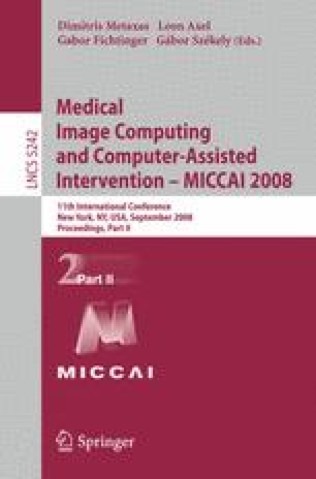
Medical Image Computing and Computer-Assisted Intervention - MICCAI 2008 ; 11th International Conference, New York, NY, USA, September 6-10, 2008, Proceedings, Part II
The program committee carefully selected 258 revised papers from numerous submissions for presentation in two volumes, based on rigorous peer reviews. The first volume includes 127 papers related to medical image computing, segmentation, shape and statistics analysis, modeling, motion tracking and compensation, as well as registration. The second volume contains 131 contributions related to robotics and interventions, statistical analysis, segmentation, intervention, modeling, and registration.

Medical Image Computing and Computer-Assisted Intervention - MICCAI 2008 ; 11th International Conference, New York, NY, USA, September 6-10, 2008, Proceedings, Part I
The program committee carefully selected 258 revised papers from numerous submissions for presentation in two volumes, based on rigorous peer reviews. The first volume includes 127 papers related to medical image computing, segmentation, shape and statistics analysis, modeling, motion tracking and compensation, as well as registration. The second volume contains 131 contributions related to robotics and interventions, statistical analysis, segmentation, intervention, modeling, and registration.

Medical Image Computing and Computer-Assisted Intervention – MICCAI 2007; 10th International Conference, Brisbane, Australia, October 29 - November 2, 2007, Proceedings, Part II
The 10th International Conference on Medical Imaging and Computer Assisted Intervention, MICCAI2007, washeldattheBrisbaneConventionandExhibition Centre, South Bank, Brisbane, Australia from 29th October to 2nd November 2007. MICCAI has become a premier international conference in this domain, with in-depth papers on the multidisciplinary ?elds of biomedical image computing, computer assisted intervention and medical robotics.

Medical image computing and computer-assisted intervention – MICCAI 2007 ; 10th International Conference, Brisbane, Australia, October 29 - November 2, 2007, Proceedings, Part I
This title is part of a two-volume set that constitute the refereed proceedings of the 10th International Conference on Medical Image Computing and Computer-Assisted Intervention, MICCAI 2007.

Medical Image Computing and Computer-Assisted Intervention – MICCAI 2006 ; Vol. 4191; 9th International Conference, Copenhagen, Denmark, October 1-6, 2006, Proceedings, Part II
T MICCAI papers are of high standard and have a long lifetime. In this v- ume as well as in the latest journal issues of Medical Image Analysis and IEEE Transactions on Medical Imaging papers cite previous MICCAIs including the ?rst MICCAI conference in Cambridge, Massachusetts, 1998. It is obvious that the community requires the MICCAI papers as archive material. Therefore the proceedingsofMICCAIarefrom2005andhenceforthbeing indexedbyMedline. Acarefulreviewandselectionprocesswasexecutedinordertosecurethebest possible program for the MICCAI 2006 conference. We received 578 scienti?c papers from which 39 papers were selected for the oral program and 193 papers for the poster program.
