



الصفحة 2
الصفحة 2
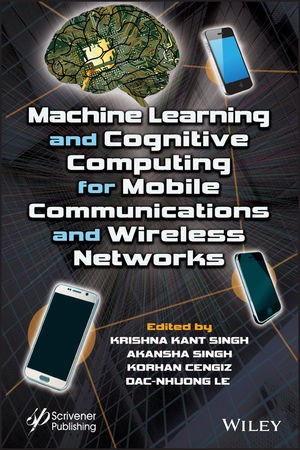
Machine Learning and Cognitive Computing for Mobile Communications and Wireless Networks
Communication and network technology has witnessed recent rapid development and numerous information services and applications have been developed globally. These technologies have high impact on society and the way people are leading their lives. The advancement in technology has undoubtedly improved the quality of service and user experience yet a lot needs to be still done. Some areas that still need improvement include seamless wide-area coverage, high-capacity hot-spots, low-power massive-connections, low-latency and high-reliability and so on. Thus, it is highly desirable to develop smart technologies for communication to improve the overall services and management of wireless communication. Machine learning and cognitive computing have converged to give some groundbreaking solutions for smart machines. With these two technologies coming together, the machines can acquire the ability to reason similar to the human brain. The research area of machine learning and cognitive computing cover many fields like psychology, biology, signal processing, physics, information theory, mathematics, and statistics that can be used effectively for topology management. Therefore, the utilization of machine learning techniques like data analytics and cognitive power will lead to better performance of communication and wireless systems.

Brain and Human Body Modeling : Computational Human Modeling at EMBC 2018
This book describes modern applications of computational human modeling with specific emphasis in the areas of neurology and neuroelectromagnetics, depression and cancer treatments, radio-frequency studies and wireless communications. Special consideration is also given to the use of human modeling to the computational assessment of relevant regulatory and safety requirements. Readers working on applications that may expose human subjects to electromagnetic radiation will benefit from this book’s coverage of the latest developments in computational modelling and human phantom development to assess a given technology’s safety and efficacy in a timely manner.

Artificial Intelligent Techniques for Wireless Communication and Networking
Wireless communication and networking based on AI concepts and techniques are explored in this book, specifically focusing on the current research in the field by highlighting empirical results along with theoretical concepts. The possibility of applying AI mechanisms towards security aspects in the communication domain is elaborated; also explored is the application side of integrated technologies that enhance AI-based innovations, insights, intelligent predictions, cost optimization, inventory management, identification processes, classification mechanisms, cooperative spectrum sensing techniques, ad-hoc network architecture, and protocol and simulation-based environments.

Applied cryptography and network security ; Vol. 3531 ; 3rd international conference, ACNS 2005, New York, NY, USA, June 7-10, 2005, Proceedings
The 3rd International Conference on Applied Cryptography and Network Security (ACNS 2005) was sponsored and organized by ICISA (the International Commu- cations and Information Security Association). It was held at Columbia University in New York, USA, 2005. This conference proceedings volume contains papers presented in the academic/research track. ACNS covers a large number of research areas that have been gaining importance in recent years due to the development of the Internet, wireless communication and the increased global exposure of computing resources. The papers in this volume are representative of the state of the art in security and cryptography research, worldwide.

Antennas & propagation for wireless communication systems ; 2nd ed.
Antennas and propagation are of fundamental importance to the coverage, capacity and quality of all wireless communication systems. This book provides a solid grounding in antennas and propagation, covering terrestrial and satellite radio systems in both mobile and fixed contexts. Building on the highly successful first edition, this fully updated text features significant new material and brand new exercises and supplementary materials to support course tutors. A vital source of information for practising and aspiring wireless communication engineers as well as for students at postgraduate and senior undergraduate levels, this book provides a fundamental grounding in the principles of antennas and propagation without excessive recourse to mathematics. It also equips the reader with practical prediction techniques for the design and analysis of a very wide range of common wireless communication systems.

An Introduction to Optical Wireless Mobile Communications
Discusses existing conventional radio frequency (RF)-based wireless access technology and presents the challenges that can impact the requirements of the future wave of new wireless services in the context of artificial intelligence (AI) driven autonomous systems and machine-type communications. The relationship between visible light communications (VLC) and light fidelity (LiFi), is explored, and the major advantages of VLC and LiFi such as security and data density, and discuss existing research challenges are also introduced. Channel modeling techniques are provided for mobile multiuser scenarios, and will introduce key building blocks to achieve LiFi cellular networks achieving orders of magnitude improvements of area spectral efficiency compared to state-of-the-art. Challenges that arise from moving from a static point-to-point visible light link to a LiFi network that is capable of serving hundreds of mobile and fixed nodes are discussed. An overview of recent standardization activities and the commercialization challenges of this disruptive technology is also provided.

Algorithms for Sensor and Ad Hoc Networks : Advanced Lectures
Thousands of mini computers (comparable to a stick of chewing gum in size), equipped with sensors, are deployed in some terrain or other. After activation the sensors form a self-organized network and provide data, for example about a forthcoming earthquake. The trend towards wireless communication increasingly affects electronic devices in almost every sphere of life. Conventional wireless networks rely on infrastructure such as base stations; mobile devices interact with these base stations in a client/server fashion. In contrast, current research is focusing on networks that are completely unstructured, but are nevertheless able to communicate (via several hops) with each other, despite the low coverage of their antennas. Such systems are called sensor or ad hoc networks, depending on the point of view and the application. Wireless ad hoc and sensor networks have gained an incredible research momentum. Computer scientists and engineers of all flavors are embracing the area. Sensor networks have been adopted by researchers in many fields: from hardware technology to operating systems, from antenna design to databases, from information theory to networking, from graph theory to computational geometry.

Advances in Electrical and Computer Technologies ; Select Proceedings of ICAECT 2019
Contains the papers presenting the latest developments in the areas of Electrical, Electronics, Communication systems and Computer Science such as smart grids, soft computing techniques in power systems, smart energy management systems, power electronics, feedback control systems, biomedical engineering, geo informative systems, grid computing, data mining, image and signal processing, video processing, computer vision, pattern recognition, cloud computing, pervasive computing, intelligent systems, artificial intelligence, neural network and fuzzy logic, broad band communication, mobile and optical communication, network security, VLSI, embedded systems, optical networks and wireless communication.

Advances in Digital Forensics III ; IFIP International Conference on Digital Forensics, National Center for Forensic Science, Orlando Florida, January 28-January 31, 2007
Digital forensics deals with the acquisition, preservation, examination, analysis and presentation of electronic evidence. Networked computing, wireless communications and portable electronic devices have expanded the role of digital forensics beyond traditional computer crime investigations. Practically every crime now involves some aspect of digital evidence; digital forensics provides the techniques and tools to articulate this evidence. Digital forensics also has myriad intelligence applications. Furthermore, it has a vital role in information assurance -- investigations of security breaches yield valuable information that can be used to design more secure systems.it describes original research results and innovative applications in the emerging discipline of digital forensics. In addition, it highlights some of the major technical and legal issues related to digital evidence and electronic crime investigations.

Advances in digital forensics ; IFIP International Conference on digital forensics, National Center for Forensic Science, Orlando, Florida, February 13-16, 2005
Digital forensics deals with the acquisition, preservation, examination, analysis and presentation of electronic evidence. Networked computing, wireless communications and portable electronic devices have expanded the role of digital forensics beyond traditional computer crime investigations. Practically every crime now involves some aspect of digital evidence; digital forensics provides the techniques and tools to articulate this evidence. Digital forensics also has myriad intelligence applications. Furthermore, it has a vital role in information assurance – investigations of security breaches yield valuable information that can be used to design more secure systems. Advances in Digital Forensics describes original research results and innovative applications in the emerging discipline of digital forensics. In addition, it highlights some of the major technical and legal issues related to digital evidence and electronic crime investigations.
