



الصفحة 2
الصفحة 2

Emerging Directions in Embedded and Ubiquitous Computing ; EUC 2006 Workshops : NCUS, SecUbiq, USN, TRUST, ESO, and MSA, Seoul, Korea, August 1-4, 2006, Proceedings
Constitutes the refereed proceedings of the EUC 2006 workshops, held in conjunction with the IFIP International Conference on Embedded and Ubiquitous Computing in Seoul, Korea, August 2006.

Embedded Software and Systems ; Vol. 3820 ; 2nd International Conference, ICESS 2005, Xi'an, China, December 16-18, 2005, Proceedings
Welcome to the proceedings of the 2005 International Conference on Emb- ded Software and Systems (ICESS 2005) held in Xian, China, December 16-18, 2005. With the advent of VLSI system level integration and system-on-chip, the center of gravity of the computer industry is now moving from personal c- puting into embedded computing. Embedded software and systems are incre- ingly becoming a key technological component of all kinds of complex technical systems, ranging from vehicles, telephones, aircraft, toys, security systems, to medical diagnostics, weapons, pacemakers, climate control systems, etc. The ICESS 2005 conference provided a premier international forum for - searchers, developers and providers from academia and industry to address all resulting profound challenges; to present and discuss their new ideas, - search results, applications and experience; to improve international com- nication and cooperation; and to promote embedded software and system - dustrialization and wide applications on all aspects of embedded software and systems.

Embedded and Ubiquitous Computing ; International Conference, EUC 2006, Seoul, Korea, August 1-4, 2006, Proceedings
Embedded and ubiquitous computing is an exciting new paradigm that p- vides computing and communication services all the time, everywhere. Now we can attach computing and communication devices to human bodies to mo- tor our health, embed computing chips into brains to cure memory losses, or make smart fabrics so they can change colors or generate heat.

Embedded and Ubiquitous Computing - EUC 2005 Workshops ; EUC 2005 Workshops : UISW, NCUS, SecUbiq, USN, and TAUES, Nagasaki, Japan, December 8-9, 2005
This book constitutes the refereed proceedings of the EUC 2005 workshops held in conjunction with the IFIP International Conference on Embedded and Ubiquitous Computing, EUC 2005, in Nagasaki, Japan in December 2005.The 132 revised full papers presented were carefully reviewed and selected from 352 submissions. Topics covered by the five workshops are ubiquitous intelligence and smart worlds (UISW 2005), network-centric ubiquitous systems (NCUS 2005), security in ubiquitous computing systems (SecUbiq 2005), RFID and ubiquitous sensor networks (USN 2005), and trusted and autonomic ubiquitous and embedded systems (TAUES 2005).

Embedded and Ubiquitous Computing - EUC 2005 ; International Conference EUC 2005, Nagasaki, Japan, December 6-9, 2005, Proceedings
Welcome to the proceedings of the 2005 IFIP International Conference on - bedded and Ubiquitous Computing (EUC 2005), which was held in Nagasaki, Japan, December 6–9, 2005. Embedded and ubiquitous computing is emerging rapidly as an exciting new paradigm to provide computing and communication services all the time, - erywhere. Its systems are now pervading every aspect of life to the point that they are hidden inside various appliances or can be worn unobtrusively as part of clothing and jewelry. This emergence is a natural outcome of research and technological advances in embedded systems, pervasive computing and c- munications, wireless networks, mobile computing, distributed computing and agent technologies, etc. Its tremendous impact on academics, industry, gove- ment, and daily life can be compared to that of electric motors over the past century, in fact it but promises to revolutionize life much more profoundly than elevators, electric motors or even personal computers. The EUC 2005 conference provided a forum for engineers and scientists in academia, industry, and government to address profound issues including te- nical challenges, safety, and social, legal, political, and economic issues, and to present and discuss their ideas, results, work in progress, and experience on all aspects of embedded and ubiquitous computing.

E-Learning Methodologies : Fundamentals, technologies and applications
Covers state of the art topics including user modeling for e-learning systems and cloud, IOT, and mobile-based frameworks. It also considers security challenges and ethical conduct using Blockchain technology. E-learning has become an important part of our educational life with the development of e-learning systems and platforms and the need for online and remote learning. ICT and computational intelligence techniques are being used to design more intelligent and adaptive systems. However, the art of designing good real-time e-learning systems is difficult as different aspects of learning need to be considered including challenges such as learning rates, involvement, knowledge, qualifications, as well as networking and security issues. The earlier concepts of standalone integrated virtual e-learning systems have been greatly enhanced with emerging technologies such as cloud computing, mobile computing, big data, Internet of Things (IoT), AI and machine learning, and AR/VT technologies.

Distributed systems and mobile computing
About Distributed Systems and Mobile Computing. This is a branch of Computer Science devoted to the study of systems whose components are in different physical locations and have limited communication capabilities. Such components may be static, often organized in a network, or may be able to move in a discrete or continuous environment. The theoretical study of such systems has applications ranging from swarms of mobile robots (e.g., drones) to sensor networks, autonomous intelligent vehicles, the Internet of Things, and crawlers on the Web. The book includes five articles. Two of them are about networks: the first one studies the formation of networks by agents that interact randomly and have the ability to form connections; the second one is a study of clustering models and algorithms. The three remaining articles are concerned with autonomous mobile robots operating in continuous space.

Distributed network systems : From concepts to implementations
This textbook covers both theoretical and practical aspects of distributed computing. It describes the client-server model for developing distributed network systems, the communication paradigms used in a distributed network system, and the principles of reliability and security in the design of distributed network systems. Based on theoretical introductions, the book presents various implementation strategies and techniques for building distributed network systems, including examples in TCP/IP communications, the use of remote procedure call and remote method invocation techniques, and the development of web-based applications, distributed databases, and mobile computing systems.

Distributed computing and networking ; 8th International conference, ICDCN 2006, Guwahati, India, December 27-30, 2006, Proceedings
VI realm between distributed computing and networking, namely, Modeling Biological Networks, Network Security, Algorithmic Issues in Wireless Sensor Networks, and Optical Networking. This was made possible by the efforts of the Tutorial Chairs, Sr- har Iyer and Pinaki Mitra. The Organizing Committee worked hard to ensure that the participants enjoyed a comfortable stay and the technical meetings proceeded as smoothly as possible.

Distributed computing ; Vol. 4167 ; 20th International Symposium, DISC 2006, Stockholm, Sweden, September 18-20, 2006, Proceedings
DISC, the International Symposium on DIStributed Computing, is an annual forum for presentation of research on all facets of distributed computing, inc- ding the theory, design, analysis, implementation, and application of distributed systems and networks. The 20th anniversary edition of DISC was held on S- tember 18-20, 2006, in Stockholm, Sweden. There were 145 extended abstracts submitted to DISC this year, and this - lume contains the 35 contributions selected by the Program Committee and one invited paper among these 145 submissions.

Distributed computing – IWDC 2005 ; 7th International Workshop, Kharagpur, India, December 27-30, 2005, Proceedings
This book constitutes the refereed proceedings of the 7th International Workshop on Distributed Computing, IWDC 2004, held in Kharagpur, India in December 2005. The 28 revised full papers and 33 revised short papers presented together with 5 invited keynote talks were carefully reviewed and selected from 253 submissions. The papers are organized in topical sections on theory of distributed computing, sensor networks, fault tolerance, optical networks, peer-to-peer networks, wireless networks, network security, grid and networks, middleware and data management, mobility management, and distributed artificial intelligence.
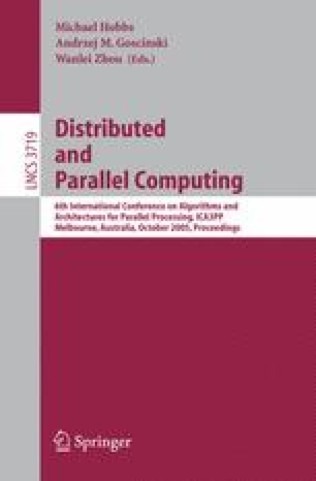
Distributed and parallel computing ; 6th International conference on algorithms and architectures for parallel processing, ICA3PP, Melbourne, Australia, October 2-3, 2005, Proceedings
There are many applications that require parallel and distributed processing to allow complicated engineering, business and research problems to be solved in a reasonable time. Parallel and distributed processing is able to improve company profit, lower costs of design, production, and deployment of new technologies, and create better business environments. The major lesson learned by car and aircraft engineers, drug manufacturers, genome researchers and other specialist is that a computer system is a very powerful tool that is able to help them solving even more complicated problems. That has led computing specialists to new computer system architecture and exploiting parallel computers, clusters of clusters, and distributed systems in the form of grids.

Dependable computing ; 3rd Latin-American Symposium, LADC 2007, Morelia, Mexico, September 26-28, 2007, Proceedings
This book presented fault-tolerant algorithms, software engineering of dependable systems, networking and mobile computing, experimental dependability evaluation, as well as intrusion tolerance and security.

CyberParks – The Interface Between People, Places and Technology: New Approaches and Perspectives
This book is about public open spaces, about people, and about the relationship between them and the role of technology in this relationship. It is about different approaches, methods, empirical studies, and concerns about a phenomenon that is increasingly being in the centre of sciences and strategies – the penetration of digital technologies in the urban space. As the main outcome of the CyberParks Project, this book aims at fostering the understanding about the current and future interactions of the nexus people, public spaces and technology. It addresses a wide range of challenges and multidisciplinary perspectives on emerging phenomena related to the penetration of technology in people’s lifestyles - affecting therefore the whole society, and with this, the production and use of public spaces. Cyberparks coined the term cyberpark to describe the mediated public space, that emerging type of urban spaces where nature and cybertechnologies blend together to generate hybrid experiences and enhance quality of life.

Coordination models and languages ; Vol.3454 : 7th international conference, COORDINATION 2005, Namur, Belgium, April 20-23, 2005, Proceedings
This book constitutes the refereed proceedings of the 7th International Conference on Coordination Models and Languages, COORDINATION 2005, held in Namur, Belgium in April 2005. The 19 revised full papers presented were carefully reviewed and selected from 88 submissions. Among the topics addressed are Web services, safe ambients, process calculus, abstract verification, role-based software, delegation modeling, distributed information flow, adaptive Web content provision, global computing, mobile agents, mobile computing, multithreaded code generation, shared data space coordination languages, automata specifications, time aware coordination, and service discovery.
Computers helping people with special needs ; 17th International Conference, ICCHP 2020, Lecco, Italy, September 9–11, 2020, Proceedings, Part II
The two-volume set LNCS 12376 and 12377 constitutes the refereed proceedings of the 17th International Conference on Computers Helping People with Special Needs, ICCHP 2020, held in Lecco, Italy, in September 2020. The conference was held virtually due to the COVID-19 pandemic.

Computers helping people with special needs ; 17th International Conference, ICCHP 2020, Lecco, Italy, September 9–11, 2020, Proceedings, Part I
The two-volume set LNCS 12376 and 12377 constitutes the refereed proceedings of the 17th International Conference on Computers Helping People with Special Needs, ICCHP 2020, held in Lecco, Italy, in September 2020. The conference was held virtually due to the COVID-19 pandemic.

Computer organization and design, enhanced : The hardware / software interface ; 5th ed.
Contains new examples and material highlighting the emergence of mobile computing and the cloud. It explores this generational change with updated content featuring tablet computers, cloud infrastructure, and the ARM (mobile computing devices) and x86 (cloud computing) architectures. The book uses a MIPS processor core to present the fundamentals of hardware technologies, assembly language, computer arithmetic, pipelining, memory hierarchies and I/O.Because an understanding of modern hardware is essential to achieving good performance and energy efficiency, this edition adds a new concrete example, Going Faster, used throughout the text to demonstrate extremely effective optimization techniques. There is also a new discussion of the Eight Great Ideas of computer architecture.

Computer organization and design : The hardware / software interface ; 6th ed.
Designed to be used in modern computing environments such as cloud computing, mobile devices, and other embedded systems. With the post-PC era now upon us, Computer Organization and Design moves forward to explore this generational change with examples, exercises, and material highlighting the emergence of mobile computing and the Cloud. Updated content featuring tablet computers, Cloud infrastructure, and the x86 (cloud computing) and ARM (mobile computing devices) architectures is included
Machine-learning-assisted intelligent processing and optimization of complex systems
Focuses on the most recent developments in intelligent optimization methods and their applications in various test cases. The reprint covers various topics, including distributed multiagent modeling, metaheuristic algorithms, multisource data fusion, mobile computing and mobile sensing, machine learning-based intelligent processing for modeling complex manufacturing systems, and data-driven intelligent modeling
