



الصفحة 2
الصفحة 2
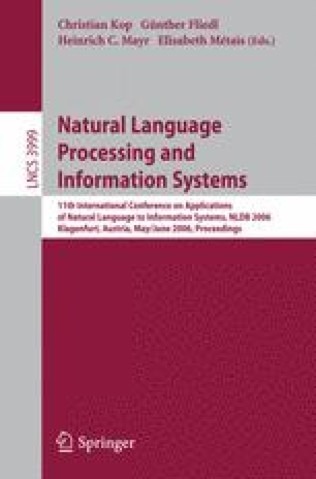
Natural Language Processing and Information Systems ; Vol. 3999 ; 11th International Conference on Applications of Natural Language to Information Systems, NLDB 2006, Klagenfurt, Austria, May 31 - June 2, 2006, Proceedings
This book constitutes the refereed proceedings of the 11th International Conference on Applications of Natural Language to Information Systems, NLDB 2006, held in Klagenfurt, Austria in May/June 2006 as part of UNISCON 2006. The book presents 17 revised full papers and 5 revised short papers, organized in topical sections on concepts extraction and ontology, ontologies and task repository utilization, query processing, information retrieval and dialog processing, and NLP techniques.
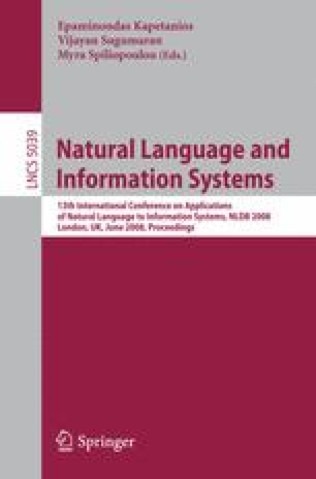
Natural language and information systems ; 13th International Conference on Applications of Natural Language to Information Systems, NLDB 2008 London, UK, June 24-27, 2008 Proceedings
This volume contains the papers presented at NLDB 2008, the 13th Inter- tional Conference on Natural Language and Information Systems, held June 25-27,2008.It also containssome of the best researchproposalsas submitted to the NLDB2008 doctoral symposium heldonJune24,2008.Theprogrammealso includes three invited talks covering the main perspectives of the application of naturallanguageto informationsystems: the wayhumansprocess, communicate and understand natural language, what are the implications and challenges - wardssemanticsearchfor the new Webgeneration, how naturallanguageapplies to the well-established database way of querying as a means to unlock data and information for end users.

Multiscaling in molecular and continuum mechanics : Interaction of time and size from macro to nano ; Application to biology, physics, material science, mechanics, structural and processing engineering
The manipulation of molecules and atoms has been regarded as a common base for both material and life science. Quantum and continuum mechanics are being applied side by side for exploring the behavior of small and large objects moving at fast and slow speed.

Multi-Agent Systems and Applications IV ; 4th International Central and Eastern European Conference on Multi-Agent Systems, CEEMAS 2005, Budapest, Hungary, September 15-17, 2005, Proceedings
In the very competitive field of agent oriented conferences and workshops nowadays (such as AAMAS, WI/IAT, EUMAS, CIA, MATES) the special profile of CEEMAS is that it is trying to bridge the gap between applied research achievements and theoretical research activities. Our ambition is to provide a forum for presenting theoretical research with an evident application potential, implemented application prototypes and their properties, as well as industrial case studies of successful (but also unsuccessful) agent technology deployments. This is why the CEEMAS proceedings volume provides a collection of research and application papers. The technical research paper section of the proceedings (see pages 11–499) contains pure research papers as well as research results in application settings while the application papers section (see pages 500–530) contains papers focused on application aspects. The goal is to demonstrate the real life value and commercial reality of multi-agent systems as well as to foster communication between academia and industry in this field.

Multi-Agent and Multi-Agent-Based Simulation ; Joint Workshop MABS 2004
The aim of the workshop was to provide a forum for work in both appli- tions of multi-agent-based simulation and the technical challenges of simulating large multi-agent systems (MAS). There has been considerable recent progress in modelling and analyzing multi-agent systems, and in techniques that apply MAS models to complex real-world systems such as social systems and organi- tions. Simulation is an increasingly important strand that weaves together this work. In high-risk, high-cost situations, simulations provide critical cost/benefit leverage, and make possible explorations that cannot be carried out in situ: – Multi-agent approaches to simulating complex systems are keytools in interdisciplinary studies of social systems. Agent-based social simulation (ABSS) research simulates and synthesizes social behavior in order to understand real social systems with properties of self-organization, scalability, robustness, and openness. – In the MAS community, simulation has been applied to awide range of MAS research and design problems, from models of complex individual agents - ploying sophisticated internal mechanisms to models of large-scale societies of relatively simple agents which focus more on the interactions between agents.

Multiaccess, Reservations & Queues
Reservation procedures constitute the core of many popular data transmission protocols. They consist of two steps: A request phase in which a station reserves the communication channel and a transmission phase in which the actual data transmission takes place. Such procedures are often applied in communication networks that are characterised by a shared communication channel with large round-trip times.In this book, we propose queuing models for situations that require a reservation procedure and validate their applicability in the context of cable networks.

Mule 2 : A Developers Guide
Mule 2: A Developer's Guide introduces the Mule 2.0 integration platform for developers of enterprise integration applications who wish to leverage Mule as a lightweight messaging framework that contains a distributable object broker for managing communication between applications. The book is based on insight, knowledge, and experience resulting from working with Mule. The text provides support, consulting, and training to developers implementing Mule in a broad range of scenarios ranging from small projects through to large corporations developing major deployments.

More Joel on software : Further toughts on diverse and occasionally related matters that will prove of interest to software developers, designers, and managers, and to those who, whether by good fortune or III Luck, work with them in some capacity
Joel Spolsky started his weblog in March 2000 in order to offer his insights, based on years of experience, on how to improve the world of programming. This weblog has become infamous among the programming world, and is linked to more than 600 other web sites and translated into 30+ languages! Spolsky's extraordinary writing skills, technical knowledge, and caustic wit have made him a programming guru. With the success of Joel on Software, there has been a strong demand for additional gems and advice, and this book is the answer to those requests. Containing a collection of all–new articles from the original, More Joel on Software has even more of an edge than the original, and the tips for running a business or managing people have far broader application than the software industry.

MooTools Essentials : The Official MooTools Reference for JavaScript™ and Ajax Development
Mootools is a light, modular JavaScript framework that makes adding Ajax, animations, and interactive elements to your site a breeze. But it's more than fancy effects and shortcuts; Mootools enhances the JavaScript language and makes writing clean, object–oriented code almost pleasant. Unlocking the power of Mootools, and therefore JavaScript, isn't that hard, but knowing where to start can be.
Modelling and Reasoning with Vague Concepts
This volume outlines a formal representation framework for modelling and reasoning with vague concepts in Artificial Intelligence. The new calculus has many applications, especially in automated reasoning, learning, data analysis and information fusion. This book gives a rigorous introduction to label semantics theory, illustrated with many examples, and suggests clear operational interpretations of the proposed measures. It also provides a detailed description of how the theory can be applied in data analysis and information fusion based on a range of benchmark problems.

Modeling Excitable Tissue : The EMI Framework
This volume presents a novel computational framework for understanding how collections of excitable cells work. The key approach in the text is to model excitable tissue by representing the individual cells constituting the tissue. This is in stark contrast to the common approach where homogenization is used to develop models where the cells are not explicitly present. The approach allows for very detailed analysis of small collections of excitable cells, but computational challenges limit the applicability in the presence of large collections of cells.

Modeling and using context ; 6th International and interdisciplinary Conference, CONTEXT 2007, Roskilde, Denmark, August 20-24, 2007, Proceedings
This volume contains the papers presented at CONTEXT 2007, the Sixth International and Interdisciplinary Conference on Modeling and Using Context. We believe that the papers of this volume represent a snapshot of current work and contribute to both theoretical and applied aspects of research.

Modeling and Simulation for RF System Design
The focus of Modeling and Simulation for RF System Design lies on RF specific modeling and simulation methods and the consideration of system and circuit level descriptions. It contains application-oriented training material for RF designers which combines the presentation of a mixed-signal design flow.

Model Driven Engineering Languages and Systems ; Vol. 3713 : 8th International Conference, MoDELS 2005, Montego Bay, Jamaica, October 2-7, 2005, Proceedings
Constitutes the proceedings of the 8th International Conference on Model Driven Engineering Languages and Systems, MoDELS 2005, held in Montego Bay, Jamaica, in October 2005. This book includes 52 papers and 2 keynote abstracts. It covers such topics as process modelling, product families, state/behavioral modeling, design strategies and more.

Model Driven Architecture ; European MDA Workshops : Foundations and Applications, MDAFA 2003 and MDAFA 2004, Twente, The Netherlands, June 26-27, 2003, and Linköping, Sweden, June 10-11, 2004, Revised Selected Papers
Model-Driven Architecture (MDA) is an initiative proposedby the Object M- agement Group (OMG) for platform-generic software development. MDA s- arates the specification of system functionality from the implementation on a specific platform. It is aimed at making software assets more resilient to changes caused by emerging technologies. While stressing the importance of modeling, the MDA initiative covers a wide spectrum of research areas. Further efforts are required to bring them into a coherent approach based on open standards and supported by matured tools and techniques. This volume contains the selected papers of two workshops on “Model-Driven Architecture – Foundations and Applications” (MDAFA): MDAFA 2003 held at the University of Twente, Twente, The Netherlands, June 26–27, 2003, and MDAFA 2004 held at Linko ¨ping University, Link¨ oping, Sweden, June 10–11, 2004. The goal of the workshops was to understand the foundations of MDA, to share experience in applying MDA techniques and tools, and to outline future research directions. The workshops organizers encouraged authors of accepted papers to re-submit their papers to a post-workshop reviewing process; 15 of these papers were accepted to appear in this volume on MDA.

Mission AI: the new system technology
Offers a strategic perspective on AI and the process of embedding it in society. After decades of research, Artificial Intelligence (AI) is now entering society at large. Due to its general purpose character, AI will change society in multiple, fundamental and unpredictable ways. Therefore, the Netherlands Scientific Council for Government Policy (WRR) characterizes AI as a system technology: a rare type of technologies that have a systemic impact on society. Earlier system technologies include electricity, the combustion engine and the computer. The history of these technologies provides us with useful insights about what it takes to direct the introduction of AI in society.

Microsoft SharePoint : Building Office 2007 Solutions in VB 2005
Microsoft SharePoint: Building Office 2007 Solutions in VB 2005 is the third edition of Scot Hillier's market-leading SharePoint book. The new version includes extensive updates from the previous editions, with a complete focus on SharePoint 2007 and its integration with the 2007 Microsoft Office System. This edition also features new approaches for using SharePoint to improve business efficiency, plus new workflow solutions for SharePoint and BizTalk, as well as a brand new chapter on building a SharePoint solution from start to finish.

Microsoft SharePoint : Building Office 2007 Solutions in C# 2005
Microsoft SharePoint: Building Office 2007 Solutions in C# 2005 is the third edition of Scot Hilliers market-leading SharePoint book. This book features extensive updates to the previous edition, with a complete focus on SharePoint 2007 and its integration with the 2007 Microsoft Office System. It also features new approaches for using SharePoint to improve business efficiency as well as new workflow solutions for SharePoint and BizTalk, plus a new chapter on building a SharePoint solution from start to finish.

Microsoft SharePoint : Building Office 2003 Solutions
This detailed second edition is Scot Hilliers follow-up to his market-leading SharePoint book. This version includes extensive updates to the previous edition, with emphasis on Visual Studio Tools for Office 2005 and new approaches for using SharePoint to improve business efficiency. Also featured are new workflow solutions for SharePoint and BizTalk, and a new chapter on building a SharePoint solution from start to finish.

Microsoft Content Management Server Field Guide
Microsoft Content Management Server Field Guide provides simple crisis-management instructions for intermediate- to advanced-level network administrators who work in the trenches. It offers practical procedural information, reference materials, and focused presentations. This book also features self-contained topics so you do not have to look further to obtain prerequisite information.
