



الصفحة 2
الصفحة 2
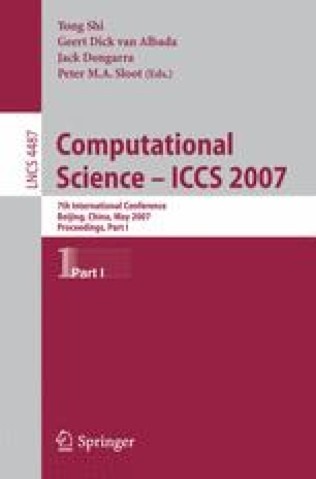
Computational Science – ICCS 2007; 7th International Conference, Beijing China, May 27-30, 2007, Proceedings, Part I
This book contiants sections on efficient data management, parallel monte carlo algorithms, simulation of multiphysics multiscale systems, dynamic data driven application systems, computer graphics and geometric modeling, computer algebra systems, computational chemistry, computational approaches and techniques in bioinformatics, computational finance and business intelligence, geocomputation, high-level parallel programming, networks theory and applications, collective intelligence for semantic and knowledge grid, collaborative and cooperative environments, tools for program development and analysis in CS, intelligent agents in computing systems, CS in software engineering, computational linguistics in HCI, internet computing in science and engineering, workflow systems in e-science, graph theoretic algorithms and applications in cs, teaching CS, high performance data mining, mining text, semi-structured, Web, or multimedia data,

Computational intelligence and security ; Vol. 3801 ; International Conference, CIS 2005, Xi'an, China, December 15-19, 2005, Proceedings, Part I
The two volume set LNAI 3801 and LNAI 3802 constitute the refereed proceedings of the annual International Conference on Computational Intelligence and Security, CIS 2005, held in Xi'an, China, in December 2005. The 338 revised papers presented - 254 regular and 84 extended papers - were carefully reviewed and selected from over 1800 submissions. The first volume is organized in topical sections on learning and fuzzy systems, evolutionary computation, intelligent agents and systems, intelligent information retrieval, support vector machines, swarm intelligence, data mining, pattern recognition, and applications.

Machine Learning for Multimodal Interaction ; 4th International Workshop, MLMI 2007, Brno, Czech Republic, June 28-30, 2007, Revised Selected Papers
This book contains a selection of revised papers from the 4th Workshop on Machine Learning for Multimodal Interaction (MLMI 2007), which took place in Brno, Czech Republic, during June 28 30, 2007. As in the previous editions of the MLMI series, the 26 chapters of this book cover a large area of topics, from multimodal processing and human computer interaction to video, audio, speech and language processing. The application of machine learning techniques to problems arising in these felds and the design and analysis of software
Linguistics for the age of AI
One of the original goals of artificial intelligence research was to endow intelligent agents with human-level natural language capabilities. Recent AI research, however, has focused on applying statistical and machine learning approaches to big data rather than attempting to model what people do and how they do it. In this book, Marjorie McShane and Sergei Nirenburg return to the original goal of recreating human-level intelligence in a machine. They present a human-inspired, linguistically sophisticated model of language understanding for intelligent agent systems that emphasizes meaning—the deep, context-sensitive meaning that a person derives from spoken or written language.

Knowledge Management for Health Care Procedures ; From Knowledge to Global Care, AIME 2007 Workshop K4CARE 2007, Amsterdam, The Netherlands, July 7, 2007, Revised Selected Papers
The incursion of information and communication technologies (ICT) in health care entails evident bene?ts at the levels of security and efciency that improve not only the quality of life of the patients, but also the quality of the work of the health care professionals and the costs of national health care systems. Leaving research approaches aside, the analysis of ICT in health care shows an evo- tion from the initial interest in representing and storing health care data (i. e. , electronic health care records) to the current interest of having remote access to electronic health care systems, as for example HL7 initiatives or telemedicine. This sometimes imperceptible evolution can be interpreted as a new step of the progress path of health care informatics.

Artificial Intelligence. IJCAI 2019 International Workshops ; Macao, China, August 10–12, 2019, Revised Selected Best Papers
This book presents selected papers of 12 Workshops held in conjunction with the 28th International Joint Conference on Artificial Intelligence, IJCAI 2019, in Macao, China, in August 2019.
Artificial intelligence in the design process : The impact on creativity and team collaboration
Discusses how to include artificial intelligence (AI) systems in the early stages of the design process. Today designers need new tools capable of supporting them in dealing with the increasing project's complexity and empowering their performances and capabilities. AI systems appear to be powerful means to enhance designers' creativity. This assumption was tested in a workshop where sixteen participants collaborated with three AI systems throughout the creative phases of research, sketching, and color selection. Results show that designers can access a broader level of variance and inspiration while reducing the risk of fossilization by triggering lateral thinking through AI-generated data. Therefore, AI could significantly impact the creative phases of the design process if applied consciously. Being AI systems intelligent agents, the book treats the Human-AI collaboration as a collaboration between human agents, proposing a set of guidelines helpful to achieving an efficient partnership with the machine.

Artificial intelligence applications and innovations II; IFIP TC12 and WG12.5 ; 2nd IFIP conference on artificial intelligence applications and innovations (AIAI-2005), Sept. 7-9, 2005, Beijing, China
Artificial Intelligence is one of the oldest and most exciting subfields of computing, covnering such areas as intelligent robotics, intelligent planning and scheduling, model-based reasoning, fault diagnosis, natural language processing, maching translation, knowledge representation and reasoning, knowledge-based systems, knowledge engineering, intelligent agents, machine learning, neural nets, genetic algorithms and knowledge management. The papers in this volume comprise the refereed proceedings of the Second International Conference on Artificial Intelligence Applications and Innovations,held in Beijing, China in 2005.

Agent Intelligence Through Data Mining
AGENT INTELLIGENCE THROUGH DATA MINING offers a self-contained overview of a relatively young but important area of research: the intersection of agent technology and data mining. This intersection leads to considerable advancements in the area of information technologies, drawing the increasing attention of both research and industrial communities. It can take two forms: a) the more mundane use of intelligent agents for improved data mining and; b) the use of data mining for smarter, more efficient agents. The second approach is the main focus of this volume. this book presents a methodology for developing multi-agent systems, describes available open-source tools to support this process, and demonstrates the application of the methodology on three different cases. AGENT INTELLIGENCE THROUGH DATA MINING is designed for a professional audience composed of researchers and practitioners in industry.

Agent Computing and Multi-Agent Systems ; 9th Pacific Rim International Workshop on Multi-Agents, PRIMA 2006, Guilin, China, August 7-8, 2006, Proceedings
PRIMA is a series of workshops on agent computing and multi-agent systems, integrating the activities in Asia and Pacific Rim countries. Agent computing and multi-agent systems are computational systems in which several autonomous or se- autonomous agents interact with each other or work together to perform some set of tasks or satisfy some set of goals. These systems may involve computational agents that are homogeneous or heterogeneous, they may involve activities on the part of agents having common or distinct goals, and they may involve participation on the part of humans and intelligent agents. The aim of PRIMA 2006 was to bring together Asian and Pacific Rim researchers and developers from academia and industry to report on the latest technical advances or domain applications and to discuss and explore scientific and practical problems as raised by the participants. PRIMA 2006 received 203 submitted papers.

Agent and multi-agent systems : Technologies and applications ; 1st KES International Symposium, KES-AMSTA 2007, Wroclaw, Poland, May 31-June 1, 2007, Proceedings
The aim of the symposium was to provide an international forum for scientific - search in the technologies and applications of agent and multi-agent systems. Agents and multi-agent systems are related to the modern software which has long been r- ognized as a promising technology for constructing autonomous, complex and intel- gent systems. A key development in the field of agent and multi-agent systems has been the specification of agent communication languages and formalization of - tologies. Agent communication languages are intended to provide standard decla- tive mechanisms for agents to communicate knowledge and make requests of each other, whereas ontologies are intended for conceptualization of the knowledge - main.

Advances in web and network technologies, and information management ; APWeb/WAIM 2007 International Workshops : DBMAN 2007, WebETrends 2007, PAIS 2007 and ASWAN 2007, Huang Shan, China, June 16-18, 2007, Proceedings
With the increasing ubiquity of personal computing devices, such as mobile phones and PDAs, and the increasing deployment of sensor networks, new distributed applications are developed over networked databases posing interesting challenges. It aimed to bring together researchers in different fields related to database management and application over networks and to provide a forum where researchers and practitioners could share and exchange their knowledge and experience.
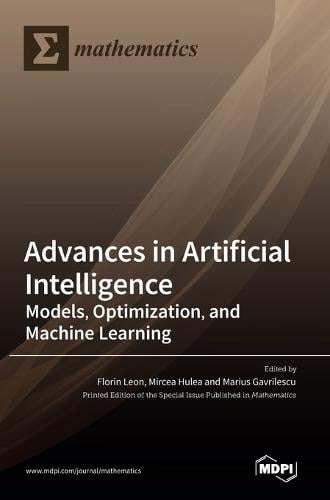
Advances in artificial intelligence: models, optimization, and machine learning
Contains all the articles accepted and published in the Special Issue “Advances in Artificial Intelligence: Models, Optimization, and Machine Learning” of the MDPI Mathematics journal, which covers a wide range of topics connected to the theory and applications of artificial intelligence and its subfields. These topics include, among others, deep learning and classic machine learning algorithms, neural modelling, architectures and learning algorithms, biologically inspired optimization algorithms, algorithms for autonomous driving, probabilistic models and Bayesian reasoning, intelligent agents and multiagent systems.
Advances in Artificial Intelligence ; Vol. 4013 : 19th Conference of the Canadian Society for Computational Studies of Intelligence, Canadian AI 2006, Quebec City, Quebec, Canada, June 7-9, Proceedings
Constitutes the refereed proceedings of the 4th Hellenic Conference on Artificial Intelligence, SETN 2006, held at Heraklion, Crete, Greece in May 2006. The 43 revised full papers and extended abstracts of 34 revised short papers presented together with 2 invited contributions were carefully reviewed and selected from 125 submissions. The papers address any area of artificial intelligence; particular fields of interest include; logic programming, knowledge-based systems, intelligent information retrieval, machine learning, neural nets, genetic algorithms, data mining and knowledge discovery, hybrid intelligent systems and methods, intelligent agents, multi-agent systems, intelligent distributed systems, intelligent/natural interactivity, intelligent virtual environments, planning, scheduling, and robotics.

Advances in Artificial Intelligence ; Vol. 3955 : 4th Helenic Conference on AI, SETN 2006, Heraklion, Crete, Greece, May 18-20, 2006, Proceedings
Constitutes the refereed proceedings of the 4th Hellenic Conference on Artificial Intelligence, SETN 2006, held at Heraklion, Crete, Greece in May 2006. The 43 revised full papers and extended abstracts of 34 revised short papers presented together with 2 invited contributions were carefully reviewed and selected from 125 submissions. The papers address any area of artificial intelligence; particular fields of interest include; logic programming, knowledge-based systems, intelligent information retrieval, machine learning, neural nets, genetic algorithms, data mining and knowledge discovery, hybrid intelligent systems and methods, intelligent agents, multi-agent systems, intelligent distributed systems, intelligent/natural interactivity, intelligent virtual environments, planning, scheduling, and robotics.
Advances in Artificial Intelligence ; 15th Conference of the Canadian Society for Computational Studies of Intelligence, AI 2002 Calgary, Canada, May 27-29, 2002 Proceedings
The AI conference series is the premier event sponsored by the Canadian - ciety for the Computational Studies of Intelligence / Soci´et´e canadienne pour l’´etude d’intelligence par ordinateur. Attendees enjoy our typically Canadian - mosphere –hospitable and stimulating. The Canadian AI conference showcases the excellent research work done by Canadians, their international colleagues, and others choosing to join us each spring. International participation is always high; this year almost 40% of the submitted papers were from non-Canadian - searchers. We accepted 24 papers and 8 poster papers from 52 full-length papers submitted. We also accepted eight of ten abstracts submitted to the Graduate Student Symposium. All of these accepted papers appear in this volume.
