



الصفحة 2
الصفحة 2

Empowering Teaching for Digital Equity and Agency ; IFIP TC 3 Open Conference on Computers in Education, OCCE 2020, Mumbai, India, January 6–8, 2020, Proceedings
This book constitutes the refereed post-conference proceedings of the IFIP TC 3 Open Conference on Computers in Education, OCCE 2020, held in Mumbai, India, in January 2020. The 11 full papers and 4 short papers included in this volume were carefully reviewed and selected from 57 submissions. The papers discuss key emerging topics and evolving practices in the area of educational computing research. They are organized in the following topical sections: computing education; learners’ and teachers’ perspectives; teacher professional development; the industry perspective; and further aspects.

Emerging Technologies and Information Systems for the Knowledge Society ; 1st World Summit on the Knowledge Society, WSKS 2008, Athens, Greece, September 24-26, 2008. Proceedings
This book, in conjunction with the volume CCIS 19, constitutes the refereed proceedings of theFirst World Summit, WSKS 2008, held in Athens, Greece, in September 2008.
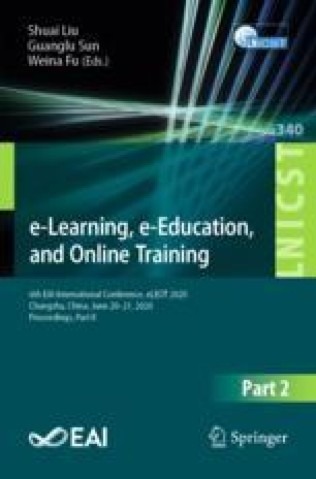
e-Learning, e-Education, and Online Training ; 6th EAI International Conference, eLEOT 2020, Changsha, China, June 20-21, 2020, Proceedings, Part II
Constitutes the proceedings of the 6th International Conference on e-Learning, e-Education, and Online Training, eLEOT 2020, held in Changsha, China, in June 2020. The conference was held virtually due to the COVID-19 pandemic. The 68 full papers presented were carefully reviewed and selected from 141 submissions. They focus on most recent and innovative trends and new technologies in for educational modernization, such as artificial intelligence and big data. The theme of eLEOT 2020 was “Education with New Generation Information Technology”.
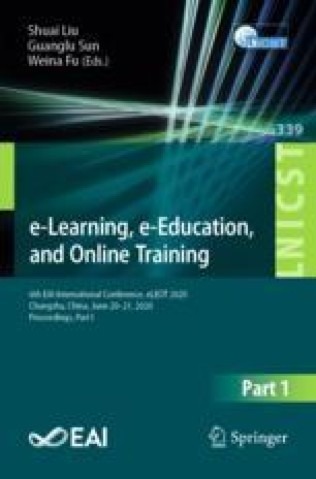
e-Learning, e-Education, and Online Training ; 6th EAI International Conference, eLEOT 2020, Changsha, China, June 20-21, 2020, Proceedings, Part I
Constitutes the proceedings of the 6th International Conference on e-Learning, e-Education, and Online Training, eLEOT 2020, held in Changsha, China, in June 2020. The conference was held virtually due to the COVID-19 pandemic. The 68 full papers presented were carefully reviewed and selected from 141 submissions. They focus on most recent and innovative trends and new technologies in for educational modernization, such as artificial intelligence and big data. The theme of eLEOT 2020 was “Education with New Generation Information Technology”.

E-Learning Methodologies : Fundamentals, technologies and applications
Covers state of the art topics including user modeling for e-learning systems and cloud, IOT, and mobile-based frameworks. It also considers security challenges and ethical conduct using Blockchain technology. E-learning has become an important part of our educational life with the development of e-learning systems and platforms and the need for online and remote learning. ICT and computational intelligence techniques are being used to design more intelligent and adaptive systems. However, the art of designing good real-time e-learning systems is difficult as different aspects of learning need to be considered including challenges such as learning rates, involvement, knowledge, qualifications, as well as networking and security issues. The earlier concepts of standalone integrated virtual e-learning systems have been greatly enhanced with emerging technologies such as cloud computing, mobile computing, big data, Internet of Things (IoT), AI and machine learning, and AR/VT technologies.

eLearning and Digital Publishing
This book provides a framework which clearly portrays the relationships between information literacy, eLearning and digital publishing. The structure of the book has three main sections: the first has primarily an educational focus, the second a focus on digital publishing, and the third builds on the first two sections to examine overall implications for the growth of knowledge and scholarly communication.

Education for the 21st Century - Impact of ICT and Digital Resources ; IFIP 19th World Computer Congress, TC-3 Education, August 21-24, 2006, Santiago, Chile
The IFIP series publishes state-of-the-art results in the sciences and technologies of information and communication. The scope of the series includes: foundations of computer science; software theory and practice; education; computer applications in technology; communication systems; systems modeling and optimization; information systems; computers and society; computer systems technology; security and protection in information processing systems; artificial intelligence; and human-computer interaction. Proceedings and post-proceedings of referred international conferences in computer science and interdisciplinary fields are featured.

Deep Statistical Comparison for Meta-heuristic Stochastic Optimization Algorithms
Presents a comprehensive comparison of the performance of stochastic optimization algorithms / Includes an introduction to benchmarking and statistical analysis / Provides a web-based tool for making statistical comparisons of optimization algorithms / Overviews of the current approaches used to analyze algorithm performance in a range of common scenarios, while also addressing issues that are often overlooked. In turn, it shows how these issues can be easily avoided by applying the principles that have produced Deep Statistical Comparison and its variants. The focus is on statistical analyses performed using single-objective and multi-objective optimization data. At the end of the book, examples from a recently developed web-service-based e-learning tool (DSCTool) are presented. The tool provides users with all the functionalities needed to make robust statistical comparison analyses in various statistical scenarios. The book is intended for newcomers to the field and experienced researchers alike. For newcomers, it covers the basics of optimization and statistical analysis, familiarizing them with the subject matter before introducing the Deep Statistical Comparison approach. Experienced researchers can quickly move on to the content on new statistical approaches.

Conceptual Modeling - ER 2007 ; 26th International Conference on Conceptual Modeling, Auckland, New Zealand, November 5-9, 2007, Proceedings
Conceptual modeling is fundamental to the development of complex systems, because it provides the key communication means between systems developers, end-users and customers.Conceptua lmodeling provides languages,methods and tools to understand and represent the application domain;to elicitate,concepalize and formalize system requirements and user needs;to communicate systems designs to all stakeholders; to formally verify and validate system designs on high levels of abstractions; and to minimize ambiguities in system development. Initially, conceptual modeling mainly addressed data-intensive information s- tems and contributed to data modeling and database application engineering. The area of conceptual modeling has now matured to encompass all kinds of application areas such as e-applications (including e-business and e-learning), web-based systems (including the semantic web and ubiquitous systems), life science and geographic applications.

Conceptual Modeling - ER 2005
Conceptual modeling is fundamental to any domain where one must cope with complex real-world situations and systems because it fosters communication - tween technology experts and those who would bene?t from the application of those technologies. Conceptual modeling is the key mechanism for und- standing and representing the domains of information system and database - gineering but also increasingly for other domains including the new “virtual” e-environmentsandtheinformationsystemsthatsupportthem.Theimportance of conceptual modeling in software engineering is evidenced by recent interest in “model-drivenarchitecture”and“extremenon-programming”.Conceptualm- eling also plays a prominent rolein various technical disciplines and in the social sciences. The Annual International Conference on Conceptual Modeling (referred to as the ER Conference) provides a central forum for presenting and discussing current research and applications in which conceptual modeling is the major emphasis.

Computers and Education : Towards Educational Change and Innovation
This volume contains a selection of papers covering the latest research and experiences on the application of Information and Communication Technologies in the field of Education, especially in the Ibero-American space.

Computational intelligence and security ; Vol. 3801 ; International Conference, CIS 2005, Xi'an, China, December 15-19, 2005, Proceedings, Part I
The two volume set LNAI 3801 and LNAI 3802 constitute the refereed proceedings of the annual International Conference on Computational Intelligence and Security, CIS 2005, held in Xi'an, China, in December 2005. The 338 revised papers presented - 254 regular and 84 extended papers - were carefully reviewed and selected from over 1800 submissions. The first volume is organized in topical sections on learning and fuzzy systems, evolutionary computation, intelligent agents and systems, intelligent information retrieval, support vector machines, swarm intelligence, data mining, pattern recognition, and applications.

Collaboration Technologies and Social Computing ; 26th International Conference, CollabTech 2020, Tartu, Estonia, September 8–11, 2020, Proceedings
This book constitutes the proceedings of the 26th International Conference on Collaboration Technologies and Social Computing, CollabTech 2020. The conference was scheduled to take place in Tartu, Estonia, in September 2020. It was held virtually due to the COVID-19 pandemic. The 10 full and 5 work-in-progress papers presented in this volume were carefully reviewed and selected from 25 submissions.

Mathematical Knowledge Management ; Vol. 4108 ; 5th International Conference, MKM 2006, Wokingham, UK, August 11-12, 2006, Proceedings
This book constitutes the refereed proceedings of the 5th International Conference on Mathematical Knowledge Management, MKM 2006, held in Wokingham, UK in August 2006 as official satellite event of the International Congress of Mathematicians, ICM 2006. The 22 revised full papers presented were carefully selected during two rounds of reviewing and improvement. The papers in this volume cover the whole area of mathematical knowledge management in the intersection of mathematics, computer science, library science, and scientific publishing. The papers are organized in topical sections on proof representations, proof processing, knowledge extraction, knowledge representation, as well as systems and tools.

Mathematical Knowledge Management ; Vol. 3863 ; 4th International Conference, MKM 2005, Bremen, Germany, July 15-17, 2005, Revised Selected Papers
This volume contains the proceedings of the Fourth International Conference on Mathematical Knowledge Management MKM 2005 held July 15–17, 2005 at - ternational University Bremen, Germany.
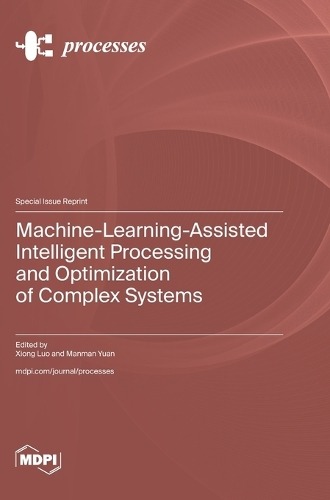
Machine-learning-assisted intelligent processing and optimization of complex systems
Focuses on the most recent developments in intelligent optimization methods and their applications in various test cases. The reprint covers various topics, including distributed multiagent modeling, metaheuristic algorithms, multisource data fusion, mobile computing and mobile sensing, machine learning-based intelligent processing for modeling complex manufacturing systems, and data-driven intelligent modeling

Learning Design : A Handbook on Modelling and Delivering Networked Education and Training
Put together contributions from members of the "Valkenburg Group", consisting of 33 experts deeply involved in e-learning and more specifically learning design. The result is a rich and lasting source of information for both e-learning course and tool developers, providing information about the specification itself, how to implement it in practice, what tools to use, and what pitfalls to avoid. The book not only reports first experiences, but also goes beyond the current state of the art by looking at future prospects and emerging applications.

Large-Scale Scientific Computing ; 6th International Conference, LSSC 2007, Sozopol, Bulgaria, June 5-9, 2007. Revised Papers
The 6th International Conference on Large-Scale Scienti?c Computations (LSSC 2007) was held in Sozopol, Bulgaria, June 5–9, 2007. The conference was organized by the Institute for Parallel Processing at the Bulgarian Academy of Sciences in cooperation with SIAM (Society for Industrial and Applied Ma- ematics). Partial support was also provided from project BIS-21++ funded by the European Commission in FP6 INCO via grant 016639/2005. The conference was devoted to the 60th anniversary of Richard E. Professor Ewing is internati- ally well known with his contributions in applied mathematics, mathematical modeling, and large-scale scientific computations.

Knowledge-Based Intelligent Information and Engineering Systems ; Vol.3684 : 9th International Conference, KES 2005, Melbourne, Australia, September 14-16, 2005, Proceedings, Part IV
The KES conference series has been established for almost a decade, and it cont- ues each year to attract participants from all geographical areas of the world, including Europe, the Americas, Australasia and the Paci?c Rim. The KES conferences cover a wide range of intelligent systems topics. The broad focus of the conference series is the theory and applications of intelligent systems. From a pure research ?eld, intel- gent systems have advanced to the point where their abilities have been incorporated into many business and engineering application areas. KES 2005 provided a valuable mechanism for delegates to obtain an extensive view of the latest research into a range of intelligent-systems algorithms, tools and techniques. The conference also gave de- gates the chance to come into contact with those applying intelligent systems in diverse commercial areas. The combination of theory and practice represented a unique opp- tunity to gain an appreciation of the full spectrum of leading-edge intelligent-systems activity. The papers for KES 2005 were either submitted to invited sessions, chaired and organized by respected experts in their ?elds, or to a general session, managed by an extensive International Program Committee, or to the Intelligent Information Hiding and Multimedia Signal Processing (IIHMSP) Workshop, managed by an International Workshop Technical Committee.

Knowledge-Based Intelligent Information and Engineering Systems ; Vol. 4251 ; 10th International Conference, KES 2006, Bournemouth, UK, October 9-11 2006, Proceedings, Part I
Delegates and friends, we are very pleased to extend to you the sincerest of welcomes to this, the 10th International Conference on Knowledge Based and Intelligent Information and Engineering Systems at the Bournemouth International Centre in Bournemouth, UK, brought to you by KES International. This is a special KES conference, as it is the 10th in the series, and as such, it represents an occasion for celebration and an opportunity for reflection. The first KES conference was held in 1997 and was organised by the KES conference founder, Lakhmi Jain. In 1997, 1998 and 1999 the KES conferences were held in Adelaide, Australia. In 2000 the conference moved out of Australia to be held in Brighton, UK; in 2001 it was in Osaka, Japan; in 2002, Crema near Milan, Italy; in 2003, Oxford, UK; in 2004, Wellington, New Zealand; and in 2005, Melbourne, Australia. The next two conferences are planned to be in Italy and Croatia. Delegate numbers have grown from about 100 in 1997, to a regular figure in excess of 500. The conference attracts delegates from many different countries, in Europe, Australasia, the Pacific Rim, Asia and the Americas, and may truly be said to be ‘International’.
