



الصفحة 2
الصفحة 2
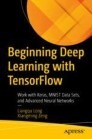
Beginning deep learning with TensorFlow : Work with Keras, MNIST data sets, and advanced neural networks
Stats with an introduction to AI, where you’ll learn the history of neural networks and what sets deep learning apart from other varieties of machine learning. Discovery the variety of deep learning frameworks and set-up a deep learning development environment. Next, you’ll jump into simple classification programs for hand-writing analysis. Once you’ve tackled the basics of deep learning, you move on to TensorFlow 2 specifically. Find out what exactly a Tensor is and how to work with MNIST datasets. Finally, you’ll get into the heavy lifting of programming neural networks and working with a wide variety of neural network types such as GANs and RNNs. Deep Learning is a new area of Machine Learning research widely used in popular applications, such as voice assistant and self-driving cars. Work through the hands-on material in this book and become a TensorFlow programmer! You will: Develop using deep learning algorithms Build deep learning models using TensorFlow 2 Create classification systems and other, practical deep learning applications

Automatic video editor
Searching in a large database of videos is one of the challenges faced by the user today as most of the results are inaccurate or correct. In our project, we worked on developing a system that receives the search word from the user and searches for it among a large number of videos using MSR-VTT dataset and COCO data set based on the elements that we see inside the video. Entered by the user. We have also worked on adding other options that the user can benefit from in modifying the videos, such as entering a black and white video clip and returning the result in color. The user can also enter a low-resolution video clip, and the system improves the accuracy of the video and sends it.

Artificial neural networks : Recent advances, new perspectives and applications
This book explores the potential of ANNs for applications in different fields. Itincludes eight chapters that discuss deep learning, ANN tools, and other cutting-edgetechnologies. It also suggests avenues for further research into ANN techniques formedical imaging to detect breast tumors, classification of COVID-19 surveillancedatasets, health management, estimation of materials processing parameters, solarenergy management, and control of a petrochemical unit.
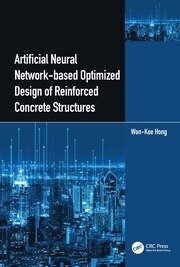
Artificial neural network-based optimized design of reinforced concrete structures
Introduces AI-based Lagrange optimization techniques that can enable more rational engineering decisions for concrete structures while conforming to codes of practice. It shows how objective functions including cost, CO2 emissions, and structural weight of concrete structures are optimized either separately or simultaneously while satisfying constraining design conditions using an ANN-based Lagrange algorithm. Any design target can be adopted as an objective function. Many optimized design examples are verified by both conventional structural calculations and big datasets. Uniquely applies the new powerful tools of AI to concrete structural design and optimization Multi-objective functions of concrete structures optimized either separately or simultaneously Design requirements imposed by codes are automatically satisfied by constraining conditions Heavily illustrated in color with practical design examples
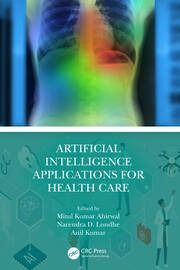
Artificial Intelligence Applications for Health Care
Covers topics on health care and artificial intelligence. Data sets related to biomedical signals (ECG, EEG, EMG) and images (X-rays, MRI, CT) are explored, analyzed, and processed through different computation intelligence methods. Applications of computational intelligence techniques like artificial and deep neural networks, swarm optimization, expert systems, decision support systems, clustering, and classification techniques on medial datasets are explained. Survey of medical signals, medial images, and computation intelligence methods are also provided.
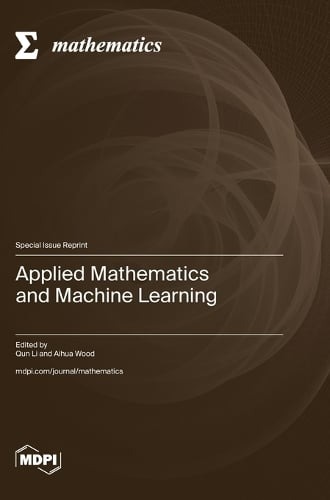
Applied mathematics and machine learning
The simultaneous availability of large datasets and high-performance computing capability in recent years has enabled the rapid development of powerful machine learning algorithms. On the one hand, state-of-the-art machine learning techniques have transformed many areas of science and engineering; on the other hand, theoretical discoveries in mathematical algorithms, differential equations, and statistical inferences, to name a few, have provided the foundation for the exploration of new multidisciplinary models for solving practical problems. This Special Issue endeavors to continue the journey that started in our previous Special Issue (Applied Mathematics and Computational Physics) by providing a platform for researchers from both academia and industry, as well as government, to present their new computational methods that have engineering and physics applications.
Applied and computational mathematics for digital environments
Contains the 11 papers that were accepted and published in the Special Issue “Applied and Computational Mathematics for Digital Environments” of the MDPI Mathematics journal. The topics of interest include, among others, scientific research, applied tasks, and problems in the following areas: The construction of mathematical and information models of intelligent computer systems for monitoring and controlling the parameters of digital environments; The development of intelligent optimization algorithms that search for optimal parameter values of mathematical and information models in digital environments; Software and mathematical technologies in the implementation of intelligent monitoring and computer control of the parameters of digital environments; The development and application of mathematical and information models, machine learning methods, and artificial intelligence for the analysis and processing of big data in digital environments.

Algorithms in Bioinformatics ; 7th International Workshop, WABI 2007, Philadelphia, PA, USA, September 8-9, 2007, Proceedings
All current issues of algorithms in bioinformatics are addressed, ranging from mathematical tools to experimental studies of approximation algorithms and reports on significant computational analyses. Numerous biological problems are dealt with, including genetic mapping, sequence alignment and sequence analysis, phylogeny, comparative genomics, and protein structure. Furthermore the papers feature high-performance computing approaches to computationally hard learning and optimization problems in bioinformatics and cover methods, software and dataset repositories for development and testing of such algorithms and their underlying models.
Algorithms and data structures for massive datasets
Learn: Probabilistic sketching data structures for practical problems Choosing the right database engine for your application Evaluating and designing efficient on-disk data structures and algorithms Understanding the algorithmic trade-offs involved in massive-scale systems Deriving basic statistics from streaming data Correctly sampling streaming data Computing percentiles with limited space resources Algorithms and Data Structures for Massive Datasets reveals a toolbox of new methods that are perfect for handling modern big data applications. You'll explore the novel data structures and algorithms that underpin Google, Facebook, and other enterprise applications that work with truly massive amounts of data. These effective techniques can be applied to any discipline, from finance to text analysis. Graphics, illustrations, and hands-on industry examples make complex ideas practical to implement in your projects--and there's no mathematical proofs to puzzle over. Work through this one-of-a-kind guide, and you'll find the sweet spot of saving space without sacrificing your data's accuracy. About the Technology Standard algorithms and data structures may become slow--or fail altogether--when applied to large distributed datasets. Choosing algorithms designed for big data saves time, increases accuracy, and reduces processing cost.

AI home decorator
Presents the development of “DesignMate”, an innovative AI home decorator application designed to revolutionize interior design. With three main features powered by artificial intelligence, DesignMate simplifies and enhances the process of home decoration. The first feature leverages an Autoregressive transformer model trained on the extensive 3Dfront dataset to suggest room decor based on room layouts. The second feature employs Generative Adversarial Networks (GANs) to enhance the colors of specific room layouts. The third feature introduces an expert system that tailors decor options to user-entered conditions. DesignMate also introduces an integrated e-commerce platform dedicated to furniture, offering users a wide selection of high-quality items that perfectly complement their preferred room designs.
3D Imaging, Analysis and Applications
This textbook is designed for postgraduate studies in the field of 3D Computer Vision. It also provides a useful reference for industrial practitioners; for example, in the areas of 3D data capture, computer-aided geometric modelling and industrial quality assurance. This second edition is a significant upgrade of existing topics with novel findings. Additionally, it has new material covering consumer-grade RGB-D cameras, 3D morphable models, deep learning on 3D datasets, as well as new applications in the 3D digitization of cultural heritage and the 3D phenotyping of crops.
